
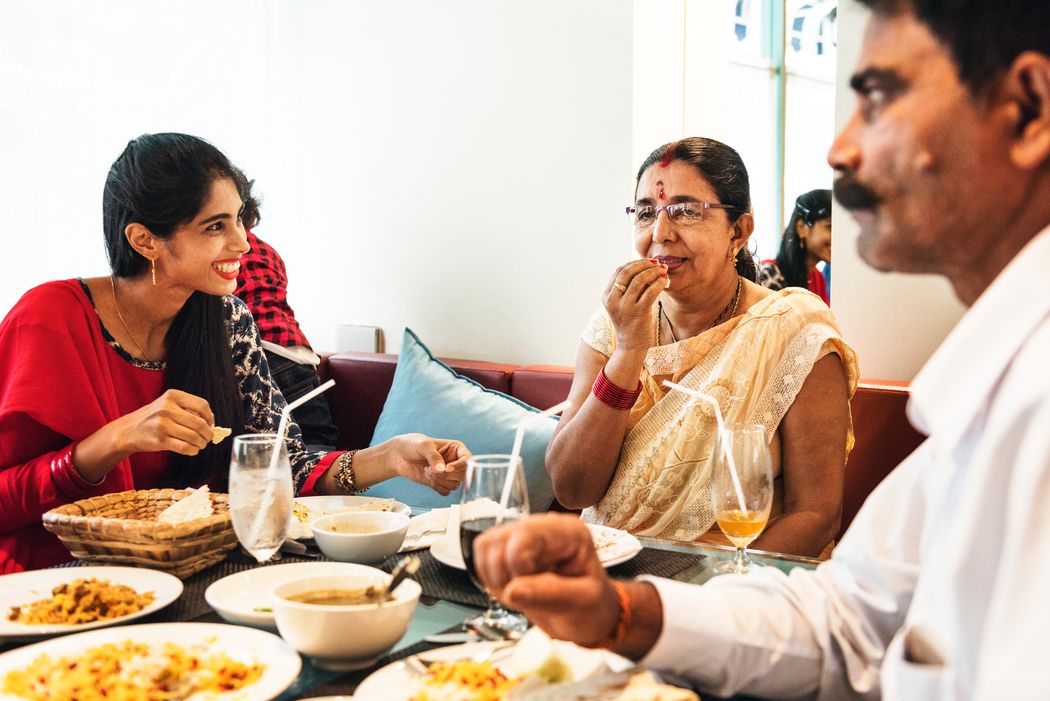
A banana leaf is laid down in front of a seven-year-old at a wedding lunch in Thanjavur. Rice goes on, then sambar, then four kinds of vegetable in a careful arc. The boy, hungry and unsupervised, reaches in with his left hand. Before his fingers touch the rice, an aunt’s hand closes around his wrist — not roughly, but with the speed of something reflexive — and moves it away. Not that one. She does not explain. Nobody at that table thinks an explanation is needed.
Most Indians have some version of that memory. And most of us carried the rule into adulthood without ever being told the reasoning, which means we also carry a slightly embarrassing inability to answer when a colleague in London or Toronto or Melbourne asks, perfectly reasonably, why.
The honest answer is more interesting than the one usually given. It is not really about hygiene, and it is not about the left hand being bad. It is about a very old idea that eating is a ritual act, and that ritual acts are performed with a designated instrument.
The Right Hand Is the Ritual Hand
Start with the word. The Sanskrit for the right side is dakshina — the same word that means a gift or offering made to a priest or teacher, and the same word that gives us Dakshinayana, the sun’s southward course. The right side in this vocabulary is the side of giving, of offering, of auspicious formal action. Its counterpart is vama, the left, which in classical usage carries senses of the reverse, the contrary, the unconventional. (The Tantric paths called vamachara get their name from exactly this: the deliberately reversed way.)
Now notice what the right hand does across Hindu practice, almost without exception. It pours the libation into the sacrificial fire. It receives prasada — consecrated food returned from the deity. It sprinkles achamana water in purification before worship. It holds the darbha grass, applies the tilak, offers flowers, performs pranam. In a traditional South Indian household it is the hand that receives a gift and the hand that gives one, and a two-handed offering is more respectful still — but never a left-handed one.
Eating sits inside that same category. That is the whole key. In this worldview, a meal is not refuelling. It is a yajna — an offering — performed at a small domestic altar that happens to be your own body. And you do not make offerings with the hand reserved for other things.
Food Is Brahma: Why the Meal Is Treated as Worship
This is not a folk idea retrofitted onto a habit. It is close to the centre of Upanishadic thought.
The Taittiriya Upanishad, in the famous sequence where the sage Bhrigu asks his father Varuna what Brahma is, arrives first at this: annam brahmeti vyajanat — “he knew food to be Brahma.” It is the first of five successive answers, and it is not dismissed by the later ones. Food, in that text, is the most accessible face of ultimate reality. You meet the absolute three times a day on a plate.
Many families chant Bhagavad Gita 4.24 before eating, the verse known simply as the Brahmarpanam:
brahmarpanam brahma havir brahmagnau brahmana hutam / brahmaiva tena gantavyam brahmakarmasamadhina
“Brahma is the offering, Brahma is the oblation, poured by Brahma into the fire of Brahma.” Every element of the meal is collapsed into one substance — the food, the eater, the act, the fire that digests it. Some households follow it with Gita 15.14, where Krishna says that he, as Vaishvanara, becomes the digestive fire within living bodies and consumes the fourfold food. The eater is not quite the one eating.
Formal practice goes further. Orthodox Brahmin households perform parishechana — sprinkling water around the leaf or plate to consecrate the space — and in some lineages the pranahuti, a sequence of five small offerings accompanied by mantras addressing the five vital breaths (prana, apana, vyana, udana, samana), the prescribed form of which is found in the Mahanarayana Upanishad. Five morsels, five breaths, offered before any food is taken for oneself. This is not practised in most Indian homes today, and it never was universal. But it tells you exactly how the meal was conceived: as a fire ritual, scaled down to a single person.
Once you see a meal that way, the right-hand rule stops looking like etiquette and starts looking like liturgy.
So What Is the Left Hand For?
Here is where the usual explanation goes wrong, and where the word choice matters a great deal.
The left hand is the hand of personal cleaning. In a culture that has washed with water rather than wiped with paper for several thousand years, one hand was always going to be assigned to ablutions — and once assigned, it had to be kept structurally separate from the hand that touches food, offers to fire, and receives prasada. That separation is the entire basis of the rule, and in a world without soap, running water or any theory of germs, it was a genuinely sophisticated piece of public health engineering encoded as religious practice.
The left hand is therefore described in the texts as ashuddha or apavitra — ritually unpurified. English translations render this as “impure” or, disastrously, “unclean,” and readers hear a moral judgement. There isn’t one. These are categories of ritual eligibility, not ethics. The same vocabulary applies to a Brahmin before his morning bath, to a person who has attended a cremation, to a cooking vessel that has not been scrubbed. None of them is wicked. All of them are temporarily outside the condition required for sacred action.
And the left hand is not idle at the table. It has real work: holding your water glass or tumbler, passing serving dishes, lifting a bowl, picking up the plate. In many households it is specifically the hand that touches communal serving spoons, precisely so that the food-touching hand never goes near shared vessels. The division of labour is practical and clean, in both senses.
Uchchhishta: The Hidden Logic of Saliva
There is one more concept without which none of this makes sense, and it explains a dozen other Indian food habits at the same time.
Uchchhishta is food that has come into contact with someone’s mouth or saliva — a bitten piece, a used plate, a spoon that has gone from mouth to serving bowl, the remnants on a leaf after eating. It is discussed in the Dharmasutras — the Apastamba and Vasishtha Dharmasutras among them — and the eleventh-century commentator Medhatithi, writing on the Manusmriti, distinguishes several distinct senses of the term. Monier-Williams glosses it as “left, rejected, stale, spit out of the mouth,” and extends it to a person who has eaten but not yet washed hands and mouth, and is therefore himself in a state of uchchhishta.
This single concept generates an enormous amount of Indian behaviour:
- Why you don’t double-dip or share a spoon. A spoon that has been in your mouth contaminates the entire serving bowl for everyone.
- Why you don’t drink directly from a shared bottle in traditional households, and why the pouring-into-the-mouth-without-touching-the-rim technique exists at all.
- Why food you have served onto your plate is yours and cannot go back. Hence the strong aversion to wasting food, and the custom of asking for small portions and more helpings.
- Why you wash your hands and rinse your mouth immediately after eating, not just before.
- Why the right hand must stay out of your mouth while eating. This is the real reason behind one of the most distinctive features of Indian eating technique, discussed below.
And then the tradition does something lovely with the same concept and inverts it. The texts hold that a student may eat his guru’s uchchhishta, and that doing so is as sacred as receiving a sacrificial oblation. What is polluting from a stranger is sanctifying from a teacher. In some regions and sampradayas, prasada is explicitly understood as the uchchhishta of the deity — God’s leftovers, and therefore the most desirable food in existence. Other traditions find that framing inappropriate and reject it. Both views are held sincerely and the disagreement is genuine, so anyone telling you flatly that prasada “is” or “is not” divine uchchhishta is reporting one school as though it were the whole tradition.
How It Is Actually Done: Technique and Regional Variation
India is not one country at a dining table, and the right-hand rule is one of very few things that holds nearly everywhere. Almost everything else varies.
How much of the hand you use
In much of South India, and particularly in orthodox households, the refined standard is to use only the fingers to roughly the first or second joint, keeping the palm and the base of the fingers clean. Rice and curry are gathered with the fingertips, compressed into a small ball, and pushed into the mouth with the thumb — and critically, the fingers do not enter the mouth. That is the uchchhishta rule in action: the hand must not become uchchhishta mid-meal, because it still has to go back into the food.
Across much of North India, where flatbread rather than rice carries the meal, technique shifts: the roti is torn with the fingers of the right hand and used as the vehicle, which keeps the hand far cleaner by default. In parts of eastern India a more generous use of the whole hand is entirely normal and carries no stigma. In Kerala and coastal Karnataka, the mixing of rice with sambar, rasam and curd in sequence on a leaf is close to an art form, and the hand is doing considerable work.
None of these is the correct one. They are regional grammars for the same sentence. A Tamil Brahmin and a Bengali grandmother would each find the other’s hand technique slightly startling, and both would be entirely within tradition.
Serving and seating
Variation extends past the hand. Who eats first, whether the server eats with the family or after, whether you sit on the floor on a pidi or at a table, whether the leaf is laid tip-left or tip-right, which corner the salt goes in, whether water is poured or placed — all of this differs by region, community and household, and a great deal of it has shifted within living memory.
Washing
One thing is close to universal: you wash thoroughly before eating, and you wash and rinse your mouth after. The post-meal wash is not optional in the traditional scheme, because a person who has eaten and not washed is, in the vocabulary above, still in a state of uchchhishta.
What About Left-Handed People?
This deserves a straight answer, because the custom has caused real distress to left-handed children in Indian families, and still does.
The classical rule is stated in terms of the right hand, not the dominant hand. Modern descriptions of Indian dining etiquette — including reference works — increasingly frame it as the dominant hand being used for food and the other kept dry for serving and passing, which is a reasonable adaptation and reflects how a lot of contemporary practice actually works.
Three things are worth saying plainly. First, there is no scriptural penalty, prescribed expiation or stated consequence anywhere for a left-handed person eating with their left hand; the rule exists to separate food from ablution, and a left-handed person who reverses both assignments has satisfied its purpose exactly. Second, many Indian families do accommodate left-handed children, and have for generations, usually without making a theological case for it. Third, forcing a left-handed child to eat with their right hand at a wedding-sized table in front of relatives is not a transmission of dharma. It is just a child being humiliated over cutlery.
If you are a left-handed person navigating a formal or orthodox setting — a temple meal, a ritual feast, an elder’s home — the respectful move is usually to use your right hand for the food if you can manage it, or to quietly use a spoon. In your own home, do what works.
Why This Matters Today
It would be easy to file all of this as heritage and move on. But several parts of it are useful in an unsentimental, practical way.
It makes you notice the food. This is the claim with the most behind it. Eating with your hands forces direct contact with temperature, texture, moisture and consistency before anything reaches your mouth. You discover a dish is too hot with a fingertip rather than your palate. You feel when rice is overcooked. Portion size becomes tactile rather than visual. For anyone trying to eat more slowly or more attentively — and the evidence on eating pace and satiety is reasonably robust — removing the metal intermediary between you and the food is a cheap and surprisingly effective intervention. The tradition would say you are participating in the offering rather than operating a tool.
It is a built-in handwashing habit. You cannot eat with your hands without washing them first. The custom hard-codes a hygiene behaviour that cutlery lets people skip.
It encodes a real separation. The one-hand-for-food, one-hand-for-everything-else division is sound practice at a shared table, germ theory or no germ theory.
A word of caution on the explanation you will encounter most often online. There is a very widely circulated claim that the five fingers correspond to the five elements — akasha, vayu, agni, jala, prithvi — and that eating with the hand therefore balances the elements or activates particular mudras and improves digestion. It is a beautiful idea, it draws on genuine mudra symbolism, and some people find it meaningful. But it is a modern wellness-literature synthesis, not a teaching you will find in that form in the classical Ayurvedic compendia or in the Dharmashastra material on eating. The texts ground the custom in ritual purity and in food as sacred offering — which is a deeper justification anyway. Be a little careful about repeating the elements claim as ancient doctrine.
For families outside India
Most of the people reading this probably live somewhere where eating with your hands reads as a cultural statement whether you intend one or not. A few practical notes.
Children are the pressure point. A child who eats roti with their hands at home and then opens a lunchbox at a school where everyone uses a fork gets a sharp, early lesson in which of their two worlds is treated as normal. The useful thing you can give them is not a rule but a reason — the short version being that in our tradition food is sacred and you touch sacred things with your hands, which is a sentence a nine-year-old can actually deploy when asked.
For adults in mixed settings: eating with your hands is appropriate wherever the food is designed for it, and a spoon is appropriate wherever it isn’t. Nobody’s grandmother ever ate spaghetti with her fingers. The tradition is about reverence and separation, not about refusing implements. And a biryani eaten properly with the right hand, at your own table, with the left hand holding the water glass, is one of the ordinary pleasures that survives relocation entirely intact.
Frequently Asked Questions
Why do Indians eat with their right hand only?
Because eating is treated as a ritual act — an offering — and the right hand (dakshina) is the hand reserved for all ritual and auspicious action: pouring libations, receiving prasada, giving gifts. The left hand is assigned to personal ablutions and so is kept structurally separate from food. The division is about ritual eligibility and practical separation, not about the left hand being morally bad.
Is it rude to eat with your left hand in India?
In most traditional settings, yes — it will register as a breach, especially among older people, at religious meals, or when eating from a shared vessel. Among urban and younger Indians the reaction is usually milder. If you are a guest and unsure, use your right hand for food and your left for your glass and for passing dishes, and you cannot go wrong.
What do the Hindu scriptures actually say about eating with the right hand?
The right-hand rule emerges from the Dharmashastra and Dharmasutra literature on ritual purity, including the Apastamba and Vasishtha Dharmasutras and the commentarial tradition on the Manusmriti, chiefly through the concept of uchchhishta — contamination by saliva and contact with the mouth. The framing of the meal as an offering comes from the Upanishads (the Taittiriya Upanishad’s annam brahmeti) and from the Bhagavad Gita verses used as pre-meal prayers, 4.24 and 15.14. There is no single verse that commands “eat with the right hand”; it follows from the purity framework as a whole.
What does uchchhishta mean?
Uchchhishta is food or a vessel rendered ritually impure by contact with the mouth or saliva — leftovers, a bitten item, a used spoon returned to a serving dish. The term also describes a person who has eaten but not yet washed hands and rinsed the mouth. It is the reason behind not sharing spoons, not returning served food, and washing after meals. In an inversion, a guru’s uchchhishta is held to be sanctifying rather than polluting, and some traditions understand prasada in the same way.
Is it healthier to eat with your hands?
The defensible benefits are indirect: it guarantees you wash your hands first, it slows the pace of eating, and it gives you direct feedback on temperature and texture, all of which support more attentive eating. The popular claim that the five fingers represent the five elements and that hand-eating thereby improves digestion through mudras is a modern interpretation rather than a documented teaching of the classical Ayurvedic texts, and it is worth treating as symbolism rather than physiology.
What should left-handed people do?
The classical rule names the right hand, but its purpose — keeping the food hand separate from the ablution hand — is fully satisfied by a left-handed person who simply reverses both assignments, and contemporary descriptions of Indian dining etiquette often frame it as the dominant hand. No text prescribes any penalty. In formal, orthodox or temple settings, using the right hand or a spoon is the diplomatic choice; at home, do what is comfortable. Forcing a left-handed child is not a religious requirement.
Why do South Indians only use their fingertips?
To keep the hand from becoming uchchhishta during the meal. If the fingers enter the mouth, the hand is contaminated and should not go back into the food. The refined technique — gathering with the fingertips and pushing the morsel in with the thumb, so the fingers never touch the lips — solves that problem. Where flatbread carries the meal, as across much of the north, the bread itself does that job and technique differs accordingly.
A Closing Thought
The aunt who grabbed that boy’s wrist could not have explained any of this, and did not need to. She was transmitting a rule whose reasoning had long since dissolved into reflex — which is how most of a tradition actually travels, not through argument but through a thousand small corrections at a thousand lunches.
Still, it is worth knowing what the reflex is protecting. Somewhere behind it is a claim that the most ordinary thing you do every day — putting food in your mouth — is a fire ritual, that the food is Brahma, that the fire is divine, and that your hand is the instrument of an offering. You can hold that belief or not. But a civilisation that decided a meal deserved a designated hand was not being fussy. It was refusing to treat anything as merely routine.
Continue Exploring
- Bhagavad Gita Chapter 4: The Yoga of Divine Knowledge
- Bhagavad Gita Chapter 15: The Yoga of the Supreme Person
- Bhagavad Gita Chapter 17: The Three Divisions of Faith
- Kashi and Its Significance for Hinduism
- Who Was Swami Vivekananda: A Journey Beyond Religion