
The last stretch of road to Bhimashankar in the monsoon is less a drive than a slow passage through weather. Cloud sits on the tarmac. Waterfalls appear sideways out of the rock, cross the road, and fall away again into a valley you cannot see. Somewhere in the canopy above, a rust-coloured animal the size of a house cat launches itself across a six-metre gap between two trees and lands without a sound. That is the Shekru — the Indian giant squirrel, Maharashtra’s state animal — and it lives almost nowhere else in such numbers.
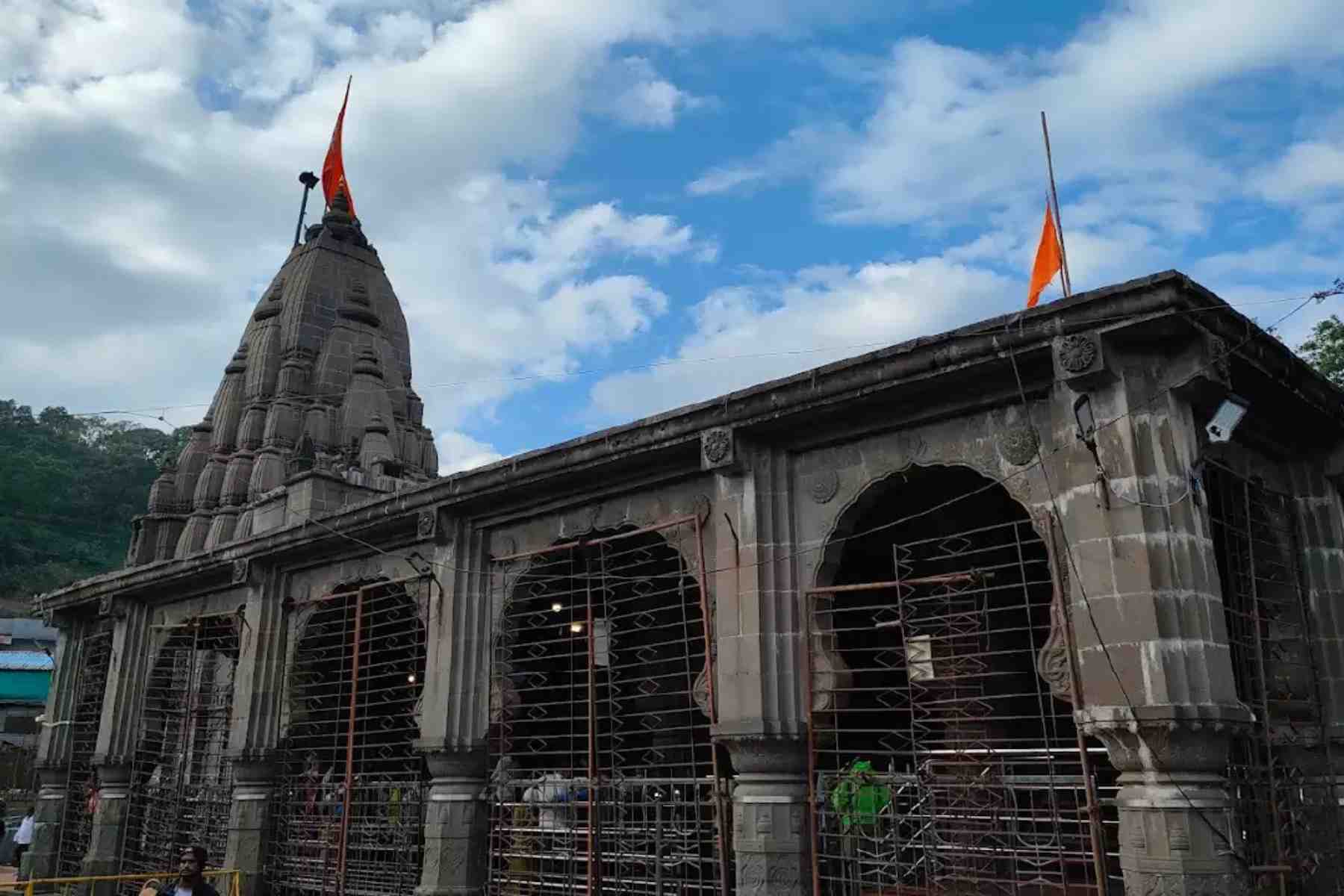
Then the road ends at a small market of flower sellers and tea stalls, and the temple is not in front of you. It is below you. A long flight of stone steps drops away through the trees, and at the bottom of it, in a courtyard that stays damp most of the year, stands a modest black-stone shrine. There is no towering gopuram, no vast plaza. For one of the twelve Jyotirlingas — the self-manifested shrines of light where Shiva is held to have appeared as a pillar of radiance — Bhimashankar is startlingly unassuming.
That is rather the point. Of all twelve, this is the one that feels least like a monument and most like a place in the forest where something happened.
Where Bhimashankar Is, and Why Its Location Matters
Bhimashankar sits in Bhimashankar village, Khed taluka, Pune district, Maharashtra, at roughly 934 metres (about 3,060 feet) in the Sahyadri range — the northern Western Ghats. By road it is around 110 to 125 kilometres from Pune depending on which route you take, and the practical railhead and airport for most pilgrims are both in Pune.
The geography is not incidental. Fifty metres or so from the temple steps there is a small kund — a stone water tank. From it, a thread of water leaves the hillside and runs east. That thread becomes the Bhima, one of the great rivers of the Deccan, which flows for more than 800 kilometres before joining the Krishna. Pandharpur, Maharashtra’s most beloved Vishnu pilgrimage, stands on its banks. Millions of people in Maharashtra and Karnataka drink from it, irrigate with it, and cremate their dead beside it. All of it starts in a puddle below a Shiva temple in a rainforest.
Pilgrims who come here for the Jyotirlinga often walk straight past the kund. It deserves a minute. Few places in India let you stand at the actual beginning of a river you have crossed a hundred times elsewhere.
The Legend: Shiva as Bhima, and the Sweat That Became a River
The story attached to this site turns on a demon named Tripurasura. In the version the temple itself preserves, Tripura performed severe penance and won boons from Brahma that left him effectively invulnerable to the gods and celestial beings. So armoured, he took the three worlds, humiliated Indra, and made the heavens unlivable for their residents. The devas did what the devas always do in these narratives: they went to Shiva.
Shiva took a form called Bhima Shankara — bhima meaning vast, terrible, awe-inducing — and met Tripurasura on these Sahyadri ridges. The battle was long. And when it ended, the account says, the sweat that poured from Shiva’s body ran off the mountain and became the Bhimarathi, the Bhima river.
It is worth pausing on how unusual that image is. Most tirtha origin stories make a river fall from heaven, or spring from a god’s hair, or pour from a sage’s water pot. This one makes a river out of exertion. The water that feeds half the Deccan is, in this telling, the residue of effort — divine labour, physically spent. Anyone who has worked at something past the point of comfort can feel what that story is reaching for.
A note on sources, honestly stated
You will see this legend attributed online to the Shiva Purana, usually to its Koti Rudra Samhita, the section that enumerates the Jyotirlingas. The Jyotirlinga list is certainly there, and the Purana does place Bhimashankar in a region it calls Dakini — the Bhimashankar forest is known locally as Dakini Vana, which is the main textual anchor for the Pune site’s claim. But the Tripurasura narrative as retold at the temple draws on local Sthala Purana and regional tradition as much as on any single surviving Sanskrit passage, and the demon’s name itself shifts between accounts. Where a post tells you flatly that “the Shiva Purana says X” about this temple, treat it with mild caution unless a chapter and verse comes with it.
The competing claims to Bhimashankar
This is the one Jyotirlinga where the identification is genuinely contested, and an honest guide should say so. Because the Shiva Purana’s geography is vague — “Dakini” is not a modern district — at least three other shrines have historically claimed to be the real Bhimashankar:
- Bhimashankar (Dakinyam) at Bhimpur, Odisha — which reads “Dakini” as a region in the east.
- Bhimeswar Dham, Assam — in the Kamrup region, with its own long local tradition.
- Moteshwar Mahadev at Kashipur, Uttarakhand — in the Kumaon foothills.
The Pune shrine is the one that appears in the standard, most widely circulated list of twelve, and it is the one the overwhelming majority of Jyotirlinga yatra circuits visit. But the other claims are not frivolous, and devotees at those sites hold them sincerely. Nothing in the tradition requires you to adjudicate. If you are doing a twelve-Jyotirlinga yatra, Bhimashankar in Pune district is where you go — and you can leave the textual question open without disrespect to anyone.
History: A Thirteenth-Century Core and a Maratha Renovation
The temple as it stands is layered. Its core is generally dated to around the thirteenth century, with later and substantially more visible work from the eighteenth.
The architecture is broadly Nagara — the North Indian temple idiom, with a curvilinear tower rising over the sanctum — executed in local basalt with strong affinities to the Hemadpanti style that spread across the Deccan under the Yadava dynasty. Hemadpanti work is recognisable by its dry masonry: dressed black stone fitted without mortar, carried on carved pillars and heavy lintels, sparing in ornament compared with the exuberance of Hoysala or Chalukya temples. Bhimashankar’s pillars and door frames carry fine carving, but the overall impression is of strength rather than display, which suits both the stone and the weather it has to survive.
Two Maratha-era interventions shaped what visitors see:
- Nana Phadnavis, the formidable administrator of the Peshwa court, built the sabhamandap (the assembly hall before the sanctum) and gave the shikhara its present form in the eighteenth century.
- Chhatrapati Shivaji Maharaj granted the revenue of the village of Kharosi to support the temple’s worship — an endowment of the kind that kept Deccan shrines functioning through politically violent centuries.
The Portuguese bell
In the courtyard hangs a large bell, and it has the strangest history of anything at Bhimashankar. It is a Portuguese church bell. Chimaji Appa, brother of Peshwa Baji Rao I, took it as spoil after the Maratha victory over the Portuguese at Vasai (Bassein) fort, and donated it to this temple in 1739.
So a bell cast for a Catholic church on the Konkan coast now rings for Shiva in a Sahyadri cloud forest. It is a small object with a great deal of Indian history compressed into it, and most visitors ring it without knowing any of that.
The Deity and the Sanctum
The linga at Bhimashankar — the aniconic stone form in which Shiva is worshipped here — sits in a sanctum you reach by descending, not ascending. The floor of the shrine is below the level of the courtyard, which is below the level of the road. The effect of walking down through forest, down through the courtyard, and down again into a low dark chamber is unmistakable: you are being taken into the hill rather than lifted above it.
The linga itself is thick and comparatively broad, and because abhishekam — the continuous bathing of the linga in water, milk and other offerings — runs for much of the morning, it is usually wet and gleaming. Unusually among major Jyotirlingas, devotees have historically been permitted close physical access for abhishekam during the morning window, which is part of why pilgrims speak of Bhimashankar with such warmth. Access arrangements do change with crowd pressure, so confirm on the day.
Shiva here is Bhima — the form that met and ended an invulnerable adversary. Devotees come with that in mind. The prayers offered at Bhimashankar tend to concern things that feel unbeatable: an illness that is not responding, litigation that will not end, a dependency, a grief that has outlasted everyone’s patience. The theology of the place is not subtle. Something that could not be defeated by the ordinary means was defeated here.
Darshan Timings, Aarti and Dress Code
The following is drawn from the temple trust’s own published schedule. Temple schedules in India shift for festivals, maintenance and crowd management, so check the official site or call ahead close to your travel date — particularly for Mahashivratri and the Mondays of Shravan, when arrangements are usually altered wholesale.
- Temple open: 5:00 AM to 9:30 PM
- Darshan and abhishekam: 5:30 AM to 12:00 PM, and 12:20 PM to 2:45 PM
- Morning aarti: 5:00 AM to 5:30 AM
- Naivedya puja (food offering): 12:00 PM to 12:20 PM
- Afternoon aarti: 2:45 PM to 3:20 PM
- Dev darshan (viewing only, no abhishekam): 3:20 PM to 7:30 PM
- Evening aarti: 7:30 PM to 8:00 PM
- Dev darshan: 8:00 PM to 9:30 PM
In practical terms: if you want to perform abhishekam yourself, you must arrive in the morning window. If you arrive mid-afternoon you will get darshan but not hands-on worship.
Dress code and conduct
The trust’s guidance is modest rather than elaborate. Bathe and wear clean clothes before entering. Footwear comes off well before the temple premises, not at the door. Helmets and hats are not to be worn inside. Leave weapons, heavy jewellery and large amounts of cash behind. No meat, alcohol or intoxicants. Maintain silence in the queue, chant Om Namah Shivaya if you wish to chant anything, and do not push — the sanctum is small and rushing it ruins it for everyone behind you.
In the absence of a stricter published rule, the sensible standard is what you would wear to any working Indian temple: shoulders and knees covered, nothing transparent, nothing you would be embarrassed to be photographed in at a shrine. Traditional dress is never wrong here.
How to Reach Bhimashankar
By road from Pune (roughly 110–125 km, about 3.5 to 4 hours). The common route runs north via Rajgurunagar (Khed) and Manchar, then west onto the ghat road. Maharashtra State Transport (MSRTC) buses run to Bhimashankar from Pune, and private taxis are easy to arrange. The final ghat stretch is narrow, with hairpins and, in monsoon, standing water and poor visibility. Do not attempt it after dark if you can avoid it.
By road from Mumbai (roughly 200+ km). Most drivers take the Mumbai–Pune Expressway, exit around Khopoli, and approach via Karjat.
By train. There is no railhead at Bhimashankar. Pune Junction is the practical arrival point for pilgrims travelling by rail; Karjat is the usual railhead for trekkers heading to the base village of Khandas.
By air. Pune is the nearest airport, with Mumbai as the main international gateway.
The two trekking routes
Bhimashankar is one of the few Jyotirlingas you can reach on foot through forest, and for many Maharashtrian devotees that is the only proper way to arrive. Both routes start from Khandas village, reachable from Karjat.
- Ganesh Ghat — about 7 km of ascent, roughly 4 hours up, graded moderate. The longer, gentler, better-shaded line, and the one most groups use for the descent as well (2 to 2.5 hours down).
- Shidi Ghat — about 5 km, roughly 3.5 hours up, graded moderate to difficult. Shorter and steeper, with iron ladder sections (shidi means ladder) bolted to rock. In heavy monsoon these can be slick and genuinely risky, and this route is sometimes closed or strongly discouraged.
Total elevation gain to the temple is roughly 850 metres. Treat it as a full day. Go with someone who knows the line, or with an organised group — the forest is dense, the trail braids, and phone signal is unreliable.
Best time to visit
Monsoon (June to September) is when the Sahyadris are at their most extraordinary: waterfalls everywhere, the forest saturated green, mist moving through the courtyard. It is also when the trek is most dangerous, leeches are active, and the ghat road is at its worst. October to February is the sweet spot — the green has not yet gone, the air is cool, visibility from the viewpoints is excellent, and the roads behave. March to May is hot, dry and the least rewarding, though the temple itself is naturally cool.
The Forest: Bhimashankar Wildlife Sanctuary
Bhimashankar is the only Jyotirlinga that sits inside a wildlife sanctuary, and the forest is a genuine reason to come even if you are not a pilgrim.
The sanctuary covers about 131 square kilometres across Pune, Raigad and Thane districts, and was notified in 1985 (some sources give 1984). Its flagship resident is the Indian giant squirrel (Ratufa indica elphinstonii), the Shekru, which is Maharashtra’s state animal. It is a large, long-tailed, maroon-and-cream arboreal squirrel that almost never comes to the ground, and Bhimashankar is one of the best places in India to see one. Look high, and listen — you often hear the landing before you see the animal.
Also present: leopard, golden jackal, sambar, wild boar, langur and bonnet macaque, and the elusive Indian pangolin. In monsoon the forest floor produces mosses, epiphytes and — in the right conditions, on rotting wood at night — bioluminescent fungi.
Nine tribal villages lie within the sanctuary, and they maintain devrai or sacred groves — patches of forest protected by religious prohibition for generations, which function as accidental seed banks of indigenous species. One woody climber at Ahupe village has been documented at an estimated 800 to 1,000 years old. These groves are among the oldest working conservation institutions in India, and they were established for entirely religious reasons, long before anyone wrote a wildlife act.
What to See Around the Temple
Most pilgrims give Bhimashankar two hours and leave. Half a day gets you considerably more. Distances below follow the temple trust’s own listing.
- Source of the Bhima — about 50 metres from the temple steps. The small kund where the river begins.
- Hanuman Lake — about 2 km, with a Hanuman temple and an Anjani Mata temple nearby, associated with the ashram of the sage Jabhalya.
- Gupt Bhimashankar and Sakshi Vinayak — about 2 km. A small Ganesha shrine, and a hidden spot in the forest where a waterfall falls continuously onto a Shivalinga. Many regular visitors consider this the most moving place on the hill.
- Nagphani Point — about 500 metres beyond Hanuman Lake. A high promontory with views over the Konkan.
- Mumbai Point — about 100 metres from the bus stand, with a Konkan view from around 3,000 feet.
- Mahadev Van and Vegetation Point — about 500 metres from the bus stand. A garden of indigenous Sahyadri plant species.
- Kondhwal waterfall (Bird Point) — 5 to 6 km off the main road, inside the sanctuary.
- Koteshwar Mahadev — 6 to 7 km, a Shiva temple at Bhorgiri village reached by a forest trail.
If you have only one extra hour, spend it at Gupt Bhimashankar.
Why Bhimashankar Matters Today
There is a specific lesson sitting on this hillside, and it is not a platitude.
Bhimashankar is a temple that has been materially sustained by the forest around it and has materially sustained that forest in return. The devrai groves exist because people believed cutting them was a sin. The sanctuary’s exceptional biodiversity is not despite the shrine; it is substantially downstream of it. India’s oldest conservation mechanism was not legislation. It was reverence — enforced socially, over centuries, by people with no scientific vocabulary for what they were protecting.
That is worth sitting with in a decade when India’s ghats are being cut for roads, resorts and quarries faster than at any point in recorded history. Bhimashankar is a working demonstration that the sacred and the ecological were never separate categories in this tradition. A river that begins at a Shiva shrine is not a metaphor here. It is a watershed, and the forest that holds the water is the same forest the tradition called holy.
And then there is the Bhima itself. Stand at that kund and you are looking at the least impressive water in Maharashtra — a few litres seeping out of rock. Eight hundred kilometres downstream it is a river that cities depend on. If you are looking for a practical teaching to carry off this hill, it is probably that one: the scale of a thing at its source tells you almost nothing about what it becomes. That applies to rivers, to practices, and to the small unglamorous disciplines people take up and abandon because the early results look like nothing.
Frequently Asked Questions About Bhimashankar
Which Jyotirlinga is Bhimashankar?
Bhimashankar is counted as the sixth of the twelve Jyotirlingas in the standard enumeration, and it is one of three Jyotirlingas in Maharashtra, along with Trimbakeshwar near Nashik and Grishneshwar near the Ellora caves. The numbering varies slightly between sources; the membership of the list does not.
Is Bhimashankar in Pune the real Jyotirlinga?
It is the shrine named in the standard, most widely accepted list, and it is the one included in essentially every Jyotirlinga yatra circuit. That said, the Shiva Purana locates Bhimashankar in a region called “Dakini” without modern coordinates, and three other temples — in Odisha, Assam and Uttarakhand — maintain their own claims. The Pune identification rests partly on the fact that the Bhimashankar forest is traditionally known as Dakini Vana and that the Bhima river rises here. Devotion at any of these sites is sincere, and the tradition does not require you to pick a side.
What are Bhimashankar temple timings?
Per the temple trust, the temple is open 5:00 AM to 9:30 PM. Darshan with abhishekam runs 5:30 AM to 12:00 PM and 12:20 PM to 2:45 PM; the three aartis are at 5:00 AM, 2:45 PM and 7:30 PM. Timings change for Mahashivratri, Shravan Mondays and other major occasions, so verify close to your date.
Can you do abhishekam yourself at Bhimashankar?
Devotees have traditionally been allowed close access for abhishekam during the morning window, which is one reason the temple is so loved. Arrangements are adjusted when crowds are heavy, so confirm on the day rather than assuming. Afternoon and evening slots are generally dev darshan — viewing only.
How difficult is the Bhimashankar trek?
Ganesh Ghat is about 7 km and 4 hours up, graded moderate, and is suitable for reasonably fit beginners in a group. Shidi Ghat is shorter at about 5 km but steeper, with fixed iron ladders, and is graded moderate to difficult. In heavy monsoon the ladders become genuinely hazardous and this route is sometimes closed. Total gain to the temple is roughly 850 metres. You can also simply drive up — no trek is required for darshan.
What is the best month to visit Bhimashankar?
October to February gives the best combination of green landscape, cool weather, clear views and safe roads. Monsoon is the most beautiful and the most difficult. March to May is hot and comparatively dull, though the forest and the sanctum stay cool.
Is there accommodation at Bhimashankar?
There are basic lodges, MTDC-type options and homestays in and around the village, generally simple rather than comfortable. Many visitors base themselves in Pune and do Bhimashankar as a long day trip. If you want to attend the 5:00 AM aarti, staying overnight nearby is the only practical way.
A Closing Thought
What stays with people about Bhimashankar is rarely the architecture. It is the descent — road to steps to courtyard to a low dark room with a wet black stone in it — and the sound the forest makes while you queue.
The story says Shiva came here, fought something that could not be beaten, and left his exhaustion behind as a river. The forest says something quieter and equally old: that people protected these trees because they could not imagine doing otherwise, and that the water still comes. Both are true in the same square kilometre. Not many places manage that.
Continue Exploring
- Somnath Temple: The First Jyotirlinga and the Shrine That Kept Being Rebuilt
- Kashi and Its Significance for Hinduism
- Shiva Trilogy: Key Highlights and Takeaways
- Durga and Mahishasura: The Story Behind Navratri’s Nine Nights
- Parashurama: The Eternal Warrior Sage of Sanatan Dharma