
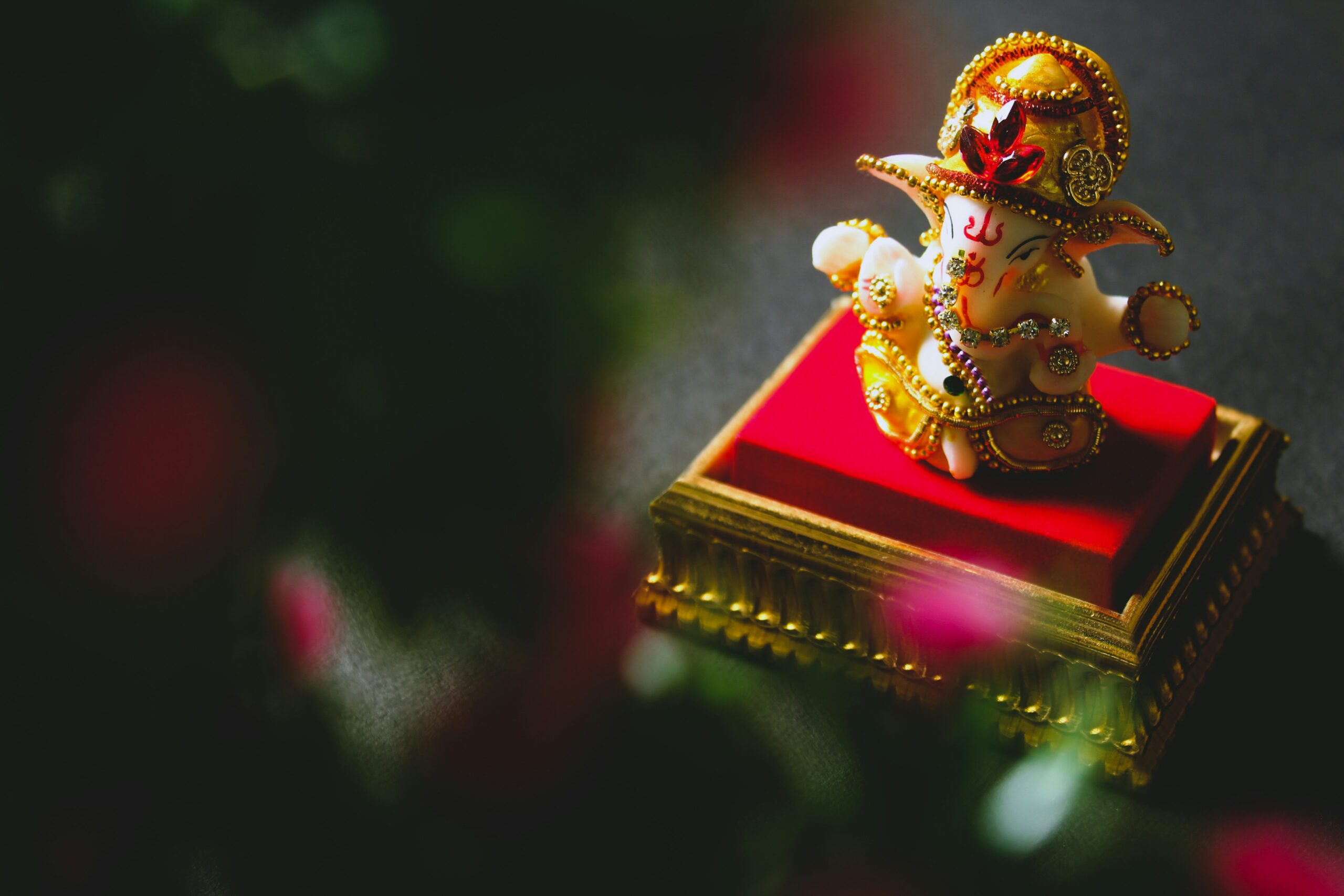
Watch what happens at the start of almost any Hindu undertaking. A wedding, the foundation of a house, the first page of an account book, a child’s first letters, a new shop, a car driven home from the showroom, the opening lines of a Carnatic concert, the start of a journey. Before anything else is done, somebody says his name.
No other deity in the tradition occupies that position. Shiva has his great shrines, Vishnu his avatars, Durga her nine nights — but the elephant-headed god with the broken tusk and the enormous belly is the one who gets there first, every time, in every sampradaya, whatever your family deity happens to be. He is prathama pujya: the first-worshipped.
And here is what is odd about that. He is also, on the evidence, one of the later arrivals in the Hindu pantheon. How a relative newcomer ended up at the head of the queue is one of the more interesting stories in Indian religion — and the stories his devotees tell about him are better than any of the scholarship.
The Names, and What They Tell You
Start with the name itself. Ganesha is gana plus isha: lord of the ganas, the hosts or troops — specifically the unruly, semi-divine retinue that attends Shiva. Ganapati says the same thing with pati, master. He is not lord of a realm or an element. He is the one put in charge of a crowd.
The Amarakosha, the classical Sanskrit thesaurus, lists eight of his names, and together they are a decent portrait:
- Vinayaka — the remover, or the pre-eminent leader
- Vighnaraja — king of obstacles
- Dvaimatura — he of two mothers
- Ganadhipa — commander of the hosts
- Ekadanta — the one-tusked
- Heramba — the protector of the helpless
- Lambodara — the pendulous-bellied
- Gajanana — the elephant-faced
Note Vighnaraja carefully, because it is routinely mistranslated. Ganesha is Vighnaharta, the remover of obstacles — but he is also Vighnakarta, the one who places them. He is lord of obstacles in both directions. In his older character he was propitiated precisely so that he would not obstruct you. That double function is not a contradiction the tradition is embarrassed about; it is the heart of what he is. An obstacle in the right place at the right time is a mercy, and most of us can name one in our own lives.
Where Ganesha Comes From: The Honest Answer
Devotional writing on Ganesha often claims he appears in the Rigveda. The verse quoted is usually Rigveda 2.23.1 — gananam tva ganapatim havamahe, we invoke you, lord of the hosts — which is still chanted at Ganesha pujas today, and beautifully so.
But the honest position is that this verse almost certainly does not refer to the elephant-headed god. Scholars including Ludo Rocher read the ganapati of RV 2.23.1 as an epithet of Brahmanaspati, and the occurrence at RV 10.112.9 as an epithet of Indra. Ganapati at that stage is a title, not a name — rather as shiva began as an adjective meaning auspicious before it became a god’s name. Later Ganapatya tradition adopted these verses deliberately, as scriptural warrant, and they are now inseparable from his worship. That is a real and meaningful thing; it is just not the same as the Rigveda knowing him.
What the material record shows is this. Terracotta images that look like Ganesha turn up from around the first century CE at sites including Ter, Pal, Verrapuram and Chandraketugarh. Textual references begin appearing in the first and second centuries CE. The recognisable classical form — elephant head, pot belly, mouse, four arms — consolidates in the fourth to fifth centuries CE, and by the ninth and tenth centuries he has his own sect, the Ganapatyas, who worship him as the supreme reality. A. K. Narain states flatly that there is no convincing evidence for him in Brahmanical literature before about the fifth century. Paul Courtright dismisses the popular theories of an older elephant cult or totem, noting there is no independent evidence for one.
The two Puranas devoted entirely to him are late: the core of the Ganesha Purana probably dates to the twelfth or thirteenth century, and the Mudgala Purana somewhere in the eleventh to fourteenth, with the scholarly dating unsettled. The much-chanted Ganapati Atharvashirsa is probably sixteenth or seventeenth century. His birth stories cluster in texts from roughly 600 to 1300 CE.
None of this diminishes him. It makes him interesting. Ganesha is the clearest case in Hinduism of a deity whose rise can actually be watched — a god who went from being a figure you placated so he would leave you alone to being the one every household greets first. A tradition that absorbs and elevates like that is a living one.
The Birth Stories, and Why They Disagree
Ask ten people how Ganesha got his elephant head and you will get the same story. Go to the texts and you will get several, and they do not reconcile. Here are the main ones, attributed properly.
The guardian at the door (Shiva Purana)
The best-known version. Parvati, wanting to bathe undisturbed, forms a boy from the turmeric paste or sandal paste scraped from her own body and breathes life into him. She sets him at the door and tells him to let nobody pass. Shiva returns and is refused entry by a child he has never seen. Neither will yield. In the fight that follows, the boy’s head is struck off.
Parvati’s grief is terrible, and in the most forceful tellings she threatens the destruction of creation itself. Shiva sends his hosts north with instructions to bring back the head of the first creature they find; they return with an elephant’s. The boy is revived, given the elephant’s head, and — this is the crucial part — made chief of Shiva’s ganas and granted the boon that he will be worshipped before all other gods.
Read the story again and notice what it actually says. Ganesha’s authority does not come from conquest or from being a son of privilege. It comes from having been loyal at a door, having lost everything for it, and having been restored and promoted. There is a reason this is the story people tell children.
Other versions
The Puranic material is genuinely various. Some accounts have Parvati fashion him from clay rather than paste. Some have Shiva create him directly, at the request of the gods. The Brahmavaivarta Purana gives a different mechanism altogether: Parvati’s son is born whole and beautiful, and the head is lost when Shani — Saturn, whose glance is held to be destructive — looks upon the infant at his naming ceremony. In other tellings he arises from Shiva’s laughter, or simply appears. The epithet Dvaimatura, he of two mothers, points to yet another layer of story again.
The responsible thing is to hold these together rather than pick one and call it the version. The Puranas are not a single book written by a single hand; they are libraries, layered over centuries, by communities who told the story the way their lineage told it.
Reading His Body: What Every Part Means
Ganesha’s image is unusually legible. Almost every element has an interpretation attached to it in the tradition, and children in Indian households are often taught the god by being taught to read him.
The elephant head
The head is buddhi — intelligence, discernment, the capacity to judge. The elephant is the strongest animal in the Indian landscape and also the most deliberate: it does not hurry and it does not forget.
The large ears and the small eyes
Big ears to listen more than you speak. Small eyes to concentrate — to see one thing properly rather than everything vaguely. These are devotional readings rather than textual doctrine, taught in homes and in temple discourses, and they are none the worse for it.
The trunk
An elephant’s trunk can uproot a tree and can also pick up a single grain of rice. It is the tradition’s image for the union of great power with great delicacy — the thing most of us manage one of and not both. The motif of the trunk curving sharply left to taste a sweet is one of the archaic features of his iconography. Where the trunk points matters in temple practice: right-turned (valampuri) murtis are relatively rare and are considered especially potent, which is why Siddhatek’s right-turned image is singled out among the Ashtavinayaka.
The broken tusk
Ekadanta is his earliest attested name, which means the broken tusk was there from very near the beginning. Two main stories explain it.
In the first, the sage Vyasa needs a scribe who can keep up while he dictates the Mahabharata. Ganesha agrees on one condition: that Vyasa not pause. Vyasa counters with his own condition: that Ganesha not write anything he has not understood. Midway through, Ganesha’s pen breaks — and rather than interrupt the flow, he snaps off his own tusk and writes with that. Scholars are clear that this episode is a later interpolation into the epic and is excluded from the Critical Edition of the Mahabharata, so it is best described as a cherished tradition rather than part of the original text. It remains the single best image of what writing costs.
In the second, found in the Brahmavaivarta Purana, the tusk is broken in a fight with Parashurama, who comes to see Shiva and is barred by Ganesha at the door — the same motif as his birth, played again. The Mudgala Purana, for its part, assigns Ekadanta to one of his incarnations.
The belly
Lambodara. The usual reading is capacity: the ability to take in and digest everything that comes, pleasant and unpleasant, without being disturbed by it. Equanimity, given a body.
What he holds
Most commonly four arms, though the earliest images have two and some central Indian forms from the ninth and tenth centuries carry fourteen or twenty.
- The ankusha (elephant goad) — that which drives you forward; in devotional reading, the spur that moves a reluctant mind.
- The pasha (noose) — that which restrains and binds; worldly attachment, and also the lasso with which obstacles are pulled aside.
- The parashu (axe) — the severing of attachment.
- The modaka — a sweet dumpling, the reward of practice. In many images one hand holds a bowl of them and one is raised in abhaya mudra, the gesture meaning do not be afraid.
Goad and noose in the same pair of hands is the whole teaching in miniature: you will be driven and you will be held back, and both come from the same source.
The mouse
His vahana, or mount, is a mouse or rat — mushaka — attested in sculpture from about the seventh century and named in the Matsya, Brahmananda and Ganesha Puranas.
The pairing is deliberately absurd and deliberately instructive. The largest animal rides the smallest. The reading most often given is that the mouse is desire — restless, nocturnal, gnawing, able to get into anywhere — and that the discerning mind does not kill it but mounts it and directs it. Another reading notes that a mouse goes where nothing else can, so that the lord of obstacles travels on the very thing that slips through every barrier. Some forms of Ganesha ride a peacock (Mayureshwara, at Morgaon) or a lion instead.
His Family and His Place Among the Gods
Ganesha is the son of Shiva and Parvati, and the brother of Kartikeya — Skanda, Murugan, Subrahmanya — and the sibling relationship is one of the warmest and most comic in Hindu story. Regional traditions differ on who is older: much of the north treats Ganesha as the elder, much of the south treats Murugan as the elder.
The best-loved story about the two is the race. Shiva and Parvati offer a prize — in the common north Indian telling, to whoever circles the world first; in the Tamil telling, a mango of wisdom, the jnana palam. Kartikeya leaves immediately on his peacock. Ganesha, who has a mouse and no illusions about its top speed, walks once around his parents and sits down, on the reasoning that for a child the parents are the world. He wins. Murugan, in the Tamil version, is sufficiently annoyed to leave for the hill at Palani.
It is worth saying plainly that this story is not traceable to a single authoritative text; it is widely told, exists in several regional versions with different prizes and different endings, and the Tamil mango version is bound up with the Murugan tradition specifically. Treat it as the tradition’s own folklore — which is not a demotion. It is the most quoted thing anyone ever says about Ganesha.
Consorts and children
Here the traditions genuinely diverge, and anyone who tells you otherwise is flattening something. Across much of the north and west, Ganesha is married — to Siddhi (attainment, spiritual accomplishment), Buddhi (intellect) and in some accounts Riddhi (prosperity). These are personified qualities as much as persons, and the point is theological: wisdom and success attend him. The Shiva Purana gives him two sons, Kshema (safety) and Labha (gain); northern variants replace Kshema with Shubha (auspiciousness).
In most of south India, by contrast, Ganesha is a brahmachari — celibate, unmarried, the perpetual son. Both positions are old and both are sincerely held. If you grew up with one, the other can be startling; neither is a corruption of the other.
Beyond Hinduism
Ganesha travelled further than almost any Hindu deity. He enters Mahayana Buddhism as Vinayaka and appears as a wealth-and-protection figure in Vajrayana and Tibetan practice, with around thirty texts in the Tibetan canon concerning him. He reached Southeast Asia with Hindu traders and settlers by roughly the seventh and eighth centuries, and there are Ganesha images from Java, Bali, Borneo and the Philippines. In Japan he is Kangiten, first mentioned in 806. Some Jain communities worship him, most likely through mercantile contact; the earliest known Jain Ganesha image is around the ninth century. A female form, Vinayaki, appears in several traditions.
The Great Ganesha Temples
As T. A. Gopinatha Rao observed, every Indian village however small has its own image of Vighneshvara — which makes a list of major temples slightly beside the point. Still, some are destinations in their own right.
The Ashtavinayaka of Maharashtra
Eight temples, all within roughly 100 km of Pune, forming a circuit that devotees complete in a prescribed order, beginning and ending at Morgaon:
- Mayureshwar, Morgaon, Pune district — the first and most important of the eight; the form riding a peacock
- Siddhivinayak, Siddhatek, Ahmednagar district — the only one of the eight whose trunk turns right
- Ballaleshwar, Pali, Raigad district — named for a child devotee; besan laddu is the prasad
- Varadavinayak, Mahad, Raigad district — the one where devotees may traditionally approach the murti closely
- Chintamani, Theur, Pune district — the nearest to Pune, about 22 km
- Girijatmaj, Lenyadri, Pune district — carved into a rock-cut cave complex, reached by a long stair
- Vighneshwar, Ozar, Pune district — the golden pinnacle
- Mahaganapati, Ranjangaon, Pune district — the last, before returning to Morgaon
Others worth knowing
- Siddhivinayak, Prabhadevi, Mumbai — the most visited Ganesha temple in India, and the one whose Tuesday queues are a Mumbai institution
- Dagdusheth Halwai Ganpati, Pune — a nineteenth-century foundation and the centrepiece of Pune’s Ganeshotsav
- Kanipakam Vinayaka, Chittoor district, Andhra Pradesh — where the murti is traditionally said to be slowly growing
- Manakula Vinayagar, Puducherry, and Ucchi Pillayar at the summit of the Rockfort in Tiruchirappalli
- Ganpatipule, on the Konkan coast, where the shrine faces the sea
Ganesh Chaturthi and the Other Festivals
Ganesh Chaturthi — Vinayaka Chaturthi — falls on the fourth day of the bright fortnight of Bhadrapada, in August or September. Clay murtis are installed in homes and in public pandals, worshipped for a day, three days, five days or the full ten, and then immersed on Anant Chaturdashi in a procession that in Mumbai and Pune stops the city.
The public festival as we know it is relatively recent and consciously political. In 1893, Lokmanya Tilak took what had been a household observance and built it into a mass public event — partly to bridge caste and sectarian divisions, and explicitly to create a lawful space for nationalist assembly under British rule. Modern Ganeshotsav, with its enormous pandals and its ten-day arc, is his design laid over a much older domestic ritual.
Also observed:
- Ganesh Jayanti (Magha Shukla Chaturthi, January or February) — kept chiefly in Maharashtra and Goa, with a murti sometimes shaped from turmeric or sindoor, sesame offerings, and a day’s fast
- Sankashti Chaturthi — the fourth day after each full moon, a monthly fast. When it falls on a Tuesday it is Angaraki Chaturthi and considered especially powerful
A date caution that matters, particularly for readers in the United States, the United Kingdom, Canada and Australia: these are lunar tithis, which begin and end at a precise moment at a precise location. Published muhurat timings are always calculated for a specific city — Indian panchangs typically for an Indian one — and the date observed abroad can fall a day either side of the Indian date. Temples in the same foreign city sometimes differ. Use your local panchang or your temple’s calendar rather than an Indian listing.
Mantras and How He Is Worshipped
The simplest and most universal is the one most people already know:
Om Gam Ganapataye Namaha. Om, and salutations to Ganapati. Gam is his bija or seed syllable. Also common: Om Shri Ganeshaya Namaha.
The shloka recited before beginnings is this one:
Vakratunda mahakaya suryakoti samaprabha / nirvighnam kuru me deva sarva karyeshu sarvada — O curved-trunked one, mighty of body, radiant as ten million suns, make all my undertakings free of obstacles, always.
It is worth knowing that this verse circulates very widely as a mangalacharana — an invocatory benediction — without a secure attribution to a single named text. It is often credited to the Brahmanda Purana and to various stotra collections, and the wording varies slightly between regions. Chant it with confidence; just do not stake a claim on its source.
The Ganapati Atharvashirsa (also called the Ganapati Upanishad) is the central text of his specialised worship, and identifies him with Om itself — omkarasvarupa, the very form of the primal sound. Scholars date it to around the sixteenth or seventeenth century, which makes it a late Upanishad rather than an ancient one.
What to offer
- Modak and laddu — his sweets, and the offering most associated with him
- Durva grass — conventionally in bunches of 21, the offering he is held to prefer above flowers
- Red flowers, especially hibiscus, and red sandal paste
- Not tulsi. Tulsi leaves, offered to almost every other deity, are traditionally withheld from Ganesha. The story behind it — a refused proposal and mutual curses, usually told from the Brahmavaivarta Purana cycle — exists in several versions and is one of those rules Indian households keep scrupulously while disagreeing about why
Why Ganesha Still Matters
Set aside the iconography for a moment and look at what he is for.
Ganesha is the deity of beginnings — which is to say, the deity of the single place where most human intention fails. Almost nobody is defeated by the middle of a project. People are defeated at the start, by the resistance that shows up before the first move, and by the thing that surfaces at week three and makes stopping look reasonable. A tradition that installs a god precisely at that threshold has noticed something true about us.
And the way he governs that threshold is the useful part. He is not a god who clears your road. He is lord of obstacles in both directions — he removes and he places — and he holds a goad and a noose in the same pair of hands. The implication is not that your obstacles will be taken away. It is that they are not random, that something intelligent is involved in their placement, and that the correct response to one is neither despair nor force but buddhi — discernment. Work out whether this particular wall is to be gone around, waited out, or walked through.
He also models it. Every story about him is a story about meeting an obstacle with intelligence rather than strength. His pen breaks, so he uses his tusk. He cannot win a footrace, so he redefines the course. He is barred, so he yields the tusk and not the door. He is a god who gets outcomes by thinking, which may be why students and shopkeepers and writers took to him so completely.
Practically: if you are starting something this week and it frightens you a little, the tradition’s instruction is unglamorous and good. Begin anyway, begin small, name the obstacle out loud, and do not assume that the thing in the road is an enemy.
Frequently Asked Questions
Why is Lord Ganesha worshipped first before all other gods?
Because of the boon granted at the end of his birth story. In the Shiva Purana account, after Ganesha is restored with the elephant’s head, Shiva makes him chief of the ganas and grants that he will be worshipped before all other deities. Devotionally the reason is that he is lord of obstacles: you address him first so that whatever you are beginning is not obstructed.
How did Ganesha get his elephant head?
The best-known account, from the Shiva Purana, is that Parvati created him from paste scraped from her own body and set him to guard her door; Shiva, returning and refused entry, beheaded him in the fight that followed, and then restored him with the head of an elephant. Other Puranas differ — the Brahmavaivarta Purana attributes the loss of the head to Shani’s glance at the infant’s naming ceremony. There is no single canonical version.
Why does Ganesha have a broken tusk?
Two main stories. In the better-known one he breaks it off to use as a pen when his own breaks while transcribing the Mahabharata for Vyasa — an episode scholars regard as a later addition to the epic and which the Critical Edition excludes. In the Brahmavaivarta Purana it is broken in a confrontation with Parashurama. His earliest name, Ekadanta, shows the single tusk is an old feature of his image.
Why is Ganesha’s vahana a mouse?
The mouse appears as his mount in sculpture from about the seventh century and is named in the Matsya, Brahmananda and Ganesha Puranas. The standard reading is that the mouse represents restless desire — which the discerning mind does not destroy but mounts and steers. Another reading is that a mouse can get through any barrier, which suits the lord of obstacles. Some forms of Ganesha ride a peacock or a lion instead.
Is Lord Ganesha married?
It depends on where you are. Across much of north and west India he is married to Siddhi and Buddhi, and in some accounts Riddhi, with sons named Kshema or Shubha and Labha. Across most of south India he is a celibate brahmachari. Both traditions are old and both are sincerely held; there is no single right answer.
What is the most powerful Ganesha mantra?
The tradition does not rank them, and the question is really about fit. Om Gam Ganapataye Namaha is the standard seed mantra and the one most widely used. The Vakratunda Mahakaya shloka is the conventional invocation before beginnings. The Ganapati Atharvashirsa is the principal text of his specialised worship. Consistency matters more than choice of formula.
When is Ganesh Chaturthi?
On the fourth day of the bright fortnight of Bhadrapada, which falls in August or September. The festival runs up to ten days and concludes with immersion on Anant Chaturdashi. Because it is set by a lunar tithi, the observed date outside India can differ by a day — check your local panchang.
A Last Thought
The thing I keep coming back to is the belly.
Of all the gods in the tradition, Ganesha is the one who looks least like an ideal and most like a friend. He is not beautiful. He is not austere. He is not armed for war in any serious way. He has a broken tooth, a stomach, a weakness for sweets and an animal for a face. He rides a mouse. And he is the one every household greets first, and the one small children are introduced to before anyone else.
That may be the real teaching. The tradition’s gatekeeper to everything is not frightening, not immaculate, not remote. He is the shape you can approach when you are nervous and unprepared and about to begin something — which is, after all, exactly when you need him.
Om Gam Ganapataye Namaha.
Continue Exploring
- Who Is Lord Shiva? The Story, Symbolism and Worship of Mahadeva
- Introduction to the Mahabharata: The World’s Longest Epic
- Parashurama: The Eternal Warrior Sage of Sanatan Dharma
- Durga and Mahishasura: The Story Behind Navratri’s Nine Nights
- Mallikarjuna Jyotirlinga, Srisailam: Where Shiva and Shakti Sit Together