
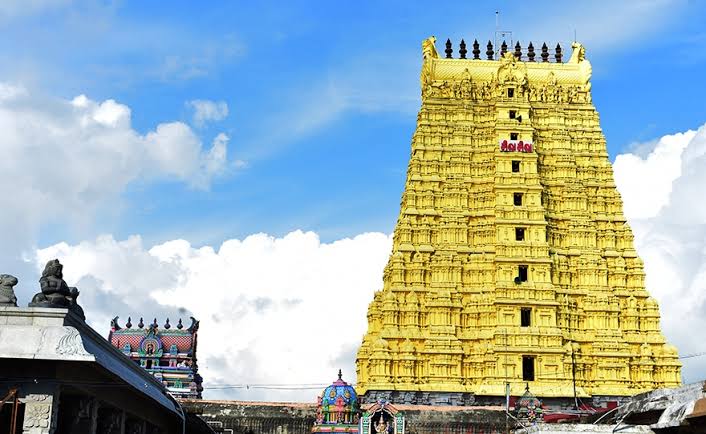
At four in the morning, Rameswaram smells of wet sand and camphor. Pilgrims are already walking down to the water’s edge in the dark, towels over their shoulders, and the Bay of Bengal here is so shallow and so still that you can wade out a hundred feet and the sea barely reaches your waist. This strip of water is Agni Theertham — the “fire ford” — and it is where a Rameswaram pilgrimage begins. People dip, surface, mutter a mantra, dip again. Then they turn and walk up the sand toward a temple whose eastern gateway rises fifty metres into the half-light, and whose corridors — if you walked every one of them — would carry you the better part of a kilometre past twelve hundred carved pillars.
This is the Ramanathaswamy Temple, and it is one of the strangest and most moving of all the great Shiva shrines, because of who is said to have built it. Not a king. Not a sage. A man carrying guilt. Rama — having won his war, having recovered his wife, having killed the enemy — arrived at this shore and asked for a way to be clean again.
Where Rameswaram Sits in the Hindu Landscape
Rameswaram is an island in the Gulf of Mannar, in Ramanathapuram district, Tamil Nadu, separated from the mainland by a narrow channel at Pamban and pointing east toward Sri Lanka like a finger. On a clear day from the sandbanks at the island’s tip you are looking at roughly thirty kilometres of shallow water and shoals — the chain traditionally called Rama Setu, Rama’s bridge.
Few places in India carry as many overlapping sanctities at once. Rameswaram is:
- One of the twelve Jyotirlingas — the shrines where Shiva is held to be present as a jyoti, a column of light, rather than as an image made by human hands. Rameswaram is the southernmost of the twelve.
- One of the four Char Dham — with Badrinath in the north, Dwarka in the west and Puri in the east. The tradition of visiting all four as a single national pilgrimage is widely attributed to Adi Shankaracharya, though that attribution rests on later hagiography rather than on documents from his own lifetime.
- One of the Paadal Petra Sthalams — the Shiva temples of the Tamil country sung by the Nayanar saints Appar, Sundarar and Sambandar in the Tevaram. Sources differ on the exact total, usually given as 274, 275 or 276.
So a devotee at Rameswaram may be completing a Jyotirlinga circuit, a Char Dham circuit, or a Tamil Shaiva pilgrimage tradition more than a thousand years old. Often all three at once. If you have read our guides to Somnath and Kedarnath, you will recognise the pattern: each Jyotirlinga has its own distinct theological personality. Rameswaram’s is expiation.
The Legend: Why Rama Needed a Shiva Lingam
The story is told in two broadly different shapes, and it is worth being honest that the texts do not agree on the sequence.
Version One: Before the Bridge
The Yuddha Kanda of the Valmiki Ramayana places Rama on this shore before the crossing, worshipping Shiva and asking for success in the war ahead. In this reading, Rameswaram is where the campaign was consecrated — Vishnu’s avatar bowing to Shiva before setting out. The Shiva Purana likewise frames Rama as receiving Shiva’s boon of victory over Ravana.
Version Two: After the War
The more widely told version, drawn largely from Puranic retellings and from local temple tradition, places the worship after Ravana’s death. Ravana was not only a demon-king; he was a Brahmin by birth, a descendant of the sage Pulastya, a scholar of the Vedas and himself a formidable devotee of Shiva. Killing him therefore incurred Brahmahatya dosha — the specific, grave stain of having killed a Brahmin. On the advice of sages, Rama was told to install and worship a Shiva lingam on this shore to be released from it.
Both versions survive, and devotees generally hold both without strain: the shore was consecrated going out and purified coming back. Where you will see the difference is in how a particular guide or pamphlet narrates it, so do not be surprised by the variation.
Hanuman, the Himalayas, and a Lingam Made of Sand
What follows is the part everyone remembers. Rama needed a lingam, and sent Hanuman north to Kailash to fetch one worthy of the occasion. Hanuman went. The auspicious hour approached. Hanuman did not return.
So a lingam was shaped out of the wet sand of the shore and installed in time. When Hanuman finally arrived with the stone lingam from the north, he was crushed — and, in the telling, tried to uproot the sand lingam with his tail to prove it unworthy, and could not budge it. Rama consoled him by ordering that the lingam Hanuman had carried, the Vishvalingam (also called the Vishwanatha or Kashi lingam), be worshipped first, before the main deity, for all time.
That order is still obeyed. To this day, in the sanctum of the Ramanathaswamy Temple, there are two lingams — the Ramalingam, the principal deity, and the Vishvalingam beside it — and the Vishvalingam receives worship first.
One honest note on a detail that sources genuinely dispute: who shaped the sand lingam. Several accounts, including the temple’s own popular tradition, say Sita made it from the sand of the shore; others attribute it to Rama. You will find both stated flatly, and there is no way to settle it from the texts. The theological point survives either version intact — that what matters in a lingam is not its material or its provenance but the devotion installed in it. Sand, made sacred by faith, outweighed stone carried from Kailash.
The presiding deities, then, are Ramanathaswamy — “the Lord of Rama,” Shiva as worshipped by Rama — and his consort Parvathavardhini. The very name of the temple records the inversion: the god is named after his devotee.
The History: A Temple Built by Many Hands
The structure you walk through today is not ancient in the way the legend is. It is a layered accretion, and the layers are traceable.
The Pandya dynasty expanded the shrine substantially in the 12th century. Then something unusual happened: the temple drew patronage from across the Palk Strait. The Sri Lankan king Parakramabahu I (r. 1153–1186) is recorded as involved in building the sanctum, and Nissanka Malla made donations. Later, the Jaffna kings Jeyaveera Cinkaiariyan (r. 1380–1410) and Gunaveera Cinkaiariyan undertook renovations of the sanctum — and Jeyaveera is said to have shipped stone blocks for the work from the Koneswaram temple at Trincomalee. A Shiva shrine on the Indian coast, partly built with stone from a Shiva shrine on the Sri Lankan coast, honouring the war fought between the two.
In the early 14th century the temple was raided by Malik Kafur, a general of Alauddin Khalji, during the Delhi Sultanate’s campaigns into the far south.
The temple’s present form is largely a 17th- and 18th-century achievement, and the family responsible were the Sethupathis of Ramanathapuram — whose title itself means “lord of the bridge,” guardians of the crossing to Rameswaram. Dalavai Sethupathi built part of the eastern gopuram in the 17th century. And Muthuramalinga Sethupathi (r. 1763–1795) built the third corridor and the Chokkattan Mandapam, the hall patterned like a chessboard where the festival images are placed during processions.
So when people call Rameswaram “the temple Rama built,” they mean the shrine’s origin. The architecture is the gift of Pandyas, Sinhalese and Tamil kings, Jaffna rulers and a line of local chieftains, across six centuries.
The Architecture: India’s Great Corridor
Rameswaram’s architectural signature is not its tower. It is its corridors.
The temple sits inside a rectangular compound wall roughly 865 feet east to west and 657 feet north to south, with gopurams on the east and west and gate towers to the north and south. The principal rajagopuram stands about 53 metres tall.
Inside, concentric pillared corridors (prakarams) run around the sanctum. The outer corridors measure roughly 400 feet on the east and west sides and about 640 feet north to south; the inner corridors about 224 feet and 352 feet. Add them together and the total corridor length comes to something near 3,850 feet — commonly described as among the longest temple corridors in the world.
The outer corridor is carried on about 1,212 pillars, each roughly thirty feet high, many individually carved. The effect in person is not a list of numbers. It is the way the perspective collapses: you stand at one end and the pillars telescope away from you into a vanishing point of grey granite and oil-lamp light, and every single one is different if you stop to look.
Around the corridors are named halls, each with its own function — the Anuppu Mandapam, Sukravara Mandapam, Sethupati Mandapam, Kalyana Mandapam (for the ritual marriage of the deities) and Nandi Mandapam. There are separate shrines for Vishalakshi, Vishnu and Ganesha. Tradition also identifies a samadhi of the grammarian-sage Patanjali within the complex, though this is a devotional attribution rather than a historically established one.
The 22 Theerthams: Bathing Your Way Through a Pilgrimage
This is the ritual that makes Rameswaram unlike any other Jyotirlinga, and it is the thing first-time visitors most often arrive unprepared for.
Rameswaram island is traditionally said to hold 64 theerthams — sacred water bodies. The Skanda Purana singles out 24 as important. Of these, 22 lie inside the Ramanathaswamy Temple itself, as wells sunk within the corridors, and the number is explained as corresponding to the 22 arrows in Rama’s quiver.
The sequence a traditional pilgrim follows is:
- Agni Theertham — a bath in the sea off the temple’s eastern shore. This is counted the first and most important of all, and it is not inside the temple at all; it is the open Bay of Bengal, about a five-minute walk from the eastern gopuram.
- The 22 wells inside the temple — a temple attendant walks you from well to well with a rope and bucket and pours a bucket of water over your head at each one. You emerge thoroughly, comprehensively soaked.
- Darshan — after changing into dry clothes, since you cannot enter the sanctum wet.
Several individual theerthams carry their own stories. Villoondi Theertham — “the buried bow” — lies on the coast roughly 7 km from the main temple toward Pamban, at the spot where Rama is said to have thrust his bow into the sand to draw fresh water for a thirsty Sita; a freshwater spring is pointed out there, within the saltwater sea. Jatayu Theertham, on the road to Dhanushkodi, is associated with the vulture-king Jatayu, who fell to earth after his wings were cut away in his attempt to stop Ravana carrying Sita off. Others — Lakshmana, Hanuman, Sugreeva and Rama Theertham — name the companions of the Ramayana one by one, so that walking the island is a way of walking through the epic. Our guide to the seven kandas of the Ramayana lays out that narrative if you want the whole sweep of it.
A Practical Pilgrim’s Guide to Rameswaram
The practical details below were checked against current secondary sources at the time of writing. Temple timings, fees and darshan arrangements at major Tamil Nadu temples are revised periodically by the Hindu Religious and Charitable Endowments (HR&CE) Department, and they change again for festivals. Please confirm with the official HR&CE portal or the temple office before you travel.
Darshan Timings
The temple is generally open from around 5:00 AM to 1:00 PM and again from 3:00 PM to 9:00 PM, with a midday closure between one and three. The shrine is opened earlier than five for the priests’ preparatory rites.
The darshan of the Spatika Lingam — a crystal lingam shown only in the pre-dawn worship — is one of the most sought-after sights at Rameswaram, and here the sources genuinely conflict: some give the window as 5:00–6:00 AM, others as roughly 4:00–5:00 AM. The ticket is modest, commonly quoted around ₹50. If this darshan matters to you, plan to be at the temple well before five and ask at the counter the previous evening rather than relying on any published figure, including ours.
The 22 Wells Bath
A token fee — usually quoted around ₹25 per person — covers the guided circuit of the 22 theerthams. Timings are reported as roughly 5:30 AM to 12:30 PM and 3:00 to 7:00 PM, though one widely used source gives 5:00 AM to noon; again, verify locally. Allow 45 minutes on a quiet morning and up to two hours in peak season.
Practical things nobody tells you: carry two complete changes of dry clothes, because you will be wet twice (sea, then wells). Phones and cameras are not permitted inside; cloakrooms and lockers are available for a small charge. Men performing abhishekam are generally expected to wear a dhoti with the upper body uncovered.
Dress Code
Rameswaram enforces traditional dress, and as of 2026 HR&CE has placed checking points at the entry gates. In practice:
- Men: dhoti or veshti, kurta-pyjama, or formal trousers with a shirt. Shorts, bermudas, jeans and sleeveless vests are turned away.
- Women: saree, half-saree, or salwar kameez with dupatta. Sleeveless tops, jeans, T-shirts, western skirts and leggings without a long kurta are not permitted.
This catches out a lot of diaspora visitors who arrive straight from an airport in travel clothes. Pack accordingly, or buy locally — the streets around the temple are full of shops that exist for exactly this reason.
How to Reach Rameswaram
- By air: the nearest airport is Madurai (IXM), about 170–175 km away, roughly three and a half hours by road.
- By rail: Rameswaram station (RMM) is about a kilometre from the temple, with connections from Chennai, Madurai and Tiruchirappalli. The rail crossing itself is now over the New Pamban Bridge, inaugurated on 6 April 2025 — India’s first vertical-lift railway sea bridge, which replaced the 1914 cantilever bridge that had closed to trains in December 2022. The old bridge still stands alongside as a landmark, and the ride across the channel is one of the most photographed approaches to any Indian temple town.
- By road: NH-87 from Madurai, crossing to the island by the road bridge that runs parallel to the rail crossing.
Best Time to Visit
Rameswaram is hot and humid for most of the year; the coastal months from October to March are the most comfortable. The northeast monsoon brings rain roughly from October into December. The temple’s major festivals include Vasanthotsavam in spring, a six-day festival in the Tamil months of Adi and Masi when the processional deities are installed in the Chokkattan Mandapam, and a Brahmotsavam that local sources place around June–July. Festival dates follow the Tamil calendar and shift each year, so check the current year’s temple calendar rather than assuming last year’s dates.
What Devotees Come Here to Seek
Different Jyotirlingas draw different prayers. At Mahakaleshwar in Ujjain people come to Shiva as the lord of time and death; at that shrine the famous Bhasma Aarti is an encounter with mortality. At Rameswaram, the prayer is almost always about release from accumulated wrong.
This is why Rameswaram is one of the principal sites in India for pitru karya — rites performed for the ancestors, including tarpana and shraddha ceremonies on the shore at Agni Theertham. Families travel here specifically to perform these rites for parents and forebears, often years after a death. If you stand on the beach at dawn you will see a dozen such ceremonies running simultaneously, priests seated cross-legged on the sand with small groups around them, darbha grass and sesame and water.
It is also a standard stop for those seeking release from a vow, a curse, a persistent run of misfortune, or the vague but heavy sense of having done something that cannot be undone. The logic is the legend: if Rama himself came here carrying the weight of killing, and was released, then the shore is a place where the unforgivable has been forgiven before.
Nearby Sites Worth the Detour
- Gandamadana Parvatham (about 3 km north) — the island’s highest point, with the Ramarpatham shrine housing what is venerated as the imprint of Rama’s feet on a chakra. The whole island is visible from the upper storey.
- Dhanushkodi and Arichalmunai (about 18–20 km southeast) — the ghost town destroyed by the cyclone of December 1964, and beyond it the sandspit where the Bay of Bengal meets the Indian Ocean, traditionally the point from which Rama’s bridge began. The road out is now good; the emptiness is extraordinary.
- Kothandaramaswamy Temple — on the Dhanushkodi road, the only structure in the area left standing after the 1964 cyclone, which is itself part of why people come.
- Dr. A.P.J. Abdul Kalam Memorial — in Rameswaram town, at the home ground of India’s eleventh President, who was born here, the son of a boatman.
- Panchamukhi Hanuman Temple — the five-faced Hanuman shrine, which also holds floating stones said to be from the Setu.
- Devipattinam (Navabashanam) — on the mainland, where Rama is held to have worshipped the nine planets; nine stones stand in the shallow sea.
Why Rameswaram Matters Today
There is a specific and useful teaching buried in this temple, and it is easy to miss while counting pillars.
Rameswaram is the place where the hero needed cleansing. Rama’s war was just. His cause was righteous. His enemy had abducted his wife. By every measure of dharma, he did what he was obliged to do — and the tradition still insists that he incurred a stain and had to come to this shore and deal with it. That is a remarkably mature moral idea. It refuses the comfortable conclusion that a right cause makes its costs disappear. Doing the necessary thing can still leave you with something to carry.
For anyone who has made a hard, defensible, unavoidable decision — ending a relationship, letting someone go from a job, choosing one parent’s care over another’s wishes, withdrawing from a family obligation — this is not an abstraction. The tradition’s answer is not “you were right, so feel nothing.” It is: go to the water, acknowledge the weight, set it down deliberately, and then walk up the beach and continue. The ritual exists because the feeling is real and needs somewhere to go.
The second teaching is the sand lingam. Hanuman flew to Kailash and returned with stone, and it was the handful of wet sand shaped on the shore in a hurry that became the temple’s heart. If you have ever felt that your practice is too small, your altar too makeshift, your knowledge of the mantras too patchy — that your devotion is sand where it should be granite — Rameswaram is the shrine that was built to tell you otherwise. And then, characteristically, the tradition honours the stone too, and worships it first, so that nobody’s effort is wasted.
Frequently Asked Questions About Rameswaram
Why is Rameswaram so famous?
Rameswaram holds three sanctities simultaneously: it is the southernmost of the twelve Jyotirlingas of Shiva, one of the four Char Dham, and one of the Paadal Petra Sthalams sung by the Tamil Nayanar saints. It is also the site where, according to the Ramayana and the Puranas, Rama worshipped Shiva in connection with the war against Ravana — which makes it the rare major Shiva shrine founded, in legend, by Vishnu’s avatar.
Which lingam is worshipped first at Ramanathaswamy Temple, and why?
The Vishvalingam, the lingam Hanuman carried from Kailash, is worshipped before the principal Ramalingam. Tradition says Rama ordered this to honour Hanuman’s effort after he arrived too late for the installation. The practice continues today.
Is Rameswaram one of the Char Dham?
Yes. Rameswaram is one of the four original Char Dham — with Badrinath, Dwarka and Puri. It should not be confused with the Chota Char Dham of Uttarakhand (Yamunotri, Gangotri, Kedarnath and Badrinath), which is a separate Himalayan circuit.
What are the 22 theerthams at Rameswaram and do I have to bathe in all of them?
They are 22 wells within the temple corridors, said to correspond to the 22 arrows in Rama’s quiver, and a temple attendant pours water from each over the pilgrim’s head in sequence. It is a traditional practice, not an obligation — darshan is valid without it — but most pilgrims do it, usually after a sea bath at Agni Theertham. Carry two sets of dry clothes.
What is the dress code at Rameswaram temple?
Traditional Indian dress is required and checked at the gates. Men wear a dhoti/veshti or trousers with a shirt; women wear a saree, half-saree or salwar kameez with dupatta. Shorts, jeans, sleeveless tops and western skirts are not permitted. Clothing can be bought easily in the streets around the temple.
How many days do you need in Rameswaram?
Two full days is comfortable: one for Agni Theertham, the 22 wells and darshan — which together can take a whole morning — and a second for Gandamadana Parvatham, Dhanushkodi, Kothandaramaswamy and the Kalam memorial. Pilgrims performing ancestral rites should allow extra time and arrange a priest in advance.
Can non-Hindus enter the Ramanathaswamy Temple?
Access arrangements at major Tamil Nadu temples vary and are set by the temple administration, with restrictions typically applying to the innermost sanctum rather than the corridors. Because these rules are revised from time to time, check with the temple office on arrival rather than relying on older online accounts.
A Closing Thought
The last thing you notice, walking out of the eastern gopuram at Rameswaram, is how ordinary the sea looks. There is no drama to it — no cliffs, no surf, just flat shallow water going out toward Sri Lanka under a white sky, and a few fishing boats, and people wading.
And that is somehow the point. The shore where the heaviest thing in the Ramayana was set down is a quiet beach where children splash and vendors sell tea. The tradition does not stage its forgiveness grandly. It gives you shallow warm water, a bucket poured over your head twenty-two times, a handful of sand that turned out to be enough, and a god who agreed to be named after the man who needed him.
Continue Exploring
- Who Is Lord Shiva? The Story, Symbolism and Worship of Mahadeva
- Somnath Temple: The First Jyotirlinga and the Shrine That Kept Being Rebuilt
- Mallikarjuna Jyotirlinga, Srisailam: Where Shiva and Shakti Sit Together
- Seven Kandas of the Ramayana Explained
- Lord Hanuman FAQs