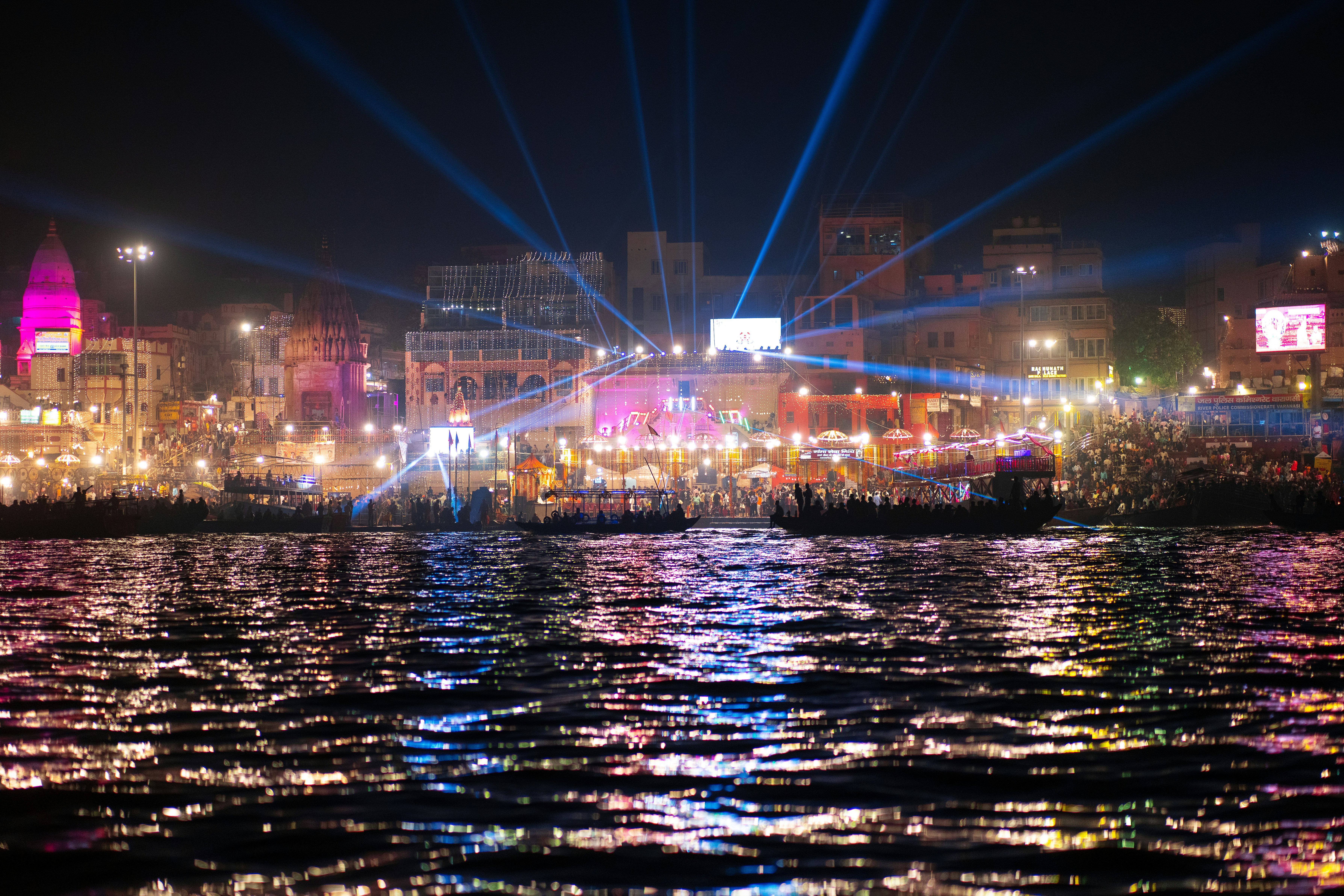
Stand at Dashashwamedh Ghat in Varanasi an hour before sunset on Kartik Purnima and you will not be able to find the steps. They are still there, somewhere under the feet and the baskets and the brass trays, but what you see is a slope of small clay cups, each with a wick, each waiting. Then the light goes out of the sky, and someone near the water touches a flame to the first one, and for the next few minutes the fire travels upward and sideways along the river in both directions until the whole curve of the Ganga from Ravidas Ghat to Rajghat is burning. More than a million lamps, by the count usually given. People set the smallest ones afloat in little leaf boats and watch until they tip.
Nobody lights those lamps for themselves. That is the heart of this night. On Diwali, a fortnight earlier, you light your doorway so that auspiciousness finds your house. On Kartik Purnima you light the riverbank because the tradition holds that the gods have come down to bathe here, and you are setting out lamps the way you would set out lamps for a guest arriving after dark. The name says it without embarrassment: Dev Deepawali — the Diwali of the gods.
When Is Kartik Purnima in 2026?
Kartik Purnima 2026 falls on Tuesday, 24 November 2026. The Purnima tithi — the lunar day of the full moon — begins at about 11:42 pm on 23 November and ends at about 8:23 pm on 24 November. Those timings are calculated for Ujjain, in Indian Standard Time, and that detail matters more than it looks.
A tithi is not a date. It is a stretch of time that begins and ends at a particular moment, and which civil day it belongs to depends on where you are standing when the sun comes up. If you are reading this in New Jersey, Leicester, Toronto or Melbourne, the Indian timings above do not travel to you unchanged. Your local observance may land a day either side of 24 November, and two temples in the same city sometimes settle on different days. Check a panchang calculated for your own city, or simply follow whichever temple you attend, and do not let the discrepancy trouble you — it is arithmetic, not error.
The run-up matters too. Prabodhini Ekadashi, when Vishnu is said to wake from the four-month Chaturmasya rest, falls on Friday, 20 November 2026 by one widely used reckoning, with the tithi running from the morning of the 20th into the early morning of the 21st; some almanacs print 21 November instead. The five days from that Ekadashi to the full moon are the most intense part of the whole month, and at Varanasi they are the span of the festival proper.
Why Kartik Is Called the Holiest Month
Kartik is the eighth month of the Hindu lunar year, falling across October and November, and it takes its name from the Krittika nakshatra — the star cluster near which the moon sits on this full moon. In the Vaishnava calendar the same month is called Damodara, one of Krishna’s names, and the devotional literature of the month is addressed to him.
Two practices define it. The first is Kartik snan, the daily bath before sunrise in a river, a lake or any sacred water, kept up for the whole month. The second is deepdan — not lighting a lamp for your own house but giving one away: floating it, or placing it at a shrine, or at the water, or in a tulsi courtyard. Month-long fasting, charity and the reading of Krishna’s story are folded in around them. Almanacs describe worship offered to any deity in Kartik as ultimately reaching Vishnu, which is one reason the month absorbs so many different observances without any sense of contradiction.
Inside it sits the Bhishma Panchak vrata, five days from Kartik Shukla Ekadashi to Kartik Purnima, kept with offerings of water and remembrance for Bhishma, the grandsire of the Mahabharata who lay on a bed of arrows and gave away his knowledge before he died. It is a fast about dying well, kept in the week of the brightest moon of the year, and the juxtaposition is deliberate.
What makes Kartik Purnima unusual is that it is simultaneously the great Vaishnava full moon and the great Shaiva one. The month belongs to Vishnu; the day is named for Shiva. Nobody in the tradition seems to have found this a problem.
The Legends Behind Kartik Purnima
The day carries more commemorations than any single text consolidates. Tradition attaches to it Shiva’s destruction of the three cities, Vishnu’s Matsya (fish) incarnation, the birth of Kartikeya, the appearance of Vrinda or Tulsi, and the worship of Radha and Krishna. These are not variants of one story competing for the slot. They are separate traditions that have each claimed the same bright night, and the honest way to describe Kartik Purnima is as a day with several unrelated reasons to be holy.
Shiva and the Three Cities: Tripurari Purnima
The best-known of them gives the day its other name. After Kartikeya killed the asura Taraka, Taraka’s three sons — Tarakaksha, Vidyunmali and Kamalaksha — undertook severe austerities and won a boon from Brahma. They asked first for immortality and were refused, then for indestructible fortresses and were refused again. At last they asked that their cities be destroyed only by a single arrow, reasoning that only Shiva could manage such a shot and that Shiva, whom they worshipped, would never take it. Brahma agreed.
The asura architect Mayasura built them three cities — iron in the underworld, silver on earth, gold in the heavens — together called Tripura. They moved independently and aligned only for a moment once in a thousand years, when the Pushya nakshatra stood with the moon. On the day of alignment the devas assembled a cosmic chariot for Shiva: the earth its body, the sun and moon its wheels, Brahma its charioteer, Mount Meru the bow, the serpent Vasuki the bowstring, Vishnu himself the arrow, Agni its tip and Vayu its fletching. Shiva smiled, and the three cities caught fire before he had drawn; Brahma begged him to loose the arrow anyway so the gods would not feel their preparations wasted. Afterwards Shiva danced over the ruins, and regretted having forgotten to spare Maya, who had been warned by Nandi and had already slipped away. The gods, released, declared the day a festival of lights. Hence Tripurari Purnima or Tripuri Purnima, and hence Shiva’s title Tripurantaka, ender of the three cities.
That is the Puranic telling — the fullest version belongs to the Padma Purana, and versions circulate in other Puranas with the details rearranged; some seat Parvati in the chariot. It is worth knowing that a much older and much barer form of the story sits in the Yajurveda, at Taittiriya Samhita vi.2.3. There the three citadels of iron, silver and gold are simply there — no sons of Taraka, no boon, no Maya, no architect. Agni is the arrowhead, Soma the socket, Vishnu the shaft, and Rudra is reluctant to shoot until he is granted lordship over animals. The myth grew; it did not arrive finished. Telling it with its layers visible is more faithful than telling it smooth.
In sculpture, Tripurantaka is carved as a four-armed archer, trident and damaru in the upper hands, the Pinaka bow drawn in the lower two. The earliest known form of the image is at Pattadakal (Badami Chalukya, sixth to seventh century); it recurs at the Kailasanatha temple at Ellora, at Balligave, in the Hoysala carvings at Javagal and Hosa Holalu where the three cities start to appear as three stacked rings, and in the Vijayanagara murals at the Virupaksha temple in Hampi.
Dev Deepawali at Varanasi
Varanasi is where the day has become spectacle. The belief is simple and old: on this full moon the gods descend to bathe in the Ganga, and the city lights the water for them.
The modern form of the festival is younger than most visitors assume. The lamp-lighting at Dashashwamedh Ghat was begun in 1991 by Pandit Kishori Raman Dubey, known as Babu Maharaj, and spread along the river from there. It now runs five days, from Prabodhini Ekadashi to Kartik Purnima, and coincides with the final day of the Ganga Mahotsav, the city’s five-day cultural festival. The evening aarti at Dashashwamedh is performed by twenty-one young priests and twenty-four young women with hymns, drums and conches. Nearly a hundred thousand pilgrims come to the riverfront. Wreaths are laid at the Amar Jawan Jyoti at Dashashwamedh for the war dead, and the closing ceremony includes a last post by the armed forces and sky lanterns.
If you are going: book months ahead, expect the lanes to be closed to vehicles, and know that a boat gives you the long view of the lit ghats while the steps give you the crowd and the sound. Both are worth having, and only one of them is quiet.
Karthikai Deepam and the Beacon on Arunachala
In Tamil Nadu the lamp festival of this season has its own name, its own reckoning and its own mountain. Karthikai Deepam falls on the full moon of the Tamil month of Karthigai when that day carries the Krittika nakshatra. Because the Tamil calendar is solar and corrects differently, it usually lands on a different day from the northern Kartik Purnima — in 2025 the two were two days apart. In 2026 they coincide: published calendars give 24 November 2026 for Karthikai Deepam as well. Confirm with the temple before you travel, because the Arunachaleswarar administration fixes its own schedule each year and the ten-day Brahmotsavam dates move with it.
At Tiruvannamalai, the Bharani Deepam is lit in the sanctum before dawn on the final day; five lamps are kindled from one flame, and that flame is later carried out of the temple as the signal for the Maha Deepam — a copper cauldron of ghee with an enormous wick, lit at dusk on the summit of Arunachala and visible for many kilometres. It burns for days. Devotees walk girivalam, the fourteen-kilometre barefoot circuit of the hill, while it is alight. Several million people are reported to attend, in a town of roughly 150,000: book far ahead, arrive a day early, carry water and a torch, and agree a meeting point, because phone networks fail under that load. Climbing the hill itself requires a limited day pass.
The legend here is the Shiva Purana’s account of the pillar of fire. Brahma and Vishnu argued over which of them was supreme, and Shiva appeared between them as a jyotirlinga, a column of light running through the three worlds. Vishnu, as a boar, searched for its base, failed, and said so. Brahma, as a swan, searched for its summit, failed, and persuaded a ketaki flower to lie for him. Shiva honoured the honesty and cursed the lie. The Maha Deepam is that column, lit once a year on a real hill. Local tradition also connects the evening to Ardhanarishvara, Shiva taking Parvati into himself. The Kanda Purana links the festival instead to the birth of Kartikeya and the Krittikas who raised him. In Kerala the day is Thrikarthika and honours Parvati, with lamps after sunset dressed in coconut and mango leaves, special food, and offerings made to cattle.
Kartik Purnima Across India
India is not one observance, and this day proves it better than most.
Odisha. Kartik ends on this full moon, and with it a month in which many Odia households are strictly vegetarian; the final five days are the Panchuka. On the morning of Kartik Purnima people perform Boita Bandana, setting miniature boats of paper, banana bark or cork afloat at dawn in memory of Kalinga’s old sea trade with Java, Bali and Sumatra. The day after is Chhada Khai, the return to a non-vegetarian diet, though which day a family keeps it varies.
Andhra Pradesh and Telangana. Lamps are lit every evening through the Karthika month, and on the full moon Shiva temples light 365-wick lamps — one wick for each day of the year.
Pushkar, Rajasthan. The Pushkar Fair builds from Prabodhini Ekadashi and peaks on Kartik Purnima, when pilgrims bathe in the lake and worship at what is widely described as the only major Brahma temple in the world. The fair’s own site gives 17 to 24 November 2026, while describing the fair variously as five days and a week, so treat the span as approximate. Roughly 200,000 people and 25,000 camels, by the usual figures.
Sonepur, Bihar. The Harihar Kshetra cattle fair at Sonepur traditionally opens on Kartik Purnima and runs for about a month. Reports for 2026 name a start in the final week of November, but this is one to confirm with Bihar Tourism rather than a travel blog; opening dates in recent years have been announced close to the event.
Sikh observance. Guru Nanak Gurpurab is kept on Kartik Purnima, and most published calendars give 24 November 2026; a few list 25 November, so check with your gurdwara. It is worth knowing that the date is itself contested within Sikh scholarship: older Sikh sources generally place Guru Nanak’s birth in Vaisakh, in April, and the Kartik observance is reported to have been established during Maharaja Ranjit Singh’s reign. The commemoration is real and ancient in practice; the month is a historical question, and a Hindu writer has no business settling it.
Jain observance. Jain pilgrims walk to the Shatrunjaya hills at Palitana in Gujarat on this day, a journey of some 216 kilometres, to worship at the Adinath temple. Some sources also attach a Mahavira commemoration to this full moon, while the nirvana of Mahavira is far more commonly placed on the Diwali new moon; the two should not be conflated.
How to Keep Kartik Purnima at Home
The classical prescriptions for the day are unusually concrete. Bathe before sunrise. Offer lamps. Give something away — the texts name cows, food and gold, which translates without much strain into a meal, a donation or an hour. Fast, or eat simply and once. And abstain: the day carries explicit prohibitions on violence, including cutting hair, felling trees and sexual activity. Whatever you make of each item, the shape of the instruction is clear. For one day you take nothing and cut nothing.
Away from a river, the practice adapts without losing much. A bucket, a tap, a few drops of any water you consider sacred, said over with attention, is a bath; the texts care about the intention and the hour, and the hour is available everywhere. For the lamps, the one thing worth protecting is that they are given rather than kept — place them where someone else will see them, at a temple, a shared doorway, a windowsill facing the street. Where open flame is not allowed, use what is allowed; nobody in the tradition held that the merit was in the fire hazard. And if you want the specifically Kartik shape of the practice, do the five days from the Ekadashi rather than the single night: a bath, a lamp given away, a simple meal and ten minutes of reading, five evenings running. It is a small enough commitment to actually complete, which is the main thing.
Why This Festival Still Matters
Kartik Purnima is the one major lamp festival in the Hindu year that is not about your own prosperity. Diwali asks for Lakshmi; this night offers light to someone else and keeps nothing back. A fortnight after the loudest, most acquisitive festival on the calendar, the tradition puts a month of early baths, plain food and given-away lamps — and then a full moon on which the instruction is explicitly to take nothing and harm nothing.
Read as a piece of design, that sequence is remarkable. It assumes you will overdo Diwali. It builds the correction into the calendar rather than into a sermon. And the correction is not guilt; it is a month of small, physical, repeatable acts, ending in a night of shared light. The Mahabharata’s dying grandsire sits in the middle of it, giving away everything he knows because he can no longer hold it. The Tripura story is about three cities that could only be destroyed once they finally lined up — which is a fair description of how most things in a life actually come apart, and of how rarely the moment is announced.
And the lamp you float is going to tip over. Everyone knows this. You float it anyway, and watch it as far as it goes. That is not a lesson about impermanence so much as a rehearsal of it: a small, pretty, deliberate practice in letting a thing you made go out on water you do not control.
Kartik Purnima FAQ
What is Kartik Purnima and why is it celebrated?
Kartik Purnima is the full moon day that closes the lunar month of Kartik, about a fortnight after Diwali. It is celebrated for several reasons at once: Shiva’s destruction of the three cities of Tripura, Vishnu’s Matsya incarnation, the birth of Kartikeya, the appearance of Tulsi, and the belief that the gods themselves descend to bathe in the Ganga. It is marked with a pre-dawn bath, the offering of lamps, charity and fasting.
What is the difference between Diwali and Dev Deepawali?
Diwali falls on the new moon and is lit for the household — Lakshmi, Rama’s return, the year’s fortune. Dev Deepawali falls on the next full moon, fifteen days later, and the lamps are offered to the gods and to the river rather than kept at home. Diwali is a family festival that spills outward; Dev Deepawali, especially at Varanasi, is a public one centred on water.
Is Kartik Purnima the same as Karthikai Deepam?
They are closely related but separately reckoned. Karthikai Deepam is fixed by the Tamil solar calendar — the Karthigai full moon carrying the Krittika nakshatra — and usually falls on a different day from the northern Kartik Purnima. In 2026 both are given as 24 November, which is a coincidence of the two calendars rather than the rule.
What should you do on Kartik Purnima?
The traditional observance is a bath before sunrise in a river or other sacred water, the offering of lamps at a shrine or on water, charity, a simple or single meal, and abstention from violence of any kind for the day — which classically includes cutting hair and felling trees. Away from a river, the bath and the lamp both adapt; the giving away of the lamp is the part worth keeping intact.
Why is Guru Nanak Jayanti on Kartik Purnima?
Sikhs keep Guru Nanak’s Prakash Parva on this full moon, and in 2026 most calendars give 24 November. The month is debated: older Sikh sources generally place his birth in Vaisakh (April), and the Kartik observance is reported to have been established under Maharaja Ranjit Singh. The two accounts coexist, and Sikh institutions are the right authority on it.
Do Kartik Purnima timings apply outside India?
No. Tithi timings are calculated for a specific city — the ones in this post are for Ujjain in IST — and because a tithi begins and ends at a moment rather than at midnight, the local observance date in the US, UK, Canada or Australia can fall a day either side. Use a panchang computed for your own city, or follow your local temple, and accept that temples in the same city sometimes differ.
A Closing Thought
There is a particular quality to a riverbank with a million lamps on it, and it is not grandeur. It is the sense of a great many people having each brought one small thing. Nobody at Dashashwamedh lit more than a handful. The effect belongs to none of them and all of them, and by morning the clay cups are swept up and the river is just a river again.
That is probably the right way to hold this festival. Kartik asks for nothing dramatic — a bath in the dark, a plain meal, a lamp you do not keep. Then one night when the whole thing is lit at once, and you see what the small repeated acts of a lot of ordinary people add up to. Then it goes out, and the month turns, and the practice begins again next year.
Continue Exploring
- Significance of Diwali: The Spiritual Meaning of the Festival of Lights
- Why We Light Diyas on Diwali: The Meaning of the Lamp
- Who Is Lord Shiva? The Story, Symbolism and Worship of Mahadeva
- Kashi and Its Significance for Hinduism
- Kashi Vishwanath Temple: The Jyotirlinga at the Heart of Shiva’s Own City