On the morning it was supposed to happen, Ayodhya had already been decorated. Banners were up. Musicians were waiting. The eldest son of King Dasharatha was to be crowned before the day was out, and the city had not slept.
By evening he was walking out of the gate in bark cloth, with a bow and almost nothing else, for fourteen years.
What makes the moment unforgettable is not the reversal. It is what he does with it. His father is too broken to speak the words himself. A junior queen, Kaikeyi, has called in two old boons at exactly the right moment. Rama is a trained warrior, publicly acclaimed, with an army that would have followed him. He asks no questions, mounts no argument, blames no one, and goes. When his brother Lakshmana rages, it is Rama who calms him down.
Hinduism has gods who overwhelm you. Shiva dissolving the universe in a dance. Krishna opening his mouth in the eleventh chapter of the Gita until Arjuna begs him to stop. And then it has Rama, who is worshipped for something much harder to depict and much harder to do: keeping his word when keeping it cost him everything he had. That is why the tradition calls him Maryada Purushottama — maryada meaning the proper limit, the line one does not cross, and purushottama meaning the highest among persons. The best man, precisely because of where he drew his lines.
Who Is Lord Rama? The Short Answer
Rama is the prince of Ayodhya, the hero of the Ramayana, and the seventh avatara (a descent of God into the world) of Vishnu. He is worshipped across India and much of Southeast Asia, by hundreds of millions of people, in three overlapping ways at once: as a historical-feeling king who ruled justly, as God himself taken human shape, and as the model of a life lived inside its obligations.
He is also, for a very large number of Hindus, the name you say rather than the figure you theorise about. Ram is the name murmured at a cremation, written on a shop ledger, used as a greeting, and chanted as a one-word meditation. The 394th name of Vishnu in the Vishnu Sahasranama is Rama — and the tradition that loves that text most says that this single name is worth all of the other nine hundred and ninety-nine.
The Name: What “Rama” Actually Means
The word comes from the Sanskrit root ram-, which carries a cluster of meanings: to stop, to come to rest, to be pleased, to delight in. A reasonable rendering is “the one in whom the mind comes to rest.”
There is a second, older sense worth knowing. In the Atharva Veda, as Monier-Williams records it, rama means dark or black. This fits the iconography, where Rama is painted dark, deep blue, or black rather than fair — a detail that modern poster art has largely erased.
His epithets each tell you something. Ramachandra, lovely as the moon. Dasarathi, son of Dasharatha. Raghava, descendant of the ancestor Raghu — hence the whole line being called Raghuvamsha. Kodandapani, holder of the Kodanda bow. And across Asia the name travels and changes shape: Phra Ram in Thai and Lao, Phreah Ream in Khmer, Megat Seri Rama in Malay, Ramudu in Telugu.
Where Rama’s Story Comes From
This matters more than it sounds, because the single commonest mistake about Rama is to treat “the Ramayana” as one fixed book. It never has been.
The Valmiki Ramayana
The oldest surviving telling is attributed to the sage Valmiki: roughly 24,000 verses in about 500 sargas (cantos), arranged in seven kandas (books). Dating it is genuinely contested. Robert Goldman places the probable oral composition between about 750 and 500 BCE, arguing the core was likely in place by the sixth or fifth century BCE. John Brockington puts the first stage around the fifth to fourth century BCE, with later stages continuing into the third century CE. Nobody serious claims a single author on a single occasion.
The text also exists in distinct recensions — broadly a northern and a southern transmission, which diverged over centuries of separate oral handing-down. A critical edition was assembled in the 1960s and 1970s at the Oriental Institute of Maharaja Sayajirao University of Baroda from dozens of manuscripts, and Robert Goldman completed an English translation of it in November 2016.
The Later Layers
Scholars including Hermann Jacobi have long argued that the first book (Bala Kanda) and the last (Uttara Kanda) are later additions to an original poem that ran from Books 2 to 6 — on grounds of style, internal contradiction, and the fact that both are absent from the oldest manuscript. Goldman and Sally Sutherland Goldman hold that the original poem ended with the Yuddha Kanda, the war book.
This is not a marginal technicality. The Bala Kanda is where the gods petition Vishnu to be born as a man, which is to say it is where Rama becomes explicitly divine. And the Uttara Kanda contains the episodes that trouble readers most. Honest writing about Rama has to say that these books sit on a different footing from the core — and also that they have been read, loved and preached as scripture for many centuries, which gives them an authority of their own. Not everyone accepts the interpolation argument; some scholars defend the Uttara Kanda as original. The disagreement is real and unresolved.
Tulsidas, and the Ramayanas in Every Language
For most Hindus in North India, the Rama they know comes not from Valmiki’s Sanskrit but from Tulsidas’s Ramcharitmanas, composed in Awadhi in the sixteenth century. It is not a translation. It is a devotional retelling in which Rama is unambiguously God and the emotional centre is love rather than duty.
And Tulsidas is one of dozens. Kamban’s Ramavataram in Tamil (twelfth century), the Ranganatha Ramayanam in Telugu (around 1300), Madhava Kandali’s Saptakanda Ramayana in Assamese (fourteenth century), Krittibas Ojha’s version in Bengali (fifteenth century), Eknath’s Bhavartha Ramayana in Marathi, Ezhuttachan’s Adhyatma Ramayanam Kilippattu in Malayalam, Bhanubhakta Acharya’s in Nepali. Add the Adhyatma Ramayana, a late medieval Sanskrit text embedded in the Brahmanda Purana with about 4,500 verses across 65 chapters, which reads Rama straightforwardly as Brahman, the absolute. Add the Yoga Vasistha, a vast philosophical dialogue between Rama and the sage Vasistha.
Then go outside India: the Kakawin Ramayana in Java (around 870 CE), the Ramakien in Thailand, the Hikayat Seri Rama in Malaysia, the Yama Zatdaw in Myanmar, versions in Cambodia, Laos and the Philippines. There are Buddhist versions — the Dasaratha Jataka, tale 461, with no abduction at all — and Jain versions, where Rama is called Padma, is the eighth balabhadra among the sixty-three illustrious beings, and ends his life as a monk rather than as an incarnation of Vishnu. Vimalasuri’s Paumacariya is the key Jain text, dated by Winternitz to the second half of the first century CE.
The useful attitude here is the one scholars like Paula Richman and A. K. Ramanujan have urged: each of these is true within the tradition that tells it. Asking which is the “real” Ramayana is the wrong question.
The Life of Rama
Birth and Ayodhya
Rama is born in Ayodhya, on the river Sarayu, in the kingdom of Kosala, to King Dasharatha and his queen Kausalya. The line is the Suryavamsha or Ikshvaku dynasty — the solar dynasty — also called Raghuvamsha after Raghu. In the telling, Dasharatha performs a sacrifice, receives a divine offering of rice and milk, and divides it among his queens: Kausalya bears Rama, Kaikeyi bears Bharata, and Sumitra bears the twins Lakshmana and Shatrughna. Rama is educated in the Vedas, the Vedangas and the martial arts.
Mithila and the Bow
At the court of King Janaka in Mithila, the condition for marrying the princess Sita is to string an enormous bow of Shiva’s. (Its name varies between tellings — Pinaka in some, Ajagava in others.) Rama strings it and it breaks. On the journey home, the fierce sage-warrior Parashurama — himself counted as Vishnu’s sixth avatar — intercepts him and challenges him to string Vishnu’s own bow, the Sharnga. Rama does, and Parashurama withdraws. It is a neat bit of narrative theology: the previous avatar hands the weapon to the next.
In South India that bow is called the Kodanda, which is why one of Rama’s loveliest temples, at Vontimitta in Andhra Pradesh, is the Kodandarama temple.
The Exile
Kaikeyi demands fourteen years of exile for Rama and the throne for her son Bharata. Rama goes to the Dandaka forest; Sita and Lakshmana refuse to be left behind. Bharata, when he learns what has been done in his name, refuses to be king and rules as a regent in waiting.
The forest years are where the Ramayana does its quietest and best work — Chitrakuta, the hermitages, the old tribal devotee Shabari whose half-eaten berries Rama accepts, Panchavati. Then Ravana’s sister Shurpanakha appears, the encounter turns violent, and Ravana — king of Lanka — carries Sita away, having lured Rama off with the demon Maricha disguised as a golden deer.
Lanka and the War
What follows is one of the great friendship stories. Rama, with no army and no kingdom, allies with the exiled vanara prince Sugriva, and through him meets Hanuman, Sugriva’s minister, who will become the most beloved devotee in all of Hinduism. Hanuman crosses to Lanka, finds Sita, and — in the Sundara Kanda — describes Rama to her so that she will believe he was really sent. The war is fought. Ravana is killed.
The Return, and What Came After
Rama returns to Ayodhya and is crowned. The lamps lit for that homecoming are one of the stories behind Diwali. His reign becomes the byword for good government: Ram Rajya.
But the story does not stop at the coronation, and this is where it becomes difficult. Rumours circulate about Sita’s time in Lanka. Rama asks her to prove her chastity before fire — the agni pariksha. She does. In the Uttara Kanda she is nonetheless exiled, bears the twins Lava and Kusha in Valmiki’s own hermitage, and the ending is sombre. Versions diverge sharply here. Some revisions have Sita die of grief and Rama walk into the Sarayu. The Burmese Thiri Rama has him rise as a six-armed Vishnu. The tradition has never settled on one ending, and it is more honest to say so than to pick.
Rama as Avatar: The Seventh Descent
In the standard reckoning of the Dashavatara, the ten descents of Vishnu, Rama is the seventh, following Parashurama and preceding Krishna. He is classed as a purnavatara, a complete descent, as opposed to the partial manifestations.
The theological logic given in the Bala Kanda is specific and worth understanding: Ravana has a boon that makes him invulnerable to gods, so Vishnu must take birth as a human being to kill him. The constraint is the whole point. Rama does not fight as a god slumming it in a body. He fights with human limits, including grief, doubt and bad information, and the tradition treats those limits as the source of his moral authority rather than an embarrassment.
Some Vaishnavas go further and regard Rama as Para Brahman, the absolute itself. Three Vaishnava Upanishads take him as their central figure: the Rama Rahasya, the Rama Tapaniya and the Tarasara.
The Ramanandi Sampradaya, founded by the fourteenth-century saint Ramananda, is the main monastic vehicle of Rama devotion — and a remarkable institution. Of fifty-two recorded sub-branches of Vaishnavism across the four sampradayas, thirty-six are Ramanandi, and its ascetic wing may well be the largest monastic order in India. It follows Vishishtadvaita philosophy, worships Rama and Sita as the supreme reality and not as different from one another, and is among the most egalitarian of Hindu orders. Its initiates receive the Ram Taraka mantra whispered into the ear and wear the upward-pointing urdhva pund tilak.
Two cautions. Scholars disagree about Ramananda’s own position on caste — J. N. Farquhar found no evidence he set out to overturn caste as an institution, while Sita Ram and George Grierson read him as trying to transcend it through love and equality. And whether the Ramanandi line descends from Ramanuja is disputed; Farquhar found the two unconnected, others found a link, and a famous debate at the 1921 Ujjain Kumbh concluded they were one tradition. Treat the question as open.
Beyond Hinduism: in Sikh tradition Rama appears as the twentieth of twenty-four avatars in the Chaubis Avtar of the Dasam Granth.
The Symbolism: Bow, Blue Skin, Four Brothers
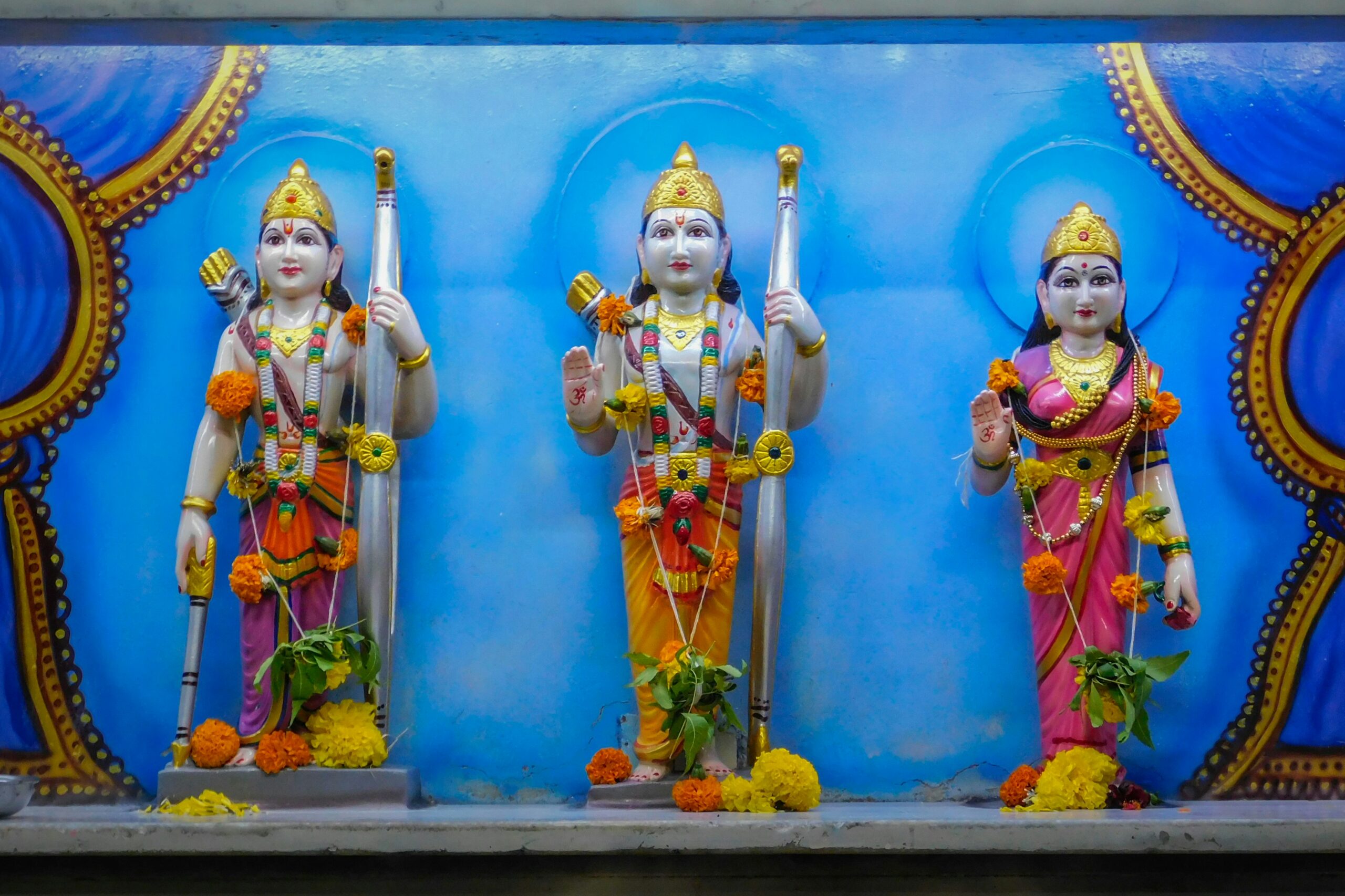
Rama’s iconography is unusually restrained. Where Durga has ten arms and Vishnu four, Rama has two: an arrow (bana) in the right hand, the bow (dhanus) in the left. He stands in tribhanga, the thrice-bent pose, or in the straighter dvibhanga and abhanga. His skin is dark, blue or black; his clothing is usually reddish.
The standard group, the Rama Darbar, arranges the family as a tableau of right relationship: Sita at his right, Lakshmana at his left, both golden-yellow, and Hanuman nearby with folded hands. Nobody is doing anything. That is the point — this is a picture of a household in order, which is the closest thing Hinduism has to an icon of dharma as a lived arrangement rather than an abstraction.
The bow carries most of the symbolic weight. Unlike Shiva’s trident or Durga’s sword, a bow is a weapon of distance and restraint: it requires stillness, aim and the decision not to release. Devotional readings make much of this, and reasonably so. The four brothers are read as four temperaments held in one family — Rama’s steadiness, Lakshmana’s heat, Bharata’s renunciation, Shatrughna’s quiet service. These readings are interpretive rather than scriptural, and worth enjoying as such.
Ram Rajya: The Benchmark That Won’t Go Away
Both Valmiki and Tulsidas describe Rama’s reign as the standard against which government is measured: no hunger, no fear, no injustice, no one left out. Ram Rajya has stayed in Indian political vocabulary ever since, used by very different people to mean very different things. It is best understood as a moral yardstick rather than a policy programme — and the Ramayana itself is not naive about it, since it is precisely the king’s obligation to public opinion that destroys his marriage.
Major Temples of Rama
Rama temples are fewer and generally later than Shiva or Devi temples, which tells you something about how his worship grew.
- Ram Mandir, Ayodhya — the Ram Janmabhoomi temple. The infant form, Ram Lalla or Balak Ram, was consecrated in January 2024. The Dhwajarohan, the hoisting of the saffron Dharma Dhwaj atop the 161-foot spire, was performed on 25 November 2025, marking the completion of the temple’s structural construction. The flag, 22 by 11 feet on a 42-foot pole, carries a stylised Sun for the solar dynasty, the syllable Om, and a Kovidara tree as a symbol of shelter and the continuity of dharma.
- Rajiva-locana Temple, Rajim, Chhattisgarh — the oldest surviving Rama temple, seventh century, restored around 1145 CE. Far less visited than it deserves.
- Bhadrachalam, Telangana — on the Godavari, associated with the saint-composer Bhadrachala Ramadasu; one of the great centres of Rama bhakti in the south.
- Kodandarama Temple, Vontimitta, Andhra Pradesh — a magnificent Vijayanagara-era complex.
- Ramaswamy Temple, Kumbakonam, Tamil Nadu — known for painted Ramayana cycles on its walls.
- Kalaram Temple, Nashik, and Raghunath Temple, Jammu.
- Sitamarhi, Bihar and Janakpur, Nepal — Sita’s side of the story, and major pilgrimage centres in their own right.
Rama temples also anchor diaspora communities, from Singapore to Trinidad and Tobago, Guyana, Suriname, Mauritius, Fiji and Durban.
Festivals of Rama
Rama Navami is the principal one: the ninth day of the bright fortnight (shukla paksha) of Chaitra, usually falling in March or April, and part of the spring Chaitra Navaratri. Observance includes fasting, Ramayana recitation — many households read the whole text in the preceding week — processions, community meals, and kalyanotsavam, a ceremonial re-enactment of Rama and Sita’s wedding. In Karnataka, panaka, a jaggery-and-pepper drink, is distributed free; in Bengaluru the Sree Ramaseva Mandali hosts a month-long classical music festival around it. At Ayodhya since 2024 a Surya Tilak has been engineered so that a ray of sunlight falls on the deity’s forehead at noon.
Vivaha Panchami marks the wedding itself and is celebrated most intensely at Janakpur in Nepal. Secondary sources place it on 14 December in 2026; confirm against your own panchang before making plans.
Vijayadashami or Dussehra marks the victory over Ravana and closes the autumn Ramlila cycle — a dramatic retelling of the Ramcharitmanas that UNESCO recognised in 2008 as intangible cultural heritage. And Diwali celebrates the homecoming.
A caution that applies to all of these: a tithi begins and ends at a particular moment in a particular place. Dates and muhurats published for Indian cities do not transfer to the United States, the United Kingdom, Canada or Australia, where the local observance can fall a day earlier or later and temples in the same city sometimes differ. Check a local panchang.
Mantras and the Practice of Rama Nama
Rama devotion is unusually simple to begin, because its central practice needs no initiation, no equipment and no Sanskrit.
- Ram — the name alone, repeated. In the phalashruti of the Vishnu Sahasranama, Shiva tells Parvati that this one name equals the thousand.
- Sri Rama Jaya Rama Jaya Jaya Rama — the thirteen-syllable Taraka mantra. The root tri means to cross over, so the name is understood as the ferry. It was carried by a remarkable line of singers and saints: Tulsidas, Bhadrachala Ramadasu, Samartha Ramdas, Tyagaraja, Purandara Dasa, Gondavalekar Maharaj. Gandhi used it as his daily chant.
- Om Sri Ramaya Namah — a standard formal invocation.
- Jai Shri Ram and Jai Siya Ram — greetings rather than mantras. The second includes Sita, and in much of North India it is the older and gentler of the two.
The Rama Tapaniya Upanishad builds a mantra practice on Rama understood as Atman and Brahman — the self and the absolute, not a figure outside you.
The Hard Questions
A site that tells you only the pleasant parts is not being reverent; it is being evasive. Three episodes are genuinely difficult, and Hindus have argued about all three for a very long time.
Sita’s trial. That Rama put his wife to a public test of chastity, and in the Uttara Kanda exiled her while pregnant, is the oldest and sharpest criticism of him from inside the tradition. Defences exist — that he acted as king rather than husband, bound by a ruler’s duty to be above suspicion, and that he never remarried and had her golden image beside him. They are not fully satisfying and many devotees do not find them so. The episode’s textual home in the layer most likely to be later is worth knowing. So is the fact that regional Ramayanas handle it very differently, and that some traditions and tellings make Sita the moral centre and Rama the one who failed.
Shambuka. In the Uttara Kanda, Rama beheads a Shudra ascetic for performing austerities. This episode has been cited against the Ramayana by Ambedkar in Annihilation of Caste (1936) and by Periyar, and it is well known among communities that identify with Shambuka. Tagore and Gandhi both treated the character as a later creation; the Uttara Kanda’s status makes that argument available but does not settle it. The responses in Indian literature are themselves a tradition: Bhavabhuti’s seventh-century Uttararamacarita shows a Rama full of regret, and Kuvempu’s Kannada Shudra Tapasvi (1944) has Shambuka survive. Whatever one concludes, no reading of dharma available today can defend killing someone for praying.
Shurpanakha. Lakshmana’s mutilation of her is brutal, and Valmiki does not soften it. Paula Richman notes the social value the episode is in tension with — that a warrior must never harm a woman.
It is worth setting against all of this a line from Valmiki’s own war book, 6.115: a superior being does not return evil for evil. The text contains its own standard, and some of the episodes fall short of it. Holding both facts at once is the adult way to read an epic.
Why Rama Matters Today
The useful thing about Rama is not that he is a nice man in a long story. It is that he is the tradition’s sustained argument about a specific and very modern problem: what to do when every available option is a betrayal of something you owe.
Rama’s choices are almost never between good and evil. They are between a promise to his father and his duty to a kingdom; between his wife’s dignity and a king’s obligation to public confidence; between his brother’s advice and his own word. This is what ordinary moral life actually looks like — not villains, but competing obligations with no clean exit. Krishna in the Gita gives you the philosophy of that situation. Rama gives you a whole life lived inside it, including the parts where it goes wrong.
Three things worth taking from him in practice. First, that a commitment made when it was easy is tested only when it becomes expensive, and that the testing is the commitment. Second, that maryada — the self-imposed limit — is a form of freedom rather than a cage; a person with clear lines spends almost no energy deliberating. Third, and least comfortable, that being good at your duties is not the same as being right, which is a thing the Ramayana itself seems to know about its own hero.
And if none of that interests you, there is still the name. The simplest practice in Hinduism is also the one most saints came back to: one syllable, repeated, until the mind in which it rests becomes quiet. Ram.
Frequently Asked Questions
Is Lord Rama a god or a human being?
Both, and the sequence matters. In the oldest core of the Ramayana he is a human prince of exceptional virtue; the explicit identification with Vishnu is clearest in the Bala Kanda, which many scholars consider a later addition, and becomes central in the Puranas and in Tulsidas. Theologically most Hindus hold that he is God taken fully human form, deliberately accepting human limits. Devotionally he is worshipped as God without reservation.
Which avatar of Vishnu is Rama?
The seventh of the ten in the standard Dashavatara list, between Parashurama and Krishna. He is classed as a purnavatara, a complete descent.
Did Rama really exist?
There is no scholarly consensus and the honest answer is that we do not know. Some Hindu texts place him in the Treta Yuga, before roughly 5000 BCE; the archaeologist H. D. Sankalia called that “pure speculation” and suggested any underlying events would fall between 1500 and 700 BCE. Whether modern Ayodhya is the Ramayana’s Ayodhya is itself debated, though the Dhanadeva inscription there dates to the first century BCE. Many historians read Rama as a composite figure gathering up older ideals. For most devotees the question is not the one that matters.
Why is Rama shown with blue or dark skin?
Partly because the word rama itself means dark in older Vedic usage, and partly because dark or blue skin marks Vishnu and his avatars across Indian art, suggesting the colour of deep water and of the infinite. The fair-skinned Rama of modern calendar prints is a recent commercial convention, not a textual one.
What is the difference between the Valmiki Ramayana and the Ramcharitmanas?
Valmiki’s is the Sanskrit original, far older, and reads as epic — Rama is a man of extraordinary virtue facing impossible choices. Tulsidas’s sixteenth-century Awadhi Ramcharitmanas is a devotional retelling in which Rama is God from the first line and the governing emotion is love. They differ in episodes, in emphasis and in tone, and most North Indian households know the second far better than the first.
What is the simplest way to begin worshipping Rama?
Repeat the name. “Ram,” or “Sri Rama Jaya Rama Jaya Jaya Rama,” needs no initiation, no priest and no ritual apparatus, and the saints who did it most are the ones the tradition trusts most. If you would like more structure, reading a few verses of the Ramcharitmanas or the Ramayana daily, and keeping Rama Navami as a fast, is the usual household pattern.
A Closing Thought
What stays with you about Rama, in the end, is not the war. It is the walk out of the gate — a young man who had everything, giving it up in an afternoon because a word had been given, and keeping his temper while he did it.
The tradition did not call him the strongest or the wisest. It called him the one who kept to the line. That is a quieter thing to admire, and a much harder one to imitate, which may be exactly why the name has outlasted every empire that ever flew it on a flag.
Continue Exploring
- Introduction to the Ramayana: Story, Characters and Meaning
- The Seven Kandas of the Ramayana Explained
- Valmiki vs Tulsidas Ramayana: Key Differences Explained
- Sankatmochan Hanuman Ashtak: Translation and Meaning
- How to Chant the Vishnu Sahasranama