
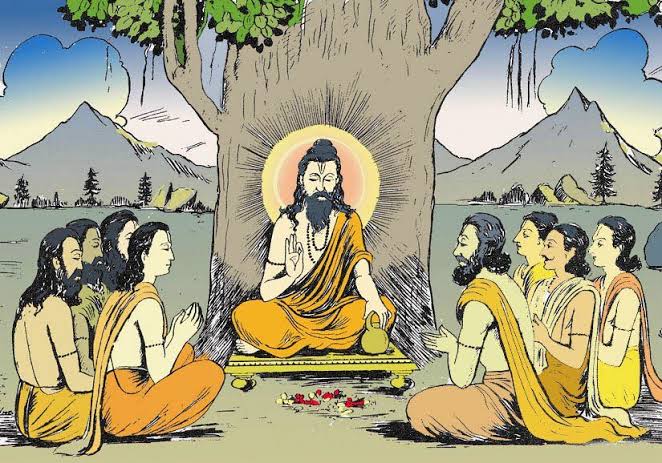
A boy walks up to a sage and asks to be taken as a student. The sage asks the question any teacher of that era would ask: what is your lineage?
The boy does not have an answer. He has already asked his mother, and she told him the truth — that in her youth she had served many people, moved about a great deal, and did not know who his father was. She said: I have only you and you have only me. Call yourself Satyakama Jabala, after my name.
He repeats all of this to the sage. Standing in front of the one man who can admit him or turn him away, with every incentive to invent a respectable grandfather, he says he does not know who his father was.
The sage, Haridrumata Gautama, accepts him on the spot — and the reason he gives is the reason the story survived. Only a brahmana, he says, could speak like that. The honesty was the qualification.
The story sits in the fourth chapter of the Chandogya Upanishad (4.4 to 4.9), and it is as good an introduction as exists to what Indians mean by guru-shishya parampara — the lineage of teacher and student. Notice what is not in it. No fee. No entrance test. No credential. One person looking at another and deciding whether there is something there worth pouring into.
What Guru-Shishya Parampara Actually Means
The phrase has three parts, and all three are worth unpacking because the popular versions of each are slightly wrong.
Guru — and a correction worth making
You will hear, constantly, that guru breaks into gu meaning darkness and ru meaning remover: the one who dispels darkness. It is a beautiful gloss and it is almost certainly not the word’s origin.
The actual Sanskrit sense of guru as an adjective is heavy, weighty, grave, venerable. It is cognate with Latin gravis and Greek barys, both meaning heavy, from a shared Proto-Indo-European root. A guru is someone of weight — a person whose presence has mass, who is substantial rather than light. Some etymologists additionally connect it to gri, to invoke or praise, or gur, to raise or lift up.
The darkness-dispelling reading comes from the Advayataraka Upanishad (verse 16: “the syllable gu means darkness”) and is repeated in the Guru Gita, with Panini’s Dhatu Patha cited in support. Scholars treat it as a devotional folk etymology rather than a historical derivation — Reender Kranenborg says plainly that darkness and light have nothing to do with the word, while Karen Pechilis notes how thoroughly the “dispeller of darkness” sense has entered popular Indian usage, and Joel Mlecko reports it as the tradition’s own understanding.
Both readings are worth keeping, for different reasons. The folk etymology tells you what the tradition believes a guru does. The real one tells you something subtler and arguably better: that the qualification is not brilliance but weight. Gravity. The quality of having actually been somewhere.
Shishya
A shishya is the one who is taught, from a root meaning to instruct or to discipline. Related words shade the meaning differently: shramana, one who exerts themselves, and chela, a follower. Note that none of them means “customer.”
Parampara
Parampara is the word that carries the weight of the whole system. It means an uninterrupted row or series — succession, continuation, handing-on. Not a school of thought, which is a sampradaya, an established parampara. Parampara is the chain itself: the fact that what you were taught was taught to your teacher, by someone, who was taught by someone.
This is not a decorative claim. In a tradition with no printing press, no library and no standardisation, an unbroken line of people was the only error-correction mechanism available. The Bhagavad Gita makes the point explicitly at 4.2 — evam parampara-praptam imam rajarshayo viduh, “received thus in succession, the royal sages knew it.” The lineage is the warranty.
Upanishad: “Sitting Down Near”
The best single clue to how Indians thought about learning is hiding in the name of the texts themselves.
Upanishad breaks into upa (near), ni (down) and sad (to sit). Sitting down near. The most abstract, metaphysically ambitious literature India produced is named after a posture — two people, close enough to speak quietly, one of them lower than the other.
Everything else follows from that image. Shruti, the word for the Vedas, means “that which is heard.” Knowledge of Brahman, brahmavidya, was transmitted by shabda, sound. The Shrauta tradition was purely oral, and the astonishing technical apparatus of Vedic recitation — the metres, the accents, the multiple redundant chanting patterns — exists because a civilisation decided to use human beings as the storage medium and had to make them reliable.
The Upanishads keep showing you this relationship rather than describing it. The Katha Upanishad is a boy named Nachiketas interrogating Yama, the lord of death, and refusing to be fobbed off with lesser gifts. The Brihadaranyaka has Yajnavalkya answering his wife Maitreyi’s questions about what survives death — a woman as the questioner, in the oldest layer. The Chandogya has Uddalaka Aruni teaching his own son Svetaketu, who has come home from twelve years of study rather pleased with himself, and being taken apart gently until he arrives at tat tvam asi, “you are that.”
These are not lectures. They are arguments, with interruptions.
The Gurukula: What Education Actually Looked Like
The gurukula — literally the guru’s family — was residential. The student did not visit; he moved in and was absorbed into the household. He gathered firewood, tended cattle, cooked, served, and in the gaps learned.
That arrangement is not incidental to the pedagogy. It assumes that most of what matters cannot be stated in sentences, and must therefore be caught by proximity — how the teacher handles an interruption, an insult, a mistake, a death in the family. You learn the subject in lessons and the character by living in the house.
From upanayana to samavartana
Formal study opened with upanayana, the initiation that began the brahmacharya stage of life, and closed with samavartana, also called snana, the bath. The Manu Smriti gives residence periods of twelve, thirty-six or forty-eight years — which tells you both that the shortest course was twelve years and that the authors were describing an ideal, not a timetable. Samavartana came after at least twelve years of study, typically around the age of twenty-one or later.
The graduate became a vidya-snataka: one who has bathed in knowledge, having crossed the ocean of learning. The rite itself is a small masterpiece of design. Students, teacher and guests assemble. The student asks the teacher to name his gurudakshina — and if the teacher names something, the student is responsible for delivering it across the rest of his life. The teacher then recites the graduate’s duties, a fire ritual is performed, and the student bathes.
The convocation address that still reads well
What the teacher recited is preserved: the eleventh anuvaka of the Shiksha Valli of the Taittiriya Upanishad. It is, as far as anyone knows, the oldest graduation speech in the world, and it holds up embarrassingly well against most modern ones.
Satyam vada. Dharmam chara. Speak the truth. Walk in dharma. Do not neglect your own well-being, your health or your prosperity. Do not neglect svadhyaya, your own continued study, or pravacana, teaching others what you know. Treat your mother as divine, your father as divine, your teacher as divine, your guest as divine. Act only in ways that cannot be faulted. And — the line that does the most work — treat others as you would want to be treated.
Notice that it does not tell the graduate to renounce the world. It tells him to pursue dharma, artha and kama — right conduct, prosperity and pleasure — to the best of his ability. The text that is supposedly about transcending the world sends its students out with instructions to live in it properly.
Diksha: The Moment of Transmission
Study is one thing; diksha, initiation, is another. It is the formal moment at which a guru accepts a student and takes on responsibility for their progress — not merely agreeing to teach, but undertaking something on their behalf. Shiksha, by contrast, is the transmission of knowledge, including techniques that in some traditions are not written down at all.
Around diksha a whole vocabulary of relationship grows up, and it is strikingly familial. Guru seva is service to the teacher; the teacher’s instruction is ajna. Students of one guru are guru bhrata and guru bhagini, brothers and sisters by virtue of a shared teacher — a bond many Indian musicians and dancers still take more seriously than professional ties. Some traditions adopt the guru’s or the lineage’s name as a surname, the guru gotra.
Tantric and yogic traditions add shaktipat, a direct transmission of energy from guru to disciple, understood as something given rather than learned. In Vajrayana Buddhism the guru is the vajra guru and the relationship is formalised by vows; breaking the link is regarded as a serious failure. Georg Feuerstein’s image for the tantric guru is a good one: the ferry that carries you across the ocean of existence.
The Scriptural Charter
A handful of verses carry most of the tradition’s weight on this subject.
- Mundaka Upanishad 1.2.12 — tad-vijnanartham sa gurum evabhigacchet: to understand that, one must approach a teacher. The verb is “approach,” and the tone is submissive; the point is that this knowledge is not self-serve.
- Bhagavad Gita 4.2 — knowledge received through succession, as discussed above.
- Bhagavad Gita 4.34 — approach the wise with humility, service and questions. Note that questions are in the list. Submission is not silence.
- Katha Upanishad 1.2.8 — the teacher is indispensable to acquiring this knowledge.
- Shvetashvatara Upanishad 6.23 — reverence for the guru is placed alongside reverence for God. This is the verse from which the tradition’s highest claims about the guru are drawn, and also the one most open to abuse.
- Rigveda 4.5.6 and Taittiriya Upanishad chapter 3, which compares the teacher-student bond to the way a child joins mother and father.
And then there is the verse every Indian schoolchild can recite: guru brahma, guru vishnu, guru devo maheshvarah — the guru as creator, sustainer and destroyer, the guru as the supreme reality itself. It belongs to the Guru Gita, a dialogue between Shiva and Parvati. Sources differ on where the Guru Gita itself sits: it is usually described as part of the Skanda Purana, though some place it in the Vishwasara Tantra and some references assign it elsewhere, and its versions run anywhere from about a hundred verses to over four hundred. The 182-verse recension chosen by Swami Muktananda is the one most often chanted today. Its date of composition is not established, so treat claims of great antiquity with caution.
Four Kinds of Guru
One structural idea is worth knowing because it explains how Indians talk about lineage. The Mahanirvana Tantra describes four gurus:
- Guru — your own immediate teacher.
- Parama-guru — the founder of your lineage; for an Advaitin, Adi Shankaracharya.
- Paratpara-guru — the source of the knowledge itself, typically Vedavyasa.
- Parameshthi-guru — the highest, usually Shiva.
This is why a Hindu teacher introducing themselves will often name three or four people before naming themselves. They are not boasting about connections. They are stating a chain of custody.
The Great Pairs
The tradition teaches this subject mostly through examples, and the examples are the best argument for it.
Krishna and Arjuna. The Bhagavad Gita is a guru-shishya dialogue conducted on a battlefield by a man having a breakdown. What makes it the model is that Arjuna argues. He objects, he doubts, he asks the same question twice, and at one point he effectively tells Krishna he is not making sense. The tradition’s central teaching text is an argument, not a sermon.
Rama and Hanuman. The bhakti model, where the relationship is itself the teaching and devotion is the method.
Govinda Bhagavatpada and Shankara. The chain that gave Advaita Vedanta its systematiser. Shankara’s own Upadesasahasri describes the teacher as a pilot and the student as one rowing a raft, and recommends that the teacher answer questions with questions rather than conclusions. For him a guru needs two qualifications: shrotriya, learned in scripture and lineage, and brahmanishtha, established in Brahman. The second cannot be examined for, which is the whole difficulty.
Ramakrishna and Vivekananda. A nineteenth-century example of the same structure producing something nobody planned: a semi-literate temple priest and a sceptical, Western-educated law student who arrived to debunk him.
And the bhakti movement, from the middle of the first millennium CE, broke the system open from inside — producing gurus who were women and gurus from every varna, in a tradition whose formal texts had assumed otherwise. The female saints of India are part of that story.
Not Only Scripture: Where the System Still Runs
Guru-shishya parampara is often discussed as though it were purely religious. It is not, and the clearest surviving examples are artistic.
In Hindustani classical music the unit is the gharana — from ghar, house, ultimately from Sanskrit griha. A gharana begins as an actual family, often patrilineal, and extends into a chain of disciples called a silsila; over generations the two become indistinguishable, and what is transmitted is not a repertoire but an entire aesthetic ideology. Most of the early gharanas were based in Delhi until Aurangzeb withdrew state patronage from the arts in the later seventeenth century, after which musicians dispersed to the princely courts — Gwalior, Lucknow, Hyderabad, Patiala, Rampur — and the gharanas took the names of those places. Gwalior is the oldest of the khyal lineages; Kirana, Agra, Jaipur-Atrauli, Patiala and Rampur-Sahaswan took shape chiefly through the nineteenth century. Tabla has its own set, from Delhi and Benares to Farrukhabad and Punjab; Kathak has Lucknow, Jaipur, Benares and Raigarh.
The training in these lineages — what musicians commonly call taleem — ran for years before a student was allowed on a stage, and it was given in person, by ear, with correction. It still largely is. The same holds in Bharatanatyam, Odissi and Kathak, in traditional Ayurveda, in temple architecture and sculpture, in Sanskrit grammar, and in the crafts.
There is a reason this persists where textbooks exist. Nobody has worked out how to put a corrected mistake into a book.
The Shadow Side
A tradition that places one human being in near-total authority over another will produce abuse, and this one has. Writing about it honestly is not disloyalty; the tradition itself contains most of the criticism.
Start with its own worst story. Ekalavya, in the Adi Parva of the Mahabharata, is the son of Hiranyadhanus, king of the Nishadas — a forest people the text itself places among the lowest of the mixed orders, outside the four-fold varna scheme altogether. He asks Dronacharya for archery training. Drona refuses him, partly on grounds of birth and partly because the boy might outshine the royal pupils. Ekalavya makes a clay image of Drona in the forest and trains in front of it, and becomes extraordinary — good enough that when the Pandavas’ dog barks at him he silences it with seven arrows in its open mouth without wounding it. Arjuna, told he is no longer the best, complains to his teacher. Drona goes to the forest and demands the boy’s right thumb as gurudakshina. Ekalavya gives it.
The epic does not endorse this. Gurucharan Das notes that the Mahabharata itself calls the demand daruna — terrible — while still granting Ekalavya his dignity. Later texts are uncomfortable enough to rewrite his birth: the Vayu Purana, Harivamsa and Brahma Purana make him the abandoned son of a Yadava prince, raised by the Nishadas, which would make him a Kshatriya after all and the exclusion a mistake. That rewriting is itself evidence that the original troubled people. In modern India Ekalavya has become a symbol of Dalit and tribal exclusion, and the episode has been argued over in print, in politics and in the courts.
The structural problem is simpler than any one story. Where the texts say that reverence for the guru equals reverence for God, and where questioning is read as failure of devotion rather than as the duty the Gita actually prescribes, there is no brake. The psychotherapist Rob Preece describes the mechanism as transference: the disciple projects their own best qualities onto the teacher, who then holds power far beyond anything they have earned. Anthony Storr’s Feet of Clay studies gurus whose authority was built on exactly that. Joel Kramer and Diana Alstad’s The Guru Papers rejects the structure outright as inherently authoritarian. Jiddu Krishnamurti, who had been groomed for the role on a global scale, dissolved the organisation built around him in 1929 and spent the next half-century arguing that no one needs a guru at all.
The tradition’s own safeguards are better than its reputation suggests. Scripture repeatedly warns against false teachers and advises testing one before accepting them. Vivekananda’s criteria were knowledge of scripture, purity of character and selflessness — specifically, no motive of gain. And the Dalai Lama’s formulation is the most useful short rule available: evaluate a teacher by the teachings, avoiding both blind faith and blind criticism.
Why This Matters Today
It would be easy to treat all this as heritage. It is more useful as a critique of how we currently learn.
We have never had more access to information and never had less of what the gurukula provided. You can watch a thousand hours of instruction on any subject and receive no correction at all, because nobody is watching you do it. The thing a teacher provides that a text cannot is not content; it is feedback on your specific errors, including the ones you cannot see. That is why surgery, music, martial arts and flying aircraft are all still taught in person, by someone standing next to you, in defiance of every efficiency available.
Three things from this tradition translate directly and cost nothing.
Find someone with weight, not reach. The original meaning of guru is the useful one. Prefer the person who has actually done the thing, at cost, over the person with the largest audience. These are different qualifications and the modern world systematically confuses them.
Earn the right to be taught. The gurukula’s firewood and cattle look like exploitation to a modern eye, but something real was encoded in them: the student demonstrated commitment before receiving anything. Showing up prepared, doing the unglamorous part, and not wasting the teacher’s time is the modern equivalent, and it still works. Teachers give their best to students who are clearly not going to waste it.
Ask questions, and keep the right of refusal. This is where tradition and good sense agree. Gita 4.34 asks for humility, service and questions. A relationship in which your doubts are unwelcome is not parampara; it is something else wearing its clothes. The test the Dalai Lama gives — judge the teaching, not the person — is the one to keep.
There is also something to be said for the other side of the chain. Almost everyone reading this knows something well enough to teach it to one person. The pravacana clause in that Taittiriya convocation — do not neglect teaching what you know — is an obligation, not a career suggestion. A parampara is only ever one handing-on away from ending.
Frequently Asked Questions
What is the meaning of guru-shishya parampara?
It is the Indian system of transmitting knowledge through an unbroken succession of teachers and students. Guru is the teacher, shishya the student, and parampara the uninterrupted chain itself. Its claim is that certain kinds of knowledge — spiritual, artistic, medical, technical — cannot be reliably transferred by text and must pass between people.
Does guru really mean “dispeller of darkness”?
That is the traditional gloss, given in the Advayataraka Upanishad and the Guru Gita, and it is what most Indians mean by the word. But linguistically guru means heavy, weighty or venerable, and is cognate with Latin gravis; scholars generally treat the darkness-removing reading as a devotional folk etymology. Both are worth knowing — one tells you the word’s history, the other tells you the tradition’s hope.
Do you need a guru in Hinduism?
Traditions differ sharply, and anyone who tells you there is a single answer is representing one school. Advaita and the tantric traditions treat a living teacher as essential. Much of bhakti holds that sincere devotion suffices and that God supplies the rest. The Advaita tradition itself says that once Self-knowledge is attained the Self becomes one’s own guru. For most ordinary practice — daily worship, reading, festivals, ethical life — no formal initiation is required at all.
What is the difference between a guru and an acharya?
In general usage a guru is a personal spiritual teacher, while an acharya is a formal teacher of doctrine or ritual, often the head of a tradition or institution — hence Shankaracharya. An upadhyaya was traditionally a teacher of a portion of the Vedas. The boundaries have always been loose and regional usage varies, so treat the distinction as a tendency rather than a rule.
What is Guru Purnima and when is it?
Guru Purnima falls on the full moon of the month of Ashadha, roughly June or July, and is the day for honouring teachers. In Hinduism it is also Vyasa Purnima, taken as the birthday of Vyasa, who divided the Vedas into four and taught them to his four chief disciples, Paila, Vaisampayana, Jaimini and Sumantu. Buddhists observe the same full moon as the day the Buddha gave his first sermon at Sarnath, establishing the Sangha; Jains mark Mahavira’s acceptance of Gautama Swami as his first ganadhara. Yogic tradition keeps it as the day Shiva became Adi Guru by beginning to transmit yoga to the seven sages. In Nepal it is observed as Teacher’s Day. The Gregorian date moves each year, so check your local panchang.
Is the gurukula system still practised?
In its full residential form, rarely — though some Vedic schools and traditional akharas maintain it. The relationship itself is very much alive in classical music and dance, in traditional medicine, in Sanskrit learning and in monastic lineages. A small modern gurukula revival movement exists, with mixed results; the strongest argument for the original was never its curriculum but its intensity, which is hard to reproduce part-time.
How do you choose a guru responsibly?
The tradition’s own advice is to test before committing. Look for lineage rather than self-proclamation, for a teaching consistent with the texts the teacher claims, and for the absence of any motive of gain. Vivekananda named knowledge, purity of character and selflessness. A practical red line: a teacher who treats your questions as disloyalty, or who requires you to cut off family, money or outside counsel, has departed from what parampara ever meant.
A Closing Thought
What is striking about Satyakama’s story is not that the sage was kind. It is what he was testing for. He did not ask the boy what he knew or who his people were in order to rank him. He asked a question whose only honest answer was humiliating, and he was watching to see whether the boy would tell the truth at his own expense.
That is a strange admissions criterion, and three thousand years of this tradition suggest it was the right one. Everything else — the texts, the chanting, the years of firewood — assumes a person who will not lie about what they do not know. There is no point pouring anything into someone who will.
The chain is still unbroken in places, and it only ever runs through individuals. Someone taught you something that mattered. At some point, presumably, you pass it on.
Continue Exploring
- Why We Touch Feet: The Meaning of Charan Sparsh
- Adi Shankaracharya: Life, Teachings and the Four Mathas
- Dronacharya: The Legendary Guru of the Mahabharata
- Bhagavad Gita Chapter 4: The Yoga of Divine Knowledge
- Female Saints of India