
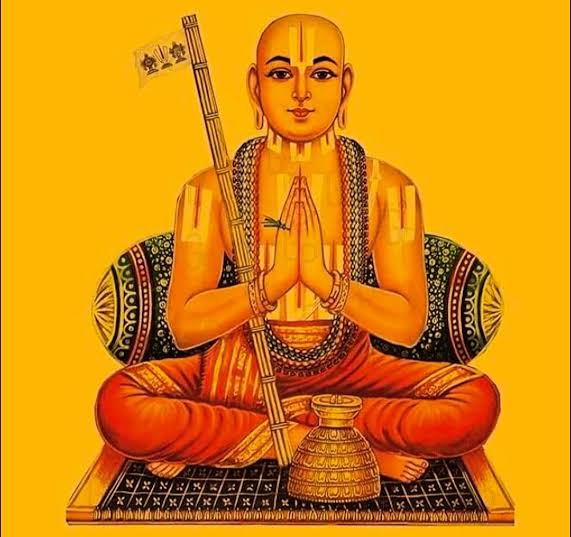
The story the tradition tells is this. A young monk had been taught a mantra by his teacher at Thirukoshtiyur and sworn to secrecy, because the syllables were held to carry liberation and were reserved for the initiated. He climbed the temple tower and shouted them to everybody standing below. When his furious teacher asked what he thought he was doing, he is said to have answered that he was willing to go to hell himself if the whole crowd could be saved. The teacher, instead of expelling him, gave him a new name: Emperumanar, one greater than myself.
Ramanuja, also called Ramanujacharya, was a South Indian philosopher and the most important teacher of the Sri Vaishnava tradition. He systematised Vishishtadvaita, or qualified non-dualism, in which God, individual souls and the material world are all real, with souls and matter forming the body of God. Tradition dates him to 1017 to 1137 CE; his best-known work is the Sri Bhashya.
That opening story may well never have happened. We will come to why. But hold on to its shape, because it tells you what Ramanuja is for in the Hindu imagination: the man who took what was private and made it public, who argued that the world you can see and touch is not a mistake, and who built a theology in which you do not have to stop being yourself in order to reach God. Nine centuries later, there is a 216-foot statue of him outside Hyderabad called the Statue of Equality. Few philosophers get that.
The Life Tradition Remembers
Ramanuja was born at Sriperumbudur, near modern Chennai, into a Tamil Brahmin family — a Vadama family, specifically, which matters later. His father is named in the tradition as Asuri Keshava Somayaji, the title Somayaji marking a man who had performed the Soma sacrifice; his mother as Kanthimathi. He was given the childhood name Ilayazhwar. He married young, separated from his wife, took sannyasa around the age of thirty, and died at Srirangam, where he had spent his last years.
Over his life he collected titles the way other men collect enemies: Udaiyavar, the possessor, which tradition says Ranganatha himself conferred along with the right to manage the Srirangam temple; Yatiraja, king of ascetics; Bhashyakara, the commentator, plainly and simply, as though there were only one.
Dates that do not add up
The traditional dates are 1017 to 1137 CE, which gives him a hundred and twenty years — roughly twice the average lifespan of his era. A widely cited alternative chronology shifts him to about 1077 to 1157, which yields a more plausible eighty. Neither is settled. Reference works repeat the revision; serious historiographical work on the community still uses the traditional dates without comment. The honest position is that we do not know when Ramanuja was born or died.
The reason is worth stating plainly, because almost no popular account does. The scholar John B. Carman observed that the earliest securely datable biography of Ramanuja was written more than a century after his death, and that the earliest hard evidence of his existence is a stone carving with an accompanying inscription showing him alongside a Hoysala king. Everything narrative — the teachers, the escapes, the miracles, the confrontations — post-dates him by a hundred years or more. The historian Paul Sydnor has gone further, calling the reconstruction of Ramanuja’s historical life nearly impossible.
This is not a reason to dismiss the stories. It is a reason to read them for what they are: a community telling itself who it is, through the figure it chose as its founder. The historian Ranjeeta Dutta reads the hagiographies exactly this way, as instruments of identity, noting that no surviving text gives a single continuous and consistent teaching lineage. What they give instead is a portrait, and portraits can be true in ways that chronicles are not.
Teachers, and a break that was not quite what we think
Here is a correction that almost every popular account of Ramanuja gets wrong. He is usually said to have studied under an Advaitin teacher, Yadava Prakasha, and broken with him over Advaita. But Yadava Prakasha was probably not an Advaitin at all. He taught a distinct position called Svabhavika Bhedabhedavada, natural difference-and-non-difference, in which Brahman is both different from and not different from the world and souls, these distinctions being built into Brahman’s own nature. The Internet Encyclopedia of Philosophy adds a sharp point: Yadava Prakasha is likely the real target of Ramanuja’s arguments, though Ramanuja never names him.
So the great break was less Advaita against Vishishtadvaita than later tradition makes it. Ramanuja did argue hard against Shankara, and against the Bhedabheda thinker Bhaskara by name. But the relationship with Adi Shankaracharya as rival and counterpart is something the tradition tidied up afterwards.
The emblematic story of that break concerns a single word. Chandogya Upanishad 1.6.7 describes the eyes of the Supreme Person using the compound kapyasam pundarikam. Yadava Prakasha glossed kapi as monkey and asa as seat, producing the eyes are red as a monkey’s hindquarters. Ramanuja re-derived kapi from kam pibati, that which drinks water, meaning the sun, and asam as blossomed — so the eyes are lovely as lotuses opened by the rays of the sun. It is a beautiful piece of grammar and a real Sri Vaishnava reading. Whether the classroom scene around it ever took place is another matter; it appears in devotional literature and not in any academic source.
The teacher he most wanted and never got was Yamunacharya, also called Alavandar, the grandson of Nathamuni and head of the Srirangam monastery. Ramanuja arrived too late; Yamuna had died. Tradition says the body lay with three fingers curled, read as three unfulfilled wishes, one of which was that somebody write a commentary on the Brahma Sutras — and that two fingers straightened as Ramanuja took the vow. Dutta’s observation about this is the useful one: because a direct teacher-student link between Yamuna and Ramanuja was missing, the tradition supplied him with five preceptors to bridge the gap. The roster of teachers is itself partly a retrospective construction. Our piece on the guru-shishya parampara explains why a lineage with a hole in it was so intolerable.
What is clear is that he was formally initiated by Mahapurna, also called Periya Nambi, Yamuna’s senior disciple, through the fivefold Sri Vaishnava initiation known as pancha samskara. There is a telling detail in that story too. The tutelage ended after a quarrel between their two wives over matters of caste and ritual purity. The logic Ramanuja spent his life subordinating to devotion was operating inside his own household.
The mantra shouted from the tower
Which brings us back to Thirukoshtiyur. The temple there, a Divya Desam in Sivaganga district, keeps a life-size image of Ramanuja in its Ashtanga Mandapam and tells the story as its own. It is, however, tradition rather than record — Ramanuja’s main scholarly biographies do not even list Thirukoshtiyur Nambi among his teachers, and the sources cannot agree on which mantra he shouted. The temple’s own account says Om Namo Narayanaya, the eight-syllable Tirumantra. Dutta’s academic treatment says the hagiographies use a different one of the tradition’s three secret mantras, the Dvaya. Others name the Charama Shloka.
The detail often added, that he was made to walk to Thirukoshtiyur eighteen times before the mantra was granted, we could not verify anywhere reliable. Treat the whole episode as the tradition’s self-portrait: here is what we think our founder was like. It is a striking thing for a community to choose as its founding image — not a vision, not a victory in debate, but a secret given away.
Vishishtadvaita: What Ramanuja Actually Argued
Vishishtadvaita is usually translated as qualified non-dualism, though a better rendering is the non-duality of the qualified whole. The later teacher Vedanta Desika compressed it into a formula: Brahman, qualified by sentient and insentient modes, is the sole ultimate reality. Worth knowing before you use the word: the school’s name was not Ramanuja’s own. It is a label applied afterwards.
His aim was to hold two things together that philosophers usually make you choose between — that reality is ultimately one, and that you, your neighbour, your grief and the chair you are sitting on are all genuinely real. Carman called his epistemology hyperrealistic, and it is a fair description. Ramanuja will not purchase unity at the price of calling your experience false.
The three realities
The Sri Bhashya sets out three categories of reality, later systematised under the name tattva-traya. (A small accuracy note: the treatise called Tattvatrayam is by Pillai Lokacharya, writing about a century and a half later, so the scheme is Ramanuja’s but the title is not.)
- Ishvara — the Lord, identified as Vishnu-Narayana, both the material and the instrumental cause of all that exists, possessing innumerable auspicious qualities and free of every defect.
- Jiva — sentient souls, in three classes: the eternally free, the liberated, and the bound, which is to say us.
- Jagat — the insentient: matter, the eternal spiritual realm of Vaikuntha, and time.
Notice what is missing. There is no illusion in this list. Ramanuja also rejected creation from nothing: souls and basic qualities are eternal features of Brahman’s body, and what God does in creation is grant beings the fruits of their desires, which is what organises a cosmos.
God has a body, and we are it
Ramanuja’s signature move is the sharira-shariri relation, body and embodied self. Carman identified this as his central doctrine. Souls and matter together constitute the body of Brahman: wholly dependent on God, owned and sustained by God, yet retaining their own identity. They are prakara, modes of Brahman, not parts dissolving into it. Paired with this is shesha-sheshin, the dependent and the one depended upon.
He defines his terms with unusual care. Commenting on Brahma Sutra 2.1.9 he writes, in a standard English rendering, that any substance which a conscious soul can completely control and support for its own purposes, and which stands to that soul in an entirely subordinate relation, is the body of that soul. Your hand is yours in exactly this sense. On Ramanuja’s account, so is the universe to God. The analogy does a great deal of work: it explains how everything can be utterly dependent on God without being identical to God, and how God can be intimately present in everything without being diminished by it.
One further feature deserves more notice than it usually gets. For Ramanuja, Brahman is not Vishnu alone but the joint reality of Vishnu-Narayana and Sri, Lakshmi. In the Sharanagati Gadyam he does not address Narayana first. He goes to Sri, praises her compassion, and asks her to recommend him — she is purushakara, the mediating and accessible face of God. Only when she agrees does he turn to Narayana. If you want to know why Sri Vaishnavism puts Lakshmi where it does, that is the passage.
Why he thought Advaita could not be right
His deepest objection is an argument about consciousness, and it is genuinely good. Ramanuja held that consciousness is always consciousness of something, and of something qualified by characteristics — a doctrine called dharmabhutajnana. A completely contentless, difference-free awareness is therefore not a rarefied achievement but an incoherent idea. Brahman is nirguna, without qualities, only in the restricted sense that no impure quality touches it.
Around that he builds others. If all cognition is erroneous, then the claim that all cognition is erroneous is itself a cognition, and so erroneous. Ignorance presupposes somebody capable of being ignorant, and Brahman, being consciousness itself, cannot be ignorant — so individuality must be prior to ignorance rather than produced by it. What causes avidya is beginningless karma, not a superimposition on Brahman. And on scripture he refuses two levels of truth: the Vedas are one corpus, all at one level, and you may not quarantine the passages affirming plurality and dharma in order to privilege the monistic ones. His epistemological rule is blunt — perception cannot be overridden by an interpretation of scripture.
The great Upanishadic saying tat tvam asi, that thou art, he reads through samanadhikaranya, co-ordinate predication: two different terms referring to one thing while emphasising different qualities of it. Readers with a philosophical background may notice how close this comes to Frege on sense and reference, and the Internet Encyclopedia of Philosophy makes the comparison explicitly.
His sustained demolition of maya runs to seven distinct objections, known in later polemical literature as the saptavidha anupapatti, the seven great untenables, set out in the Sri Bhashya at the very opening of the commentary. In outline: illusion has no coherent location, neither in the soul nor in Brahman; the idea that Brahman is concealed and a false universe projected is unintelligible; illusion’s own nature is untenable, since if it is real we have dualism and if unreal we must ask what caused it; the proposed third category between real and unreal is incoherent; no valid means of knowledge establishes it; knowledge of Brahman could not remove it; and in fact nothing could, since knowledge reveals rather than destroys. Enumerations of the seven differ slightly between retellings, and the numbered title is later than Ramanuja himself.
Liberation, for him, is videhamukti only — after death, not in this life. And the soul keeps its individuality, serving God in Vaikuntha and finding joy in the contemplation of Brahman. You are not a drop returning to the ocean. You are a person who finally gets to be one properly.
| Question | Advaita (Shankara) | Vishishtadvaita (Ramanuja) | Dvaita (Madhva) |
|---|---|---|---|
| Is Brahman qualified? | Nirguna, without attributes | Saguna, with real auspicious attributes; identified as Vishnu-Narayana with Sri | Saguna; Vishnu as supreme personal God |
| Is the world real? | Appearance, ultimately maya | Fully real, and is the body of Brahman | Fully real and distinct from God |
| What happens to the soul in liberation? | Realises its identity with Brahman | Remains individual as a mode of Brahman and serves God | Remains eternally distinct and serves God |
| How many ultimate distinctions? | None, finally | Real distinction within one organic whole | Five eternal distinctions (pancha-bheda) |
| Levels of scriptural truth | Two, higher and lower | One; the whole Veda at one level | One |
| Liberation while alive? | Yes, jivanmukti | No, only after death | No |
| Principal path | Jnana, knowledge | Bhakti, which is itself a mode of knowing | Bhakti |
One caution about that table. Madhva comes roughly a century after Ramanuja, in the thirteenth century, and actually borrows Ramanuja’s three-category framework. Reading the three schools as a tidy debate among contemporaries is convenient and false.
Bhakti, Prapatti and the Path
Ramanuja’s most original claim about devotion is that bhakti is itself an epistemic state — not a feeling that accompanies knowledge but a way of knowing. It begins as karma yoga, duty performed without attachment and offered to God, combined with constant worship; it counteracts accumulated karma and cultivates service; and when it takes firm root it becomes parabhakti, maturing into sakshatkara, a direct awareness of God more like perception than like inference. In the Sri Bhashya he defines it with great economy, in George Thibaut’s translation: steady remembrance of this kind is designated by the word devotion. Devotion as steady remembrance. Our guide to the three paths to liberation in the Bhagavad Gita sets this alongside the alternatives.
Then there is prapatti, also called saranagati — total, unconditional self-surrender, the throwing of oneself on God’s mercy with nothing offered in return. It is the idea most associated with Ramanuja in popular accounts, and here we have to be careful, because it is the one place where the scholarship genuinely bites.
Surrender appears in the Gadyas and is largely absent from the undisputed commentaries. Robert Lester used that absence to argue that the Gadyas are not Ramanuja’s at all. Others read the works together and see two emphases on a single path rather than rival paths. And Carman made a historical point that settles the practical question: it was about a century after Ramanuja that his followers began presenting prapatti as an alternative to bhakti rather than part of it, and the subsequent argument over whether any human effort forms part of surrender is precisely what later split the community in two. So Ramanuja taught surrender. Ramanuja did not teach surrender-instead-of-devotion. That was his grandchildren.
The Nine Works
Nine Sanskrit works are traditionally attributed to him. You will sometimes see them called the nine gems or navaratna; we could not find that term in any source, so treat it with suspicion. Three are universally accepted as genuine.
- Sri Bhashya — his commentary on Badarayana’s Brahma Sutras and his masterwork. It lays out the three realities, the body-self relation and bhakti as the means to liberation, and opens by stating and demolishing the view that undifferentiated consciousness is the only reality. The classical English translations are by M. Rangacharya and by George Thibaut in the Sacred Books of the East.
- Vedartha Sangraha — probably his first work, a summary of the meaning of the Veda in 252 sections, critiquing both Shankara and Bhaskara’s Bhedabheda before setting out his own account.
- Gita Bhashya — his commentary on the Bhagavad Gita, read as three groups of six chapters: the nature of the self and karma yoga; bhakti, defined as the flow of consciousness toward Narayana; and finally surrender. Its governing pair of ideas is paratva and saulabhya, God’s transcendence and God’s accessibility, held together rather than traded off.
The remaining six are contested to varying degrees. Two short Brahma Sutra commentaries, the Vedanta Deepa and Vedanta Sara, are traditionally explained as simplified aids to the Sri Bhashya — which is exactly the claim J. A. B. van Buitenen doubted, on the reasonable ground that a philosopher is unlikely to abridge his own book. The three Gadyas, elaborate prose hymns traditionally composed at Srirangam on the festival day of Panguni Uttiram and still recited in Vishnu temples, are questioned on the grounds discussed above. The Nitya Grantha is a short manual of daily worship. Scholars disagree about where exactly to draw the line, and the sceptical maximum is a minority view, but it is worth knowing that the texts most quoted for Ramanuja’s devotional warmth are the ones whose authorship is least certain.
Two Vedas, Sanskrit and Tamil
Before Ramanuja there were the Alvars, Tamil poet-saints whose hymns make up the Nalayira Divya Prabandham, some four thousand verses that the tradition calls the Tamil Veda. Twelve are counted in Sri Vaishnava reckoning, including Andal, the one woman among them. Their dates are wildly disputed — hagiography places the earliest in prehistory, Britannica between the seventh and tenth centuries CE, other scholars across ranges as wide as the third to the tenth. What is agreed is that they came before Ramanuja and that his theology is soaked in them. The older claim that the Alvars were his disciples is simply wrong.
What Ramanuja inherited was a lineage already trying to join two libraries. Nathamuni, the first Sri Vaishnava teacher, is credited with recovering and compiling the Prabandham and introducing its recitation into temple service at Srirangam. Yamunacharya argued in his Agama Pramanya that the Pancharatra Agamas carry authority equal to the Vedas — the move that makes temple worship Vedically legitimate, and the precondition for everything Ramanuja later did with temples.
The fusion is called ubhaya Vedanta, dual Vedanta, and it is both a traditional term and a scholarly one — Carman and Vasudha Narayanan devote a book, The Tamil Veda, to it. The honest evidence for Ramanuja’s part in it is institutional rather than textual. His own surviving Sanskrit works do not quote the Prabandham. What he did was authorise his disciple Thirukurugai Piran Pillan to write the Arayirappadi, the Six Thousand, the first commentary on Nammalvar’s Tiruvaymoli — in other words, he had the Tamil canon given the full Sanskritic commentarial apparatus, which is as explicit a statement of equal status as a medieval scholar could make. For why the choice of language carried so much weight, see our piece on the significance of Sanskrit.
The Social Record: What We Know and What We Wish We Knew
This is where the gap between tradition and evidence is widest, and where most writing about Ramanuja is least reliable. It deserves care rather than enthusiasm.
The tradition claims a great deal: that he opened temples and teaching to people excluded by caste, that he called them Tirukulattar, those of noble lineage, and secured their admission to the temple at Melukote, that he brought non-Brahmins into temple service, and that he founded seven hundred monasteries. The seven hundred is devotional arithmetic — several of the monasteries counted were demonstrably founded later. The Tirukulattar claim rests on thin sourcing and we could not confirm that he coined the term.
Srirangam and the Code of Udaiyavar
The best-supported social claim is the reorganisation of the Srirangam Ranganathaswamy temple. Carman records that he restructured it and tried to persuade other temples to adopt a stricter Vaishnava liturgy. Dutta, working from the temple chronicle known as the Koil Olugu, describes the reforms collectively as the Code of Udaiyavar and states that they encouraged non-Brahmin participation in temple affairs. Introduced at Srirangam and later made mandatory at other Vaishnava centres, the code made Srirangam the institutional heart of the community, with Ramanuja as its spiritual head. A stone inscription at the Arya Patal Vasal records the codification.
Even here, hedge. The Koil Olugu is a late temple chronicle, not a contemporary record; the historian A. Srivathsan, who takes it seriously, also notes that it contains interpolations, jumbled events and biased reporting. And Dutta’s broader judgement is the corrective that matters most: across the community’s history, the Brahmanical hierarchy dominated and varnashramadharma was always upheld. Ramanuja was born a Vadama Brahmin; his teachers were all Brahmins. Carman’s structural observation cuts both ways — Ramanuja’s success in drawing relatives and other Brahmins into a multi-caste devotional community meant leadership moved further into Brahmin hands, even as caste rank became subordinate, in principle, to the quality of devotion. That qualifier is doing a great deal of work and should be left in.
It is also worth noting that the Sri Vaishnava order already included non-Brahmins before him — Kanchipurna and Mahapurna are both cited. Ramanuja did not invent cross-caste devotion. What is fair to say is that he gave it a theology and an institution.
The exile and the Hoysala years
Tradition tells of a Chola king hostile to Sri Vaishnavism who summoned Ramanuja; of his chief disciple Koorathalvar going in his place in his robes and being unmasked; of Koorathalvar and Mahapurna blinded for refusing to accept Shaivism, with Mahapurna dying on the road home; and of Ramanuja fleeing Chola territory for twelve to fourteen years in the Hoysala country.
Which king is genuinely unresolved. The hagiographies do not give a regnal name at all; they call him Krimikanta Chola, the worm-necked Chola, a hostile epithet referring to a throat affliction. Candidates proposed include Kulottunga I, Kulottunga II, Adhirajendra and Virarajendra. Srivathsan’s reading is the sharpest and the most uncomfortable: the hagiographers probably wished the king a painful death, and the epithet rather than a name may be exactly why. He also raises a quite different possibility — that the conflict at Srirangam was intra-Vaishnava and sacerdotal rather than royal and sectarian. The chronology is entangled with the dating problem, since choosing a king effectively chooses a Ramanuja chronology.
At Melukote, also called Thirunarayanapuram, in present-day Karnataka, tradition has him installing the deity Tirunarayana and establishing a monastery to manage the temple. Here the epigraphic record offers a flat correction: the Mysore Archaeological Department, working from inscriptions, found that the Melukote deity was already a well-known object of worship before Ramanuja arrived. The dates given in tradition for the temple’s construction sit awkwardly with the reign of the king who is supposed to have funded it.
That king is Vishnuvardhana, originally called Bittideva, the Hoysala ruler who reigned from about 1108 to around 1152, built the Chennakesava temple at Belur, and was given the name Vishnuvardhana by Ramanuja himself. He was raised a Jain, came under Ramanuja’s influence, and began patronising Vaishnavism. But calling it a conversion overstates it: his queen Shantala Devi and his family remained Jain devotees, and he went on making land grants to Jain establishments at Shravanabelagola and elsewhere throughout his reign. Royal patronage in twelfth-century Karnataka was plural, not exclusive. The familiar story that Ramanuja won the king over by healing his daughter is hagiography with nothing behind it.
And yet — remember Carman’s point about the stone carving. The single piece of hard material evidence that Ramanuja existed at all is an image and inscription showing him with a Hoysala king. The episode least supported as a story is the one episode with an actual anchor in stone.
Ramanuja Today
His millennium was celebrated in 2017, with Tirumala Tirupati Devasthanams running a year of observances from May 2016 to 1 May 2017 and events held worldwide. Note the quiet irony: the anniversary is calculated from the traditional birth year of 1017, the very date modern scholarship questions.
The most visible monument is the Statue of Equality at Muchintal near Hyderabad, inaugurated by the Prime Minister on 5 February 2022. It stands 216 feet high, seated on a 54-foot three-storey base called the Bhadra Vedi, cast in panchaloha, a five-metal alloy of gold, silver, copper, brass and zinc weighing around seven hundred tonnes, and surrounded by 108 stone model temples replicating the Divya Desams. It was conceived by the ascetic Chinna Jeeyar, built in sections in China and assembled on site, and its cost is reported at around a thousand crore rupees, though considerably lower figures appear in some reports. Inside the base sits a smaller image: a 54-inch Ramanuja in 120 kilograms of gold, the weight chosen to represent the 120 years tradition says he lived. The monument encodes the hagiography in bullion.
At Srirangam you will hear that Ramanuja’s body is still there, preserved. The claim circulates in incompatible versions — mummified with camphor and saffron in one account, miraculously emerging from the earth after burial in another — and there is no academic source and no published examination behind any of them. The earliest tradition reported says simply that he was interred and an image installed. Better attested, and more interesting, is that three images of Ramanuja are traditionally recognised as approved by him in his own lifetime, at Melukote, Sriperumbudur and Srirangam.
His community itself divided, eventually, into the Vadakalai and Tenkalai schools, associated with Kanchipuram and Srirangam respectively. Their best-known difference is a pair of images about grace: the Vadakalai monkey, whose baby must hold on to its mother, so some human effort is required; and the Tenkalai cat, whose kitten is simply carried, so grace does everything. Dutta’s careful account has the two lineages diverging slowly from the thirteenth century and hardening into formal sects only under the litigation and codification of the colonial era. Be warned that a great deal of writing about Ramanuja is sectarian advocacy in scholarly dress, each school claiming him as its own.
Why Ramanuja Still Matters
The most useful thing Ramanuja offers a modern reader is permission to take ordinary life seriously. A version of Hinduism in which the world is a mistake and the self an illusion is intellectually thrilling and practically difficult: it asks you to treat your own grief, your work, your love for particular people as finally unreal. Ramanuja refuses that bargain. The world is real. You are real. Your particularity is not an obstacle to God but the very thing that is held and sustained by God. In liberation you do not evaporate; you become fully yourself in relation to something larger.
His argument about consciousness has worn well too, and not only within Vedanta. The claim that awareness is always awareness of something qualified, that pure contentless consciousness is not a summit but a contradiction, is a live question in philosophy of mind, and he made it in the twelfth century with a rigour that repays reading.
And then there is what the tradition chose to remember. Stripped of the miracles, the Thirukoshtiyur story is about a man who decided that knowledge held in reserve is not knowledge worth having. Whether or not he climbed any tower, a community built itself around that as its founding image and called him Emperumanar for it. There are worse things for a religion to be proud of.
One last note of honesty. If you search for Ramanuja quotations you will find a great many inspirational one-liners about equality and love attributed to him. We could not trace a single one of them to any passage of the Sri Bhashya, the Vedartha Sangraha, the Gita Bhashya or the Gadyas. The authentic Ramanuja does not speak in aphorisms. He speaks in arguments, at length, and his voice is unmistakable once you have heard it.
Frequently Asked Questions
What is Vishishtadvaita in simple terms?
Vishishtadvaita holds that reality is one, but that the one reality has real parts within it. God, individual souls and the material world all genuinely exist; souls and matter are not illusions but the body of God, wholly dependent on God while keeping their own identity. The usual translation is qualified non-dualism, though the non-duality of the qualified whole is closer to the sense. The practical upshot is that you do not have to call your ordinary experience false in order to be serious about God.
How is Ramanuja different from Adi Shankaracharya?
On four main points. Shankara’s Brahman is without attributes; Ramanuja’s has real auspicious qualities and is identified as Vishnu-Narayana together with Sri. Shankara treats the world as finally appearance; Ramanuja treats it as fully real and as Brahman’s body. Shankara reads scripture on two levels of truth; Ramanuja insists the whole Veda stands at one level. And in liberation, Shankara’s soul realises its identity with Brahman while Ramanuja’s remains an individual in loving service. Ramanuja also set out seven detailed objections to the doctrine of maya in the opening of his Sri Bhashya.
When was Ramanuja born, and did he really live 120 years?
Tradition gives 1017 to 1137 CE, which is a hundred and twenty years — about double the average lifespan of the period. A widely cited alternative chronology places him around 1077 to 1157, giving roughly eighty years. Neither is established, and the dates remain genuinely unresolved. The underlying problem is that the earliest datable biography was composed more than a century after his death, and the only hard material evidence of his existence is a stone carving and inscription showing him with a Hoysala king.
What did Ramanuja write?
Nine Sanskrit works are traditionally attributed to him. Three are undisputed: the Sri Bhashya, his great commentary on the Brahma Sutras; the Vedartha Sangraha, probably his earliest, summarising the meaning of the Veda; and the Gita Bhashya on the Bhagavad Gita. The others are the short Vedanta Deepa and Vedanta Sara, the three prose hymns known as the Gadyas, and the Nitya Grantha, a manual of daily worship. Scholars have challenged the authenticity of several of these, with the Gadyas the most contested.
Was Ramanuja a social reformer?
Partly, and the honest answer requires distinguishing what is documented from what is remembered. Well attested in outline are his liturgical and administrative reorganisation of the Srirangam temple, described in the temple chronicle as encouraging non-Brahmin participation, and a theology in which caste rank is subordinate, in principle, to the quality of devotion. Less secure are the specific temple-entry episodes and the picture of him as a reformer in the modern sense, which come from hagiography written a century or more later. The community he founded remained Brahmin-led, and the order already included non-Brahmins before him.
Where can I see shrines connected to Ramanuja today?
Three images are traditionally recognised as approved by Ramanuja himself, at Sriperumbudur near Chennai where he was born, at Melukote in Karnataka, and at the Ranganathaswamy temple in Srirangam where he died. Thirukoshtiyur in Sivaganga district keeps a life-size image of him in its Ashtanga Mandapam. The newest is the 216-foot Statue of Equality at Muchintal near Hyderabad, inaugurated in February 2022, which is encircled by 108 model temples replicating the Divya Desams.
Somewhere in a temple tonight, in Tamil Nadu or New Jersey or Melbourne, somebody will recite verses that a tenth-century Tamil poet composed and a twelfth-century philosopher decided were scripture. That is Ramanuja’s real monument, and it weighs nothing at all.
Continue Exploring
- Adi Shankaracharya: Life, Teachings and the Four Mathas
- Guru-Shishya Parampara: How India Passed Its Deepest Knowledge On
- Bhagavad Gita Explained: Chapters and Significance
- Bhagavad Gita Chapter 12: The Path of Devotion
- How to Chant the Vishnu Sahasranama