
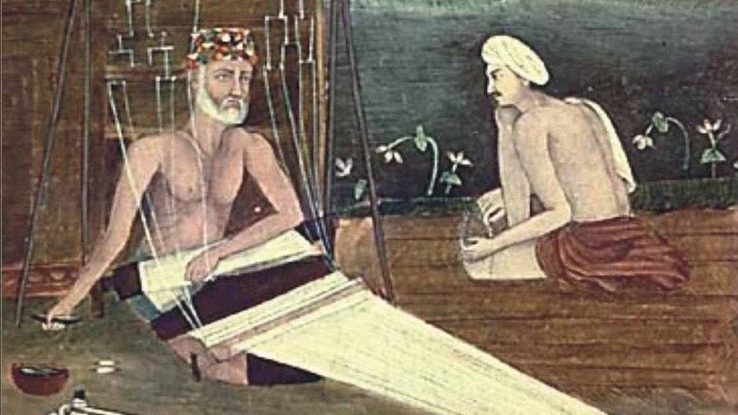
Somewhere in fifteenth-century Varanasi, a weaver sat at his loom. He worked with his hands for a living, in a trade that the city’s learned men looked down on, and by his own account he never became a scholar. Today his verses are recited by Hindu sadhus, sung at Muslim shrines, and bound inside the holy scripture of the Sikhs — where some 541 of his compositions sit alongside the words of the Gurus themselves. No other figure in Indian religious history has been claimed so insistently by so many traditions, and none worked harder, while alive, at belonging to none of them.
Sant Kabir was a fifteenth-century North Indian mystic poet and weaver from Varanasi, revered across Hindu, Muslim and Sikh traditions. Born into a Muslim weaver family, he rejected caste, idol worship and religious ritual alike, teaching devotion to a formless God. Some 541 of his verses are preserved in the Sikh Guru Granth Sahib.
He is usually introduced as the great harmoniser of Hindu and Muslim faith. That description would have irritated him. Kabir did not blend the two religions; he stood outside both and told each one what he thought of it, in the language of the street, in verse short enough to remember and sharp enough to sting.
What We Actually Know About Kabir’s Life
Less than you would expect, and it is worth being honest about that from the start. The years of Kabir’s birth and death are genuinely uncertain. Some historians favour roughly 1398 to 1448; others favour 1440 to 1518. You will often see the two outer figures combined into a single lifespan of 1398 to 1518, which would make him a hundred and twenty years old — a devotional claim rather than a historical one. Scholarly reference works tend to settle on born around 1440 at Varanasi and died around 1518 at Maghar, aged about seventy-eight, while flagging the whole question as open.
The traditional birth date is given as Samvat 1455, on the full moon of the month of Jyeshtha, at the hour of brahmamuhurta just before dawn. The earliest surviving biographical accounts of him are considerably later than his life: the Persian Dabestan-e Mazaheb, two hagiographies — Anantadas’s Kabir Parachai from around 1600 and Raghavdas’s Bhaktamal from the seventeenth or eighteenth century — and the traditions of the sect that grew up in his name. These disagree with each other. One calls him a bairagi, a Vaishnava ascetic; another makes him a Sufi of the Firdausi order. Each tradition recruited him.
Born a Muslim Weaver in the City of Shiva
Kabir was born into a family of Muslim weavers — the community generally identified with the Julahas — in Varanasi, the most sacred city in the Hindu world. That single fact explains much of his poetry. He grew up Muslim by birth inside a Hindu holy city, at the loom rather than in a school, watching both religions conduct their business at close range and from below.
His family is believed to have lived in the Kabir Chaura locality of the city, where a math in his memory still stands, along with a house called Nirutila said to hold the graves of Niru and Nima.
The Foundling by the Pond
A few accounts say Kabir was not born to Niru and Nima at all but found by them as an infant beside Lahartara Lake, and raised as their own. Devotional tradition goes further: his followers tell of him descending from Satloka, the realm of truth, onto a lotus on that pond, witnessed by a sage. Both stories are old and both are cherished, and neither is history. There is considerable scholarly debate about his origins, and the plain answer is that nobody knows who his parents were. Tradition also gives him a wife, Loi, and two children; these too belong to the legends rather than to the record.
Was Ramananda His Guru?
Tradition is firm that Kabir became one of the many disciples of Ramananda, the Vaishnava teacher of Varanasi, and the early Persian account describes him exactly so. A famous story, retold in countless versions, has the young Kabir engineering his initiation by stealth because a Brahmin teacher would not knowingly accept a Muslim weaver as a student.
Treat the connection as tradition rather than documented fact. It is early and widely attested within the devotional literature, which is not nothing; it is also exactly the kind of link a later tradition would want to establish, giving an outsider poet an impeccable guru-shishya lineage. What is certain is that Kabir himself insisted on the guru’s necessity. In Tagore’s translation he says: Kabir is the child of Allah and of Ram: He is my Guru, He is my Pir — collapsing Hindu teacher and Muslim master into one.
Hindu, Muslim, or Neither?
This is the question everyone asks, and the popular answer is wrong. Kabir is routinely presented as a synthesiser who fused Hinduism and Islam into a single harmonious faith. The scholar Linda Hess is blunt about it: the picture is a false one. Kabir, she argues, emphatically declared his independence from both the major religions of his day and vigorously criticised both. Many scholars now read his poetry as questioning the need for organised religion at all, rather than as an attempt at communal reconciliation.
Beyond that, scholars disagree sharply. Ronald McGregor concludes that Kabir left Islam. David Lorenzen calls the extent of his borrowing from Islam controversial, and notes that many recent scholars see him drawing chiefly on Hindu traditions — a reading with which the sadhus of his own sect agree. Whether his imagery owes a debt to Sufism is likewise contested: some scholars find Sufi roots in his inversion of the lover and the beloved, while others suspect the Sufi and bhakti streams simply developed alongside one another, and that assigning a direction of influence is guesswork.
What his verse actually does is refuse the choice. He uses Ram, Allah, Karim and Hari as names for one reality, and then tells you not to get attached to the names either. Hess and Singh translate one line: Don’t say Ram, don’t say Khuda, so says Kabir. He mocks the Hindu who will not eat and the Muslim who kills for meat in the same breath. It made him unpopular in his lifetime — he says so himself, in a verse that translates roughly as: Saints, I see the world is mad. If I tell the truth they rush to beat me. The traditional stories of persecution by the sultan at the urging of Brahmins are doubted by most historians, who note there is no corroborating evidence and little reason a Muslim ruler would have acted on such a request.
Nirguna: The God Without Qualities
Kabir belongs to the nirguna stream of Indian devotion — God without attributes, without form, without image. The contrast is with saguna bhakti, devotion to God with qualities: Krishna with his flute, Rama with his bow, a deity you can picture, dress, feed and garland. Kabir’s absolute has no such handles. When he says Ram, he does not mean the prince of Ayodhya; he means the unconditioned reality for which Ram is simply a convenient syllable.
Where this idea comes from is debated. Charlotte Vaudeville tied Kabir’s absolute to the Upanishadic Brahman-Atman and the monistic reading of Advaita Vedanta; Lorenzen and others trace it to Shankara, with differences. Vaudeville also pointed out the tension honestly: if God is wholly within, external devotion ought to be abolished altogether, and yet Kabir sings. She suggested that loving devotion may be the road towards the formless rather than its opposite. Not every scholar accepts that resolution, and Kabir himself never tidied it up.
How Kabir Wrote, and Where His Poetry Survives
Kabir composed in spoken vernacular, not in the Sanskrit of the learned — part of the point. He worked in a handful of compact forms. The sakhi or doha is a two-line aphorism; the word sakhi means witness, as though each couplet were testimony. The sabad or pada is a song. The ramaini is a longer reflective verse. His own word for his compositions was simply banis, utterances.
Here is the crucial thing about those utterances: he almost certainly did not write them down. They were composed orally in the fifteenth century and transmitted by mouth for up to two hundred years before being committed to manuscript. Everything we have reaches us through that gap, which is why the collections differ so much.
| Collection | Preserved by | Contents | Textual reliability |
|---|---|---|---|
| Adi Granth (Guru Granth Sahib) | Sikh tradition | Around 541 verses of Kabir | The most stable text; the largest contribution by any non-Sikh to the scripture |
| Bijak (The Seed) | The Kabir Panth | Ramaini, Shabda and Sakhi sections, plus folksongs | First written down in the 17th century; survives in two major recensions |
| Kabir Granthavali | The Dadu Panth, Rajasthan | Padas and sakhis | The western Kabir, noticeably more devotional in tone |
| Sakhi Granth and other works | Various sects and manuscripts | Mostly couplets | Around 82 works have been attributed to him; most attributions are late and doubtful |
How much is really his? Scholars have spent a century trying to answer that. The judgements are sobering: of the hundred poems in Tagore’s famous 1915 English collection, one critic argued that only six are authentic. The Bijak was written down two centuries after Kabir died, in a Mirzapuri dialect of Old Awadhi whose classification is itself disputed. Charlotte Vaudeville, the leading authority on the recensions, showed how far the versions drift apart. There is also a geographic pattern: the Rajasthani collections give a more devotional Kabir, while the eastern material gives a blunter, more down-to-earth householder.
None of which makes the poetry less valuable. It does mean that when someone hands you a Kabir doha on social media, the honest description is Kabir as the tradition remembers him.
What Kabir Actually Taught
Against Ritual and Religious Theatre
Kabir’s most consistent target is religion performed rather than lived. He rejected what he saw as hypocrisy and misguided ritual in the practice of his day, in both Islam and Hinduism — the fasting, the pilgrimage, the ritual bath, the marks on the forehead, the mullah’s call and the pandit’s recitation. His line of attack is always the same: you have mistaken the signpost for the destination. In Tagore’s rendering he asks where you imagine God is, if He is neither in the mosque nor in the image you travelled to see, and answers: look within your heart, for there you will find both Karim and Ram.
Against Caste and Learning as Status
A weaver who argued theology with Brahmins was itself an argument. The legends that grew around him make him a protester against social discrimination and economic exploitation, and the sect in his name explicitly rejects ritualism and social division. His contempt for scholarship-as-status is one of his most quoted themes. Vaudeville translates: Reading book after book the whole world died, and none ever became learned. Coming from a man who may have been unlettered, aimed at a city full of pandits, it is not humility. It is a counter-attack.
The Ego, the Body and the Guru
Kabir’s positive teaching is compact. To know the truth, drop the I. The divine is not in a distant heaven but within the body, which makes the body the site of the search rather than an obstacle to it. The guru is indispensable. Truth and simple living matter more than observance. And criticism — even malicious criticism — is useful: in Callewaert’s translation, keep the slanderer near you, build him a hut in your courtyard, for without soap or water he will scrub your character clean.
One note for honesty’s sake. Modern readers have found a real problem in some of the verses attributed to him: his language about women can be harsh, and scholars including Nikky-Guninder Kaur Singh and Wendy Doniger have described a misogynist bias in the corpus. Others read the relevant passages allegorically, the woman standing for the soul. Both readings are in print, and a reader meeting Kabir today deserves to know the dispute exists rather than discover it later.
Death at Maghar and the Flowers Beneath the Shroud
Kabir died at Maghar, near present-day Gorakhpur in eastern Uttar Pradesh, and the story of what happened next is the most famous thing about him. When he died, both the Hindus and the Muslims he had inspired claimed him as their own. According to popular belief, his body disappeared and fragrant flowers were found in its place. The flowers were divided between his Hindu and Muslim disciples, and each community built a memorial for its share: a dargah and a samadhi, standing about a hundred metres apart at Maghar to this day, along with a meditation cave shown to visitors. The site has been under restoration in recent years, so check its current condition before making a journey.
You will also read, almost everywhere, that Kabir chose to die at Maghar deliberately — to demolish the belief that dying in Kashi guarantees liberation while dying at Maghar condemns you. It is a perfect Kabir gesture, entirely in character, and a wonderful story. It also belongs to popular retelling rather than to anything a historian can verify, and I have not been able to trace it to a scholarly source. Take it as the tradition’s own commentary on his life, which may be the truest kind of biography he would have accepted.
What is beyond dispute is the shape of the legend: two religions arguing over a corpse, and finding they had nothing to fight over. For a man who spent his life refusing to be sorted into a category, it is a fitting last word.
Kabir’s Afterlife
The Kabir Panth, the sect that venerates him as its founder, was not established by Kabir. It took shape over the seventeenth and eighteenth centuries, generations after his death, around figures such as Dharamdas and Suratigopal, and it splintered into branches with their own lineages and headquarters — Damakheda in Chhattisgarh, Kabir Chaura in Varanasi with its branch at Maghar, and centres across Bihar and beyond. Estimates of its size vary wildly, from the 843,171 recorded in the 1901 census to figures in the millions today; none is firm. One of the largest communities outside India is in Trinidad and Tobago. Tellingly, Hindu Kabirpanthis recite the name Ram while Muslim Kabirpanthis use Khuda — the division he spent his life mocking, preserved inside his own sect.
His wider influence runs deeper. He stands at the centre of the North Indian sant tradition, alongside Ravidas, Namdev and the Sufi Farid. The word sant comes from the Sanskrit sat, truth or reality, and translating it as saint is misleading: Schomer and McLeod gloss it as one who knows the truth, or one who has experienced ultimate reality. Whether Kabir influenced Guru Nanak is genuinely contested — Hew McLeod placed Nanak within the Kabir-associated sant tradition, while J. S. Grewal and Surjit Singh Gandhi have rejected that reading as historically and theologically mistaken. What is not in doubt is that Guru Arjan included Kabir’s verses in the Sikh scripture, where they remain.
In 1915 Rabindranath Tagore, working with Evelyn Underhill and from a collection made by Kshitimohan Sen, published the English translations that carried Kabir to the world — a slim book of a hundred poems whose scholarly reliability is, as noted, doubtful, and whose literary influence was enormous anyway. And he survives most vividly in music: in Kumar Gandharva’s classical renderings, and among the folk singers of Malwa and Rajasthan recorded by Shabnam Virmani’s Kabir Project, where singers like Prahlad Tipanya and Mukhtiyar Ali still perform him in village courtyards, which is roughly where he started.
Kabir Jayanti is observed on the full moon of Jyeshtha, following the traditional account of his birth, which usually places it in late May or June. Because it follows the lunar calendar the Gregorian date shifts each year, and reliable sources do not give a fixed one — check a current panchang, and if you are observing outside India, bear in mind that the tithi may fall on a different local date than it does in Varanasi.
Why Kabir Still Matters
We live in a moment unusually good at sorting people into camps and unusually bad at tolerating those who will not be sorted. Kabir is the patron poet of that refusal. He was claimed by everyone because he belonged to no one, and the reason his verses outlasted the arguments of his better-educated contemporaries is that he aimed at something underneath the arguments.
There is a practical teaching in him too, and it is not comfortable. Kabir’s test for any religious practice is whether it has changed the person performing it. The pilgrimage, the fast, the recitation, the gesture of respect — all fine, and all worthless if the ego walks away intact. That question travels well. It applies as easily to a meditation app, a wellness regime or a professed set of values as it did to a ritual bath in the Ganga in 1450.
He also offers something to anyone who has felt on the outside of their own inheritance: a Muslim weaver in a Hindu holy city who became one of the most quoted religious voices in Indian history without acquiring a single credential. Kabir’s authority came from the clarity of what he said. That route is still open.
Frequently Asked Questions
Who was Sant Kabir Das?
Kabir was a mystic poet and weaver who lived in Varanasi in the fifteenth century, and one of the most influential voices of the North Indian bhakti movement. Born into a Muslim weaver family, he taught devotion to a single formless God and rejected caste, idol worship and religious ritual in both Hinduism and Islam. His verses are revered by Hindus, Muslims and Sikhs alike.
Was Kabir Hindu or Muslim?
He was born into a Muslim family but cannot be straightforwardly called either. Scholars explicitly reject the popular idea that he harmonised the two faiths; Linda Hess argues he declared his independence from both and criticised both vigorously. Some scholars, such as Ronald McGregor, conclude he left Islam; others stress how much he drew from Hindu tradition. Many read him as questioning organised religion itself.
When was Kabir born and when did he die?
The dates are uncertain and genuinely disputed. Some historians favour about 1398 to 1448, others about 1440 to 1518; standard reference works often give born 1440 at Varanasi, died 1518 at Maghar, aged seventy-eight. The commonly quoted 1398 to 1518 would mean a lifespan of 120 years, which is a devotional tradition rather than a historical finding.
How many of Kabir’s verses are in the Guru Granth Sahib?
Around 541 compositions attributed to Kabir appear in the Sikh scripture, which is the largest contribution by any non-Sikh figure included in it. They were incorporated when the Adi Granth was compiled under Guru Arjan. Because the Sikh text was fixed early and carefully, it is also considered the most textually reliable source for Kabir’s poetry that we have.
What is the Bijak?
The Bijak, meaning the seed or seedling, is the principal scripture of the Kabir Panth. It is arranged in sections called Ramaini, Shabda and Sakhi, with a further group of miscellaneous folksongs. It was first written down in the seventeenth century, roughly two hundred years after Kabir’s death, and survives in two major recensions that differ from each other.
Are the Kabir dohas circulating online authentic?
Often not, or not verifiably. Kabir composed orally and his verses were transmitted by mouth for up to two centuries before being written down, so attribution is a real scholarly problem — one critic argued that only six of the hundred poems in Tagore’s celebrated collection are authentic, and around 82 works have been attributed to Kabir in total. Enjoy the couplets, but treat them as the tradition’s Kabir rather than as verified quotations.
Return to the loom for a moment. A man throwing a shuttle back and forth, making cloth thread by thread, in a city built on the certainty that where you die decides where you go. He did not write a treatise or found an order or leave a single manuscript in his own hand. He made couplets short enough for people with no education to carry in their heads, and in the end those outlasted the libraries. Six centuries on, the weaver is still being argued over — which is, one suspects, exactly how he would want it.
Continue Exploring
- Kashi and Its Significance for Hinduism
- Female Saints of India: Seven Women Who Changed Indian Devotion
- Guru-Shishya Parampara: How India Passed On Its Deepest Knowledge
- Adi Shankaracharya: Life, Teachings and the Four Mathas
- Valmiki vs Tulsidas Ramayana: Key Differences Explained