
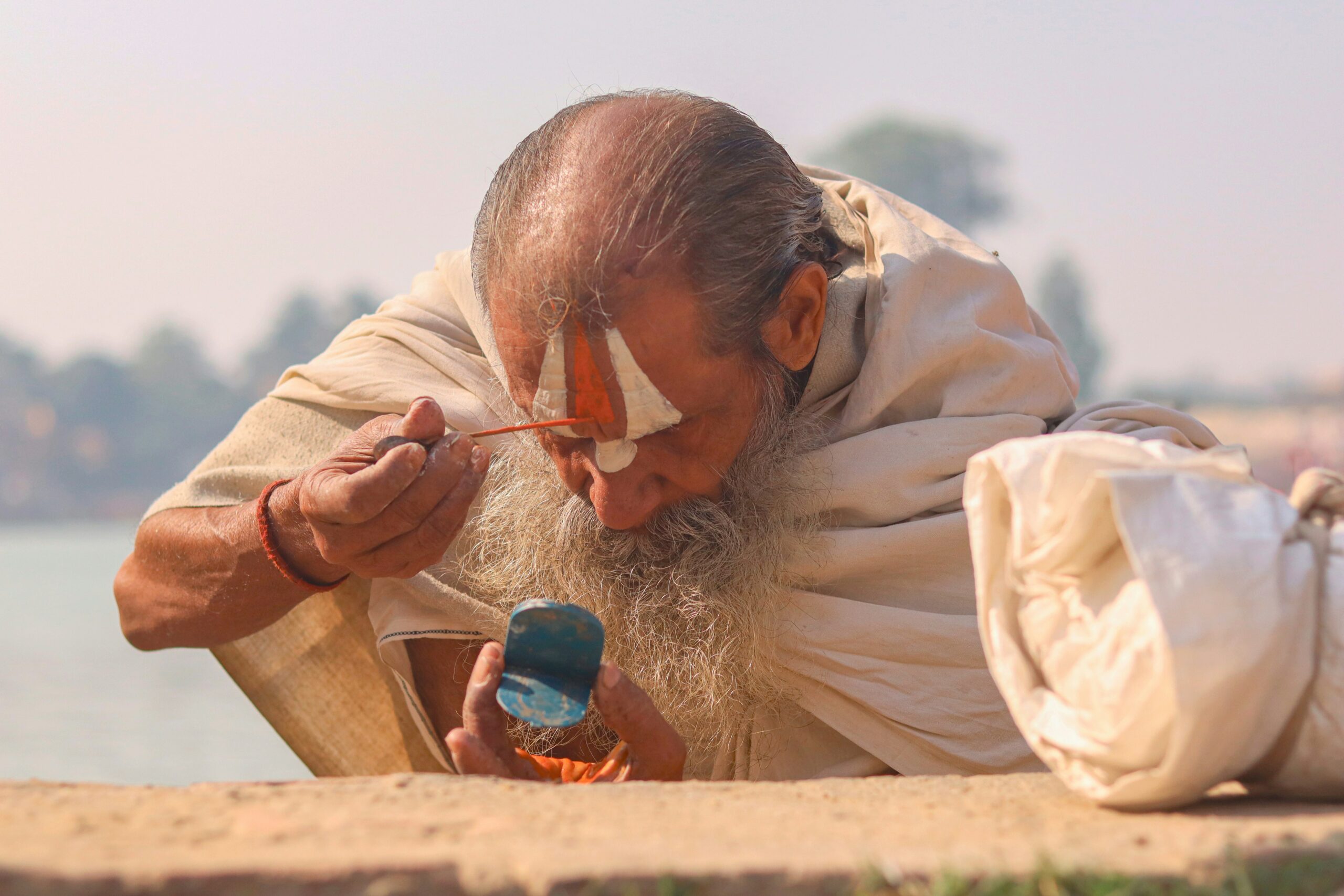
A friend’s father retired at fifty-eight from a bank in Nashik. Within a month he had done something that baffled his children: he moved out of the main bedroom into the small room at the back, handed the house accounts to his son, stopped attending family decisions unless asked, and began spending his mornings reading and his evenings teaching free mathematics to the neighbourhood’s children. Nobody had told him to. When his daughter asked why he had made himself smaller in his own house, he said something that stayed with me: “It is not my turn any more. My turn was good. Now it is theirs, and my job is to not be in the way.”
He would not have put it this way, but he had entered vanaprastha. He was following a map that is roughly two and a half thousand years old.
The four ashramas are the four stages of life described in Hindu tradition: brahmacharya, the celibate student; grihastha, the married householder; vanaprastha, the one who withdraws from worldly duty; and sannyasa, the renunciant who seeks liberation. Set out in the Dharmasutras and the Manusmriti, they map a single human life as a movement from learning, through engagement, to detachment.
What makes the scheme interesting is not that it tells you what to do. It is that it assumes a whole life has a shape — that the things appropriate at twenty are not appropriate at seventy, and that a well-lived life is not one long attempt to stay in its best phase. Modern life mostly assumes the opposite. We treat ageing as a problem to be delayed and retirement as a loss of status. The ashramas treat each stage as having its own legitimate work, including the last.
Where the Four Ashramas Come From
The system is laid out in the Dharmasutras and Dharmashastras — the Sanskrit texts on duty and law — rather than in the Vedas themselves. The specific texts most often cited are the Baudhayana, Apastamba, Gautama and Vasistha Dharmasutras, the Manusmriti, the Vaikhanasa Dharmasutra, and the Ashrama Upanishad, which the scholar Joachim Friedrich Sprockhoff dates to around the third century CE. The Mahabharata and several Puranas discuss the stages too, usually in more flexible terms.
Dating is genuinely contested, and you should distrust any confident single date. Reference accounts variously place the system’s emergence “around the fourth century BCE,” put the later two stages at “about or after the 7th century BCE,” and date the early Dharmasutras to the second and third centuries BCE or, for Baudhayana, as early as the seventh century BCE. The Indologist Patrick Olivelle argues the four-stage scheme reached mainstream scholarly acceptance around the second century BCE. The reasonable summary: the pieces are old, the tidy four-part system is later than the pieces, and the whole thing was still being argued over for centuries.
These are the same text traditions that give us the life-cycle rites, and the two systems interlock: the sixteen samskaras mark the thresholds, while the ashramas describe the territory between them.
Brahmacharya: The Student
Brahmacharya is the first stage, and its name is more ambitious than “studentship” suggests. It is usually glossed as “conduct consistent with Brahman” or “on the path of Brahman” — that is, a way of living oriented towards ultimate reality, not merely a period of schooling. Texts commonly assign it the first twenty to twenty-five years of life, with formal study beginning somewhere around ages five to eight and continuing into the teens or early twenties. Manusmriti is cited for the twenty-five-year figure.
The stage traditionally opened with the upanayana, the sacred-thread initiation, after which the student went to live in the gurukula — literally the household of the teacher. Study covered the Vedas, the Upanishads, the Vedangas (the auxiliary sciences of grammar, phonetics, metre, etymology, ritual and astronomy) and the various shastras. Any income the student earned went to the guru as dakshina, the teacher’s due. It is worth noting that the sources do not describe one single universal initiation rite; practice varied.
Celibacy was required, and the reason given is practical rather than puritanical: sexual preoccupation interferes with the sustained attention that learning demands. The Chandogya Upanishad (8.5.1–4) makes a startling claim about this stage — that “what people call yajña (sacrifice) is really brahmacharya.” In other words, a young person studying with discipline is performing the equivalent of the great fire rituals. The Mundaka Upanishad (III.1.5) lists brahmacharya alongside satya (truth), tapas (austerity) and samyagjñana (right knowledge) as the means of reaching the Self.
The relationship at the heart of this stage — the transmission from teacher to student that no book can replace — is the subject of its own long tradition; see our piece on the guru-shishya parampara.
Grihastha: The Householder
Grihastha means “being in and occupied with home and family” — the householder. A person entered it by marriage, and ancient texts place it roughly from twenty-five to fifty. This is the stage of earning, raising children, building a home, giving to others and carrying the community. It is also, and this surprises people who expect Hinduism to be world-denying, the stage several texts rank highest.
The Gautama Dharmasutra (3.2–3.3) calls the householder stage the foundation of all the other ashramas — for the obvious reason that students, forest-dwellers and renunciants all eat food that householders grow and give. The Manusmriti (4.1–6) sets out lawful livelihoods for the householder and disapproves of servile dependence. Scholarly accounts, citing R. K. Sharma, note that ancient and medieval texts treat grihastha as the most important stage “in sociological context,” and the Chandogya Upanishad and the Vedanta Sutra tradition (at III.4.48) have been read as holding it highest outright. Worth being precise here: no single scripture is usually named for the sweeping “most important stage” claim, so treat it as the weight of the tradition rather than a quotable verse.
The five great offerings of the householder
The householder’s religious duty was organised as the pancha maha yajna, the five great offerings — a daily programme, not an annual festival. They are usually listed as:
- Brahma yajna — study of the Vedas, prayer and meditation: the debt to knowledge.
- Deva yajna — offerings into the fire: the debt to the gods.
- Pitr yajna — care of parents, elders and ancestors.
- Bhuta yajna — service to the poor, the needy and animals.
- Atithi yajna — hospitality to the guest, who is treated as divine.
Notice what this does. It takes an ordinary domestic day — reading, cooking, looking after your parents, putting rice out for the crows, feeding whoever turns up — and classifies every part of it as sacrifice. The Vishnu Purana expands the obligations to ancestors, gods, guests, sages, progenitors, spirits and the world at large. The householder is not a person postponing spirituality until retirement. The householder is performing it, continuously, by being reliable.
Traditional teaching often frames this through the three rinas or debts — to the sages for knowledge, to the gods, and to the ancestors for one’s own existence — discharged respectively by study, by ritual and by raising a family. This is a long-standing and widely taught framework, though the Dharmasutra passages on the ashramas themselves do not spell out the connection; the link between the debts and the stages is interpretive rather than textual. The wedding rites that open this stage are examined in our guide to Indian wedding rituals.
Vanaprastha: The One Who Steps Back
Vanaprastha means “the way of the forest” or “forest road,” and the literal image has caused a lot of misunderstanding. The stage is often given as roughly ages fifty to seventy-four, though it is worth knowing that this neat range is weakly sourced — reference works carry it with a citation flag. What the stage actually describes is a transition: handing household responsibility to the next generation, moving from decision-maker to adviser, and progressively loosening one’s grip on property, status and control.
Did people literally go to the forest? Some did. The Manusmriti (6.21) describes the forest retiree’s diet, and the Markandeya Purana paints a frugal life of sleeping on the ground and living on fruit and roots. But the scholar Albertina Nugteren’s conclusion, widely cited, is that the forest departure was “in practice, a metaphor and guideline.” Most people stayed near their families in an advisory role. Mariasusai Dhavamony characterises the stage as one of detachment and increasing seclusion rather than physical exile. Notably, the sources are not clear on whether a spouse was expected to accompany the forest-dweller; the texts leave it open.
The Narada Parivrajaka Upanishad distinguishes four types of forest-dweller — Audumbara, Vaikhanasa, Samprakshali and Purnamanasa — which tells you the category was lived in enough different ways to need subdivisions. The Mahabharata’s Shanti Parva (Section LXVI) goes further and says a king attains the object of vanaprastha simply by protecting his kin, honouring the worthy, feeding all creatures and defending the righteous. That is a thoroughly symbolic reading: the inner work of the stage can be done without leaving your post.
My friend’s father, in his back room in Nashik, had understood this better than most commentaries.
Sannyasa: The Renunciant
Sannyasa is usually derived as “to put down everything, all of it.” The renunciant gives up property, home, family ties, ambition, and — this is the part people miss — the ritual obligations of social religion itself. The sannyasi has no household fire to maintain, no guests to honour, no ancestors to feed. The single remaining aim is moksha, liberation. The Bhagavad Gita (5.3) locates the state internally rather than externally: “He is known as a permanent Sannyasin who does not hate, does not desire, is without dualities.”
The Baudhayana Dharmasutra (II.10.18.1–10) gives the renunciant five major vows — non-injury, truthfulness, non-appropriation, abstention from sensual pleasure, and kindness — and five minor ones: freedom from anger, obedience to the guru, avoidance of rashness, cleanliness and purity in eating. The sannyasi begs for food without annoying anyone, and shares what is received.
On timing, the texts openly disagree. Baudhayana (II.10.17.2–5) says sannyasa generally suits a person after the age of seventy, while other texts say seventy-five — but the same passage permits renunciation immediately after brahmacharya, and allows childless couples to take it at any time. The Yajnavalkya Smriti (3.56) permits skipping vanaprastha altogether. And one point deserves emphasis because it is so often missed: sannyasa was never mandatory, and only a small minority ever took it. A tradition that produced Adi Shankaracharya at one extreme produced vastly more householders who died householders, with the tradition’s full approval.
Practical matters were handled too, which is a sign of a real institution rather than an ideal. A renunciant’s estate passed to the state’s handling, and the Vishnu Smriti (6.27) is blunt that a debtor who takes sannyasa leaves his sons or grandsons to settle the debts. You could renounce the world. You could not renounce your creditors.
The Four Ashramas at a Glance
| Ashrama | Meaning | Age range (idealised) | Central work | Dominant aim |
|---|---|---|---|---|
| Brahmacharya | Conduct on the path of Brahman; studentship | Birth to about 25 | Study, celibacy, service to the teacher | Dharma through learning |
| Grihastha | Occupied with home and family | About 25 to 50 | Marriage, earning, raising children, the five daily offerings | Dharma, artha and kama together |
| Vanaprastha | The way of the forest | About 50 to 74 (weakly sourced) | Handing over, advising, loosening attachment | Shift from artha and kama towards moksha |
| Sannyasa | To put down everything | Traditionally after 70 or 75; no fixed rule | Renunciation, begging, undivided spiritual practice | Moksha alone |
Read the age column with suspicion. It reflects a scheme written for an idealised long life in an agrarian society, and the texts themselves are inconsistent about it. The sequence is the substance; the numbers are scaffolding.
How the Ashramas Relate to the Four Purusharthas
The purusharthas are the four legitimate aims of human life: dharma (duty, righteousness), artha (wealth and means), kama (desire, pleasure, love) and moksha (liberation). Dharma takes precedence when they conflict, and moksha is held to be the ultimate aim. It is extremely tempting to line the four aims up neatly against the four stages, one each.
Resist the temptation. Olivelle specifically dismisses the neat mapping, pointing out that no text says each of the first three stages must pursue one goal predominantly. What the sources do support is looser: the householder stage emphasises the first three aims, vanaprastha shifts the weight from artha and kama towards moksha, and there is overwhelming consensus that sannyasa is devoted entirely to moksha with complete renunciation of artha and kama. The Manusmriti (12.88) frames the underlying movement in two words — pravritti, engagement with the world, and nivritti, withdrawal from it — and treats both as important rather than ranking one above the other.
If you want to go deeper into the first of these aims, our explainer on what dharma actually means works through its several senses, and the companion piece on the law of karma addresses the most widely misunderstood of them.
Who Was This System Actually For?
Honesty is required here, because the question is contested and the comfortable answers are often wrong in both directions.
On varna: Gavin Flood’s account is that the terminology was coined to describe particular lifestyles, especially those of exceptional Brahmins. The older Dharmasutras do not uniformly restrict ashrama rituals to the three upper varnas; the later Dharmashastras vary, with some limiting vanaprastha to three classes while the Vaikhanasa Dharmasutra includes all four. And whatever the texts prescribed, the record shows people of all castes entering sannyasa in practice. So: an upper-varna framework in its literary origins, considerably more porous in life.
On women: the picture is genuinely mixed rather than uniformly exclusionary. The Vedas and Upanishads do not restrict the student stage to men, and the Atharva Veda (11.5.18) refers to a girl who completes brahmacharya. Women entered grihastha by marriage on the same footing. Reference accounts note that a woman as well as a man could skip the householder stage. For sannyasa, the Jabala Upanishad permits renunciation regardless of class or gender, Kautilya’s Arthashastra refers to women ascetics (pravrajitā), and yet several minor Upanishads and later monastic orders explicitly exclude women. The sources are notably silent on women’s upanayana and on stage-specific duties for women — a silence worth naming rather than filling in. What the record does show, unambiguously, is women who achieved the highest spiritual standing anyway; several appear in our account of the female saints of India.
Was It Ever Really a Sequence?
This is the single most interesting scholarly point about the ashramas, and almost nobody mentions it.
The classical system, as the later Dharmashastra texts and the Ashrama Upanishad present it, is sequential: four stages in order, with recommended ages for entry. But the earlier Dharmasutras appear to present the ashramas as alternatives — four permanent vocations a person could choose between after completing studentship, rather than four phases everyone passed through. On Olivelle’s reading, the sequential model is a later synthesis, and part of what it was doing was absorbing renunciation — a genuinely disruptive movement that pulled people out of social obligation — into an orderly scheme where it became the respectable last chapter instead of a rival to household life.
Even within the sequential texts the edges are soft: the Vasistha and Apastamba Dharmasutras and the Manusmriti all describe sequential stages but differ from one another; Yajnavalkya allows a stage to be skipped; Baudhayana allows renunciation straight out of studentship. Reference accounts are explicit that the householder stage is a recommendation and not a requirement, that vanaprastha can be bypassed, and that Hinduism imposes “no formal demands nor requirements” on a person’s manner of life. If you were told the four ashramas are a rigid ladder every Hindu must climb, you were told something the texts do not quite say.
What the Ashramas Offer a Modern Life
Nobody is going to the forest at fifty. Pensions, medicine and nuclear families have changed the arithmetic beyond recognition, and the ashrama scheme functions today mostly as a cultural framework and a developmental psychology — one that has, as the psychologist Pradeep Chakkarath observes, shaped the orientations and goals of a great many people in India regardless of whether they could name the four stages. Various ashrams and mathas still call their novices brahmacharis. The categories survive as vocabulary even where the timetable does not.
But there are three genuinely portable ideas in it, and they are worth more than most contemporary advice on ageing.
The first is that different things are correct at different ages. Ambition at twenty-eight is appropriate; the same ambition, unchanged, at sixty-eight is a man refusing to leave the stage. The ashramas give you permission to let a phase end without reading the ending as decline.
The second is that the householder years are not a spiritual waiting room. This correction matters, because a certain kind of popular spirituality treats earning a living and raising children as obstacles to real practice. The tradition’s own view is close to the opposite: the five daily offerings make the householder’s ordinary reliability into the sacrifice itself, and the Dharmasutras call that stage the foundation everything else rests on. If you are thirty-eight with a mortgage and small children, you are not behind on your spiritual life. You are in it.
The third, and hardest, is the practice of handing over. Vanaprastha describes a specific skill: becoming the person who advises rather than the person who decides, and doing it before you are forced to. Anyone who has watched a family business curdle because the founder would not let go, or a parent stay the chief executive of their adult children’s lives, knows what the absence of this skill costs. The ashrama scheme treats the ability to make yourself smaller, deliberately and in good time, as an achievement rather than a defeat.
Frequently Asked Questions
What are the four ashramas in Hinduism?
Brahmacharya (the celibate student), grihastha (the married householder), vanaprastha (the one who withdraws from worldly duty and advises rather than decides) and sannyasa (the renunciant devoted wholly to liberation). They are set out chiefly in the Dharmasutras, the Manusmriti and the Ashrama Upanishad as the four stages of a complete human life.
What are the ages for each ashrama?
The traditional figures are roughly: brahmacharya to about twenty-five, grihastha from about twenty-five to fifty, vanaprastha from about fifty into the seventies, and sannyasa after that. These should be held loosely. The texts disagree with each other, the fifty-to-seventy-four range for vanaprastha is weakly sourced even in reference works, and several texts explicitly allow stages to be entered early or skipped entirely.
Which ashrama is the most important?
Grihastha, by most traditional accounts — which surprises people who assume renunciation ranks highest. The Gautama Dharmasutra calls the householder stage the foundation of all the ashramas, since students, forest-dwellers and renunciants are all materially supported by householders, and the Chandogya Upanishad and Vedanta Sutra tradition have been read as holding it highest. Sannyasa is the highest in terms of spiritual aim; grihastha is the one everything else stands on.
Do women have ashramas in Hinduism?
Partly, and the sources are mixed rather than consistent. The Vedas and Upanishads do not restrict the student stage to men and the Atharva Veda refers to a girl completing brahmacharya; women entered the householder stage by marriage; the Jabala Upanishad permits renunciation regardless of gender and the Arthashastra refers to women ascetics. Against that, several minor Upanishads and later monastic orders excluded women, and the texts are largely silent on women’s initiation and on stage-specific duties for women. Anyone who tells you the answer is a flat yes or a flat no is simplifying.
Is it compulsory to take sannyasa in old age?
No. Sannyasa was never mandatory, and only a small minority of Hindus in any era took it. The Yajnavalkya Smriti permits skipping vanaprastha; reference accounts state plainly that Hinduism imposes no formal requirement on a person’s manner of life. Dying as a householder, having discharged a householder’s duties well, is a complete and approved life in this framework.
How do the four ashramas differ from the four varnas?
They answer different questions and are frequently confused. The ashramas are stages of one person’s life over time — everyone who lives long enough passes through them. The varnas are social categories of occupation and duty. The two intersect in the Dharmashastra literature, which sometimes restricts certain ashrama observances by varna, but they are not the same scheme and the ashramas are not a hierarchy of persons.
There is a quiet generosity in this old map that is easy to miss on first reading. It does not ask you to be a renunciant, or to be anything other than what your stage of life actually permits. It asks something more modest and more difficult: to notice which stage you are in, to do its work properly, and to let it go when its time is over. My friend’s father, moving his things into the small back room without being asked, had got to the end of that sentence before most of us have read the beginning.
Continue Exploring
- What Is Dharma? The Hindu Idea That Holds Everything Together
- The Sixteen Samskaras: The Hindu Rites That Mark a Life
- Guru-Shishya Parampara: How India Passed On Its Deepest Knowledge
- What Is Karma? The Hindu Law of Action, Explained Properly
- Bhagavad Gita Explained: Chapters and Significance