Carve a god into stone and you must first decide how he will stand. At Badami in northern Karnataka, sometime between the sixth and eighth centuries, a sculptor made a different choice. He laid him down. Vishnu reclines across the rock face on the coils of a vast serpent, one knee loosely bent, Lakshmi near his feet, and ranged in a band above him his descents into the world. He is neither asleep nor awake. He is resting between universes, and when he stirs, creation begins again.
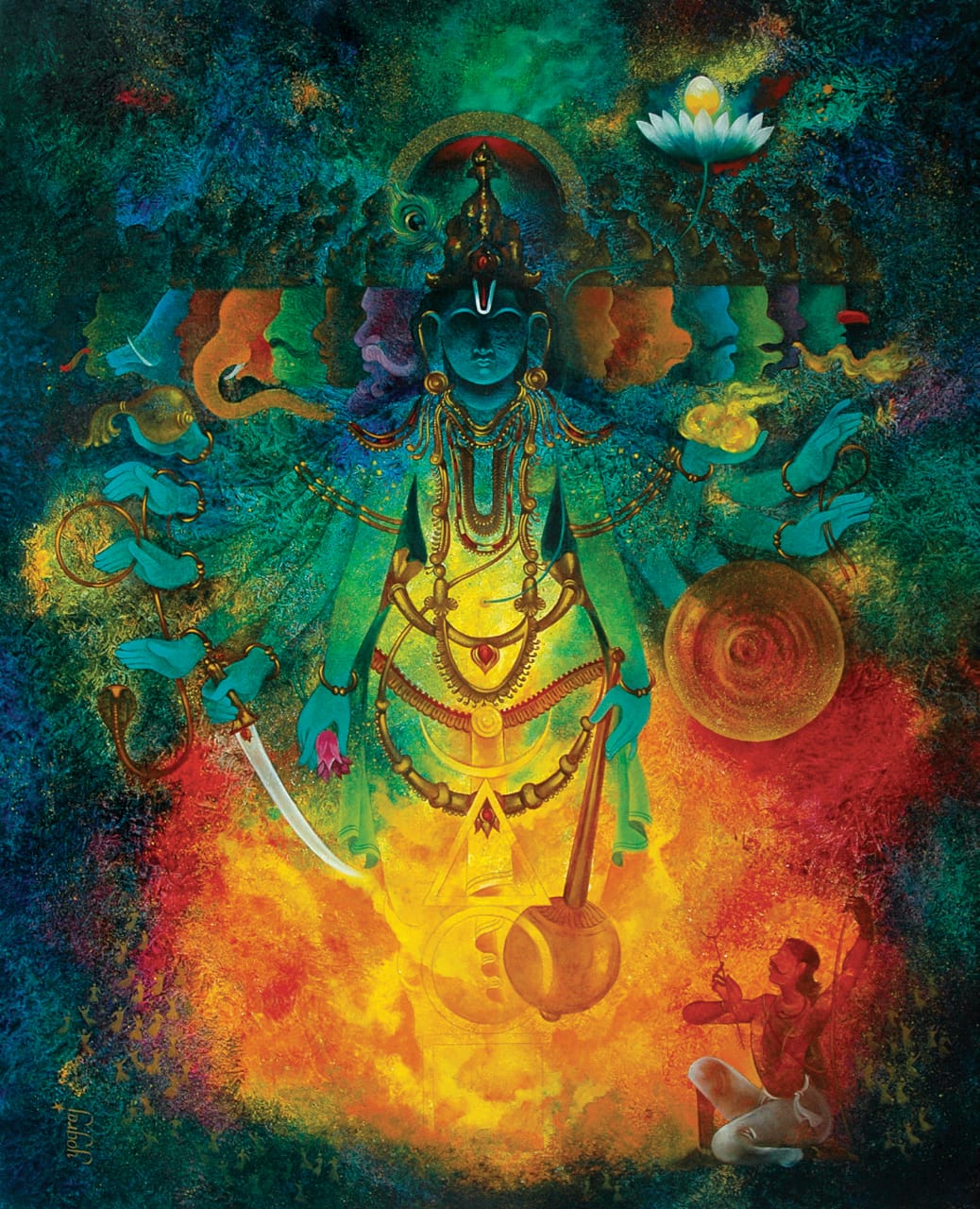
Vishnu is one of Hinduism’s principal deities, worshipped as the preserver who sustains the cosmos and restores dharma when it declines. Vaishnavas revere him as the supreme being, Narayana. He is shown four-armed and dark-blue, bearing conch, discus, mace and lotus, riding the eagle Garuda, and descending to earth as avatars including Rama and Krishna.
That reclining posture tells you something about how Hindus have understood him. Where other deities are caught mid-action, Vishnu is most characteristically shown at rest, because his work is not creation or dissolution but the long, patient business of keeping things going. He is the one who holds. And when holding is no longer enough, he comes down himself.
What Does the Name Vishnu Mean?
The name is usually glossed as all-pervasive — the one who is everywhere. The grammarian Yaska, in his Nirukta (around the fourth century BCE), derived it from roots meaning to enter or to pervade: the one who enters everywhere. The eleventh-century commentator Medhatithi put it more bluntly still — one who is everything and inside everything. Yaska offers a second reading too: that which is free from fetters and bondage.
His other names each carry a picture. Narayana is the name under which the Taittiriya Aranyaka hails him as the supreme being. Padmanabha means the one with the lotus-navel, and sculptures bearing that epithet survive from the fifth and sixth centuries. He is also Hari, Madhava, Keshava, Govinda, Achyuta and Janardana — the Vishnu Purana uses several of these interchangeably in its opening chapters. The Padma Purana gives a list of 108 of his names.
Vishnu in the Vedas: The God Who Rose
Here is a fact that surprises most people: in the oldest layer of Hindu scripture, Vishnu is a minor figure. Of the 1,028 hymns of the Rigveda, only about five are dedicated to him. He appears as a solar deity and a close ally of Indra, helping to kill the serpent Vritra. The thunderous, world-filling Vishnu of later devotion is simply not there yet.
Scholars read this differently. Jan Gonda argued he may already have been a significant deity among non-elite worshippers whose hymns were not the ones preserved. Gavin Flood traces his rise through the Brahmana texts in the middle of the first millennium BCE, after which he absorbed and merged with Vasudeva-Krishna, Gopala-Krishna and Narayana across the last centuries BCE and the first centuries CE. By the Puranic period he is supreme.
The Three Strides
The one Vedic image that survived into everything later is the Trivikrama, the three strides. Rigveda 1.154, the Vishnu Sukta, opens: I will now proclaim the heroic deeds of Vishnu. In three steps he measures out the whole of existence. Klaus Klostermaier summarises the Vedic understanding: the first step covers the earth, the second the middle air, the third the entire heaven — and the third, the realm of the immortals, is beyond mortal sight.
Worth noting honestly: the later Puranic retelling, where Vamana takes three paces of land from the demon-king Bali, places that third step differently — on Bali’s own head, with Bali sent to rule the netherworld. The Vedic third stride reaches heaven; the Puranic one reaches down. The same image has been read in two directions, and both readings are genuinely part of the tradition.
How to Read an Image of Vishnu
A Vishnu image is a sentence in a visual language. Four arms, each holding one object, and an epithet that names them in order: shankha-chakra-gada-pani, the one whose hands hold conch, discus and mace. The oldest known Vishnu sculpture, from Malhar in Chhattisgarh, carries the mace and dates to roughly 200 BCE.
One caution before the details. Texts and regions disagree about which hand holds what. The Vishnudharmottara places lotus and conch in the upper hands with mace and discus below; other authorities put the lotus in the lower left. Art historians have counted twenty-four distinct arrangements of the same four attributes. If the image in your local temple does not match a diagram you have seen, the image is not wrong.
The Conch: Panchajanya
The shankha is a conch shell, blown to open worship and once blown to open battle. It is counted among the most auspicious of all Hindu symbols and ties Vishnu to the waters — both as a fertilising force and as a cosmic sign, the sound that carries across water and air. Its name, Panchajanya, belongs to the conch Krishna carries in the Mahabharata.
The Discus: Sudarshana Chakra
The chakra is a spinning, razor-edged disc, Vishnu’s decisive weapon. Its origin is told two incompatible ways. A Shaiva account in the Shiva Mahapurana has Shiva present the discus to Vishnu after testing him with a thousand and eight lotuses. The Mahabharata, in the Khandava forest episode, has Varuna give both the discus and the mace to Krishna. Which story a text tells usually reveals which deity that text considers senior.
The Mace: Kaumodaki
The gada is a heavy club, and its name is contested. Readings include kumuda (the blue water-lily), Gonda’s kaumudi (joy on the earth), and, following the Vishnu Purana, stupefier or captivator of the mind. Its meaning is equally plural: the Vishnu Purana and Gopala Tapani Upanishad read it as the power of knowledge; the Krishna Upanishad equates it with Kali and the power of time; the Vishnudharmottara says it represents Lakshmi herself. In some sculptures it is personified as a woman, Gadadevi.
The Lotus: Padma
The padma is the clearest of the four. It stands for dharma, the cosmic law, and for purity — a flower that rises through filthy water and opens clean towards the sun, untouched by what it grew in. The Vishnudharmottara adds a second layer: the lotus growing from Vishnu’s navel is the earth itself, its stalk the cosmic mountain Meru. Held in Vishnu’s hand it signifies water; in Lakshmi’s hand it signifies wealth.
Garuda, Shesha and the Ocean of Milk
Vishnu’s mount is Garuda, the great eagle — speed and sky, the vehicle of one who pervades everywhere. His other constant companion is Shesha, also called Ananta, the endless serpent who represents time. Vishnu sleeps on Shesha’s coils, floating on the Kshira Sagara, the primeval ocean of milk, with Lakshmi beside him. From his navel a lotus opens, and within it, says the Vishnu Purana, Brahma is born and instructed to generate the universe.
This is the Anantashayana form — Vishnu reclining on the infinite — and it is the image at Badami, and the one enshrined at Thiruvananthapuram. It is also, quietly, a complete cosmology: time as the couch, water as the ground, and creation as something that flowers out of a sleeping god’s body.
Vishnu and Lakshmi
Vishnu’s consort is Lakshmi, and the relationship is described as genuine partnership rather than attendance — she is his equal complementary partner, his shakti. In the churning of the ocean she rises from the waters and chooses him, garlanding him with lotuses. In South Indian Vaishnavism the pairing is often doubled: Sridevi and Bhudevi flank him, prosperity and the earth. As Varaha, the boar, his consort is Bhudevi, the earth he has just lifted out of the ocean.
There is a theological point buried in the iconography. Lakshmi holds a lotus; Vishnu holds a lotus. Where Shiva and Parvati are often shown as opposites that complete each other, Vishnu and Lakshmi are shown as two of a kind.
Vishnu, Shiva and the Trimurti
The familiar formula gives Brahma the creating, Vishnu the preserving and Shiva the dissolving, mapped onto the three gunas: Brahma as rajas, Vishnu as sattva, Shiva as tamas. The tradition itself adds that the Trimurti are beyond the three gunas, and that the three are one in meaning.
It is worth saying plainly that this tidy triad is a later synthesis, not a Vedic given, consolidated during the Puranic centuries. Lived Hinduism has never been neatly divided by it. A Vaishnava regards Vishnu as the supreme reality of which the others are aspects; a Shaiva says the same of Shiva; the Smarta panchayatana worship treats five deities, Vishnu among them, as equivalent approaches to one divinity. The triad is a useful teaching diagram, not a census of belief.
The Ten Avatars of Vishnu (Dashavatara)
The avatar doctrine — literally a descent — is Vishnu’s distinctive contribution to Hindu thought. Its charter verse is Bhagavad Gita 4.7-4.8: Whenever righteousness wanes and unrighteousness increases I send myself forth. For the protection of the good and for the destruction of evil, and for the establishment of righteousness, I come into being age after age.
The number ten was fixed well before the tenth century CE. The most widely accepted list runs as follows.
| Avatar | Form | What he does |
|---|---|---|
| Matsya | Fish | Saves Manu and the seeds of life from the great deluge |
| Kurma | Tortoise | Supports Mount Mandara during the churning of the ocean |
| Varaha | Boar | Lifts the earth from the cosmic ocean after a long battle with Hiranyaksha |
| Narasimha | Man-lion | Kills Hiranyakashipu to save the child devotee Prahlada |
| Vamana | Dwarf | Takes three paces of land from Bali, who then rules the netherworld |
| Parashurama | Warrior sage | Son of Jamadagni and Renuka; curbs the arrogance of kings |
| Rama | Prince of Ayodhya | The hero of the Ramayana; defeats Ravana |
| Krishna | Cowherd and charioteer | Eighth son of Devaki and Vasudeva; speaks the Bhagavad Gita |
| Buddha | The Awakened One | Teaches compassion and non-violence (included from roughly the Gupta period) |
| Kalki | Rider on a white horse | Yet to come; ends the Kali Yuga |
The lists genuinely differ, and anyone who tells you there is only one is simplifying. Balarama replaces Buddha in Gaudiya Vaishnavism and in several Puranic lists; the Shiva Purana gives Balarama and Krishna; the Warkari tradition of Maharashtra puts Vithoba in the tenth place; some Odia sources substitute Jagannath. The Mahabharata’s own list in the Shanti Parva includes Hamsa, the swan, and has no Buddha at all. And the Bhagavata Purana abandons ten altogether, listing twenty-two incarnations in its first canto and twenty in its second.
The earliest hard evidence is numismatic: a coin of the Indo-Greek king Agathocles, around 185-170 BCE, showing Balarama-Samkarshana with mace and plough and Vasudeva-Krishna with conch and discus.
The Great Temples of Vishnu
Vishnu’s temples are among the largest and busiest religious sites on earth. A brief orientation, with the caveat that timings, dress rules and entry conditions change — check the temple’s own current notices before travelling.
Tirumala, Andhra Pradesh. Venkateswara, also called Balaji, Srinivasa and Govinda, stands facing east in the gold-plated Ananda Nilayam sanctum on the seventh of the seven hills. Local tradition reads those peaks as the seven heads of Adishesha. It is among the wealthiest temples in the world and reports something like 24 million visitors a year, with daily footfall commonly above 60,000. Expect a queue system and biometric tokens.
Srirangam, Tamil Nadu. Ranganatha reclining — known affectionately as Periyaperumal and Namperumal — in a complex of concentric enclosures spread over some 156 acres, often described as the largest functioning Hindu temple in the world.
Badrinath, Uttarakhand. A one-foot black granite Vishnu as Badrinarayan, seated in padmasana, high in the Garhwal Himalaya at roughly 3,100 metres. One of the Char Dham, and one of the Chota Char Dham with Kedarnath, Gangotri and Yamunotri. It opens for only about six months a year, from late April or early May around Akshaya Tritiya to a closing day in October or November — so the season, not the week, is what you plan around. Pilgrims bathe first in the Tapt Kund hot springs. Tradition credits Adi Shankaracharya with establishing it as a pilgrimage site in the ninth century, and the head priests are still drawn from Kerala.
Padmanabhaswamy, Thiruvananthapuram. Vishnu reclining on the five-hooded Anantha, in an image said to be built from 12,008 shaligram stones brought from the Gandaki river in Nepal. Entry is restricted to those professing the Hindu faith and the dress code is enforced strictly: men in plain white vesti and angavastram, women in sari. In 1750 the ruler Anizham Thirunal surrendered the kingdom of Travancore to the deity, and his successors have styled themselves Padmanabhadasa — servants of Padmanabha — ever since.
Guruvayur, Kerala. Guruvayurappan, Vishnu in the form of Krishna: a standing four-armed figure about 1.2 metres tall, carved from shaligram stone, holding all four attributes. The temple was formally opened to all Hindus on 2 June 1947 after a long non-violent campaign. Its dress and entry rules are notably strict and are best checked directly.
The Alvars and the 108 Divya Desams
Between roughly the sixth and ninth centuries — the dating is contested, with proposals ranging from the fifth to the tenth century — twelve Tamil poet-saints called the Alvars, meaning the immersed, remade devotion to Vishnu in the vernacular. Their four thousand verses, the Nalayira Divya Prabandham, were compiled by Nathamuni, who called the collection the Tamil Veda. Ramanuja later granted it standing equal to the Sanskrit Veda.
The 108 Divya Desams are the temples their hymns sanctify. Of these, 105 are in India — 84 in Tamil Nadu alone — one is Muktinath in Nepal, and the last two are not on earth at all: the ocean of milk, and Vaikuntha itself. Two of the Alvars stand out. Nammalvar, whose Tiruvaymoli runs to 1,102 verses, is remembered for preferring service to the Lord over liberation itself. Andal, the only woman among them, is the bridal mystic who vowed to marry none but Vishnu; her Tiruppavai is still sung every Margazhi morning, and she is counted among India’s great women saints.
Festivals of Vishnu
Vishnu’s calendar is largely the calendar of his avatars. Rama Navami marks Rama’s birth and Krishna Janmashtami Krishna’s, in late August or early September. Narasimha Jayanti honours the man-lion. Diwali is read in much of India as Rama’s return to Ayodhya, while in Kerala Onam and in Maharashtra Balipratipada mark the yearly homecoming of Bali, the king Vamana humbled — the same festival season, two different heroes.
Vaikuntha Ekadashi is the great Vaishnava observance. It falls on the eleventh day of the waxing fortnight in the solar month of Dhanu, which places it somewhere between 16 December and 13 January; at Srirangam the northern Paramapada Vasal, the gate to the highest realm, is opened on this one day of the year. Note that the reckoning and the accompanying names differ between North and South India, and sources do not fully agree on how this day lines up with Mokshada or Putrada Ekadashi. Shayani Ekadashi and Prabodhini Ekadashi bracket the four months of Vishnu’s sleep, and Tulsi Vivaha follows soon after — a cluster that also shapes Kartik Purnima.
Because all of these are reckoned by the lunar and solar Hindu calendar, their Gregorian dates move every year, and any muhurat you read online is calculated for a particular city. If you are observing from the United States, the United Kingdom, Canada or Australia, the tithi may begin and end on a different local date than it does in India. Check a panchang for where you actually are.
Mantras and Chants for Vishnu
Three are in constant use. Om Namo Narayanaya — I bow to Narayana — is the simplest and the most widely chanted. Om Namo Bhagavate Vasudevaya addresses him as Vasudeva, the son of Vasudeva and the indwelling one. And Hari Om is short enough to carry through an ordinary day.
The great recitation, though, is the Vishnu Sahasranama, the thousand names. It appears in the Anushasana Parva of the Mahabharata, where a dying Bhishma recites it to Yudhishthira, and again in the Garuda Purana. Many households chant it on Saturdays or on Ekadashi; it takes about half an hour, and the traditional claim is that the names are not descriptions of Vishnu but doorways into him.
Why Vishnu Still Matters
Of the three great functions, preservation is the least glamorous. Creation is dramatic. Destruction is dramatic. Maintenance is what happens on Tuesdays. And yet the thing most of us are actually doing with our lives is maintenance: holding a family together, keeping a commitment we made years ago, turning up again for work that nobody applauds.
Vishnu is the deity who takes that seriously. His theology says the universe does not merely need to be started; it needs to be held, continuously, by someone paying attention. And the avatar doctrine adds something tougher: that when the holding fails, the response is not to abandon the world but to enter it. Vishnu does not fix things from Vaikuntha. He is born, as a fish, as a boar, as a child in a cowherd village, and takes the consequences from inside.
There is one more practical idea worth carrying away. In the Vaishnava traditions, the decisive movement is not the devotee’s climb but the Lord’s descent. You are not required to become worthy first. That is a genuinely different emotional architecture from self-improvement, and it is why so much Vaishnava poetry sounds less like striving and more like being found. Vishnu’s own dharma, if we can speak that way, is to keep showing up.
Frequently Asked Questions
Who is Lord Vishnu in Hinduism?
Vishnu is the Hindu deity of preservation — the one who sustains the cosmos and intervenes to restore dharma when it declines. In the Trimurti framework he stands between Brahma the creator and Shiva the dissolver. For Vaishnavas, who make up one of the largest streams of Hinduism, he is not one god among three but the supreme reality itself, worshipped as Narayana.
What are the 10 avatars of Vishnu in order?
The most widely accepted order is Matsya the fish, Kurma the tortoise, Varaha the boar, Narasimha the man-lion, Vamana the dwarf, Parashurama, Rama, Krishna, Buddha and Kalki, who is still to come. That said, the lists genuinely vary by tradition: Balarama replaces Buddha in Gaudiya Vaishnavism and several Puranas, the Warkaris of Maharashtra name Vithoba, and the Bhagavata Purana counts twenty-two incarnations rather than ten.
What do Vishnu’s four hands hold and what do they mean?
He holds the conch Panchajanya, the discus Sudarshana, the mace Kaumodaki and the lotus Padma. Broadly, the lotus signifies dharma and purity, the conch links him to the primordial waters and to sacred sound, the discus is his decisive power against disorder, and the mace is read variously as the power of knowledge, of time, or of Lakshmi herself. Which hand holds which object varies by text and region.
Is Vishnu the same as Krishna?
It depends on who you ask, and the difference matters. Most Hindus regard Krishna as an avatar of Vishnu — a descent of the preserver into human form. But in Gaudiya Vaishnavism, and in the Vallabha and Nimbarka traditions, Krishna is Svayam Bhagavan, God in his own original person, with Vishnu understood as his expansion rather than his source. Both positions are internally coherent and both are long established.
Why is Vishnu blue?
The traditional explanation connects the colour to the infinite: the blue-black of deep water and of the night sky, the hue of something too vast to be seen whole. Vishnu is associated with the cosmic ocean, and dark blue reads as boundlessness rather than as a skin tone. It is an iconographic convention carrying a theological claim about his immensity, not a literal description.
Which is the most important temple of Vishnu?
There is no single answer, and the honest reply depends on the tradition. Tirumala Tirupati draws the largest crowds and the greatest wealth. Srirangam is the foremost of the 108 Divya Desams for Sri Vaishnavas and probably the largest working temple complex anywhere. Badrinath carries unmatched weight as a Char Dham site. Padmanabhaswamy and Guruvayur are supreme in their own regions. Devotees rank them by lineage, not by size.
Go back to the Badami rock and look at the posture once more. A god lying down, perfectly at ease, with the whole of time coiled beneath him and the universe about to open from his navel like a flower. It is not an image of power as we usually picture it. It is an image of something so secure that it can afford to rest — and so attentive that it will rise, again and again, whenever the world needs holding.
Continue Exploring
- Who Is Lord Krishna? The Story, Symbolism and Worship of the Eighth Avatar
- Who Is Lord Rama? The Story, Symbolism and Worship of Maryada Purushottam
- Who Is Goddess Lakshmi? The Story, Symbolism and Worship of the Goddess of Fortune
- How to Chant the Vishnu Sahasranama
- Who Is Lord Shiva? The Story, Symbolism and Worship of Mahadeva