
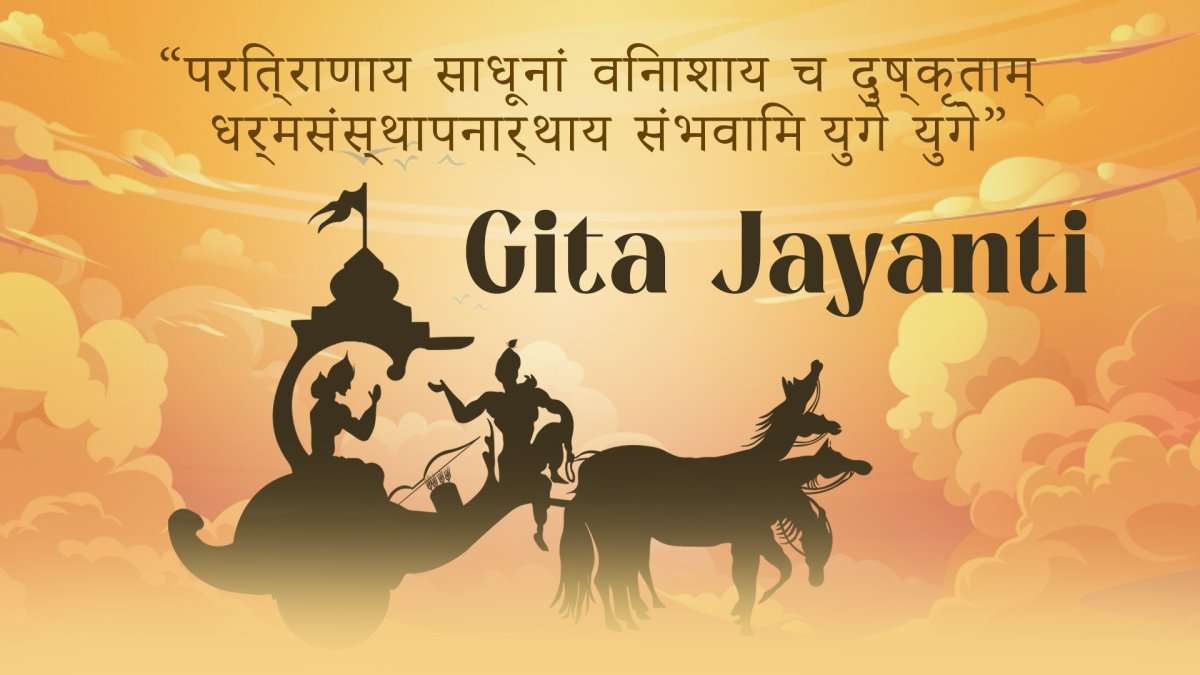
The armies had already taken their positions. Conch shells and kettledrums had torn the morning open, and two vast formations stood facing each other across a few hundred yards of dust, waiting for the word. And then the greatest archer of his age asked to be driven into the empty ground between them, looked at the faces on both sides — uncles, cousins, the teacher who had taught him to hold a bow — and found that he could not do it. Arjuna sat down in his chariot. The Gandiva, the bow that kings feared, slipped out of his hand.
What his charioteer said to him in the hour that followed did not make the war go away. It did something stranger and far more lasting. It turned one soldier’s collapse into the most widely read spiritual dialogue in human history. Hindus do not, as a rule, celebrate the birthday of a book. For the Bhagavad Gita — literally the Song of the Lord — they make an exception, and that exception is called Gita Jayanti.
Gita Jayanti marks the day Krishna is believed to have spoken the Bhagavad Gita to Arjuna at Kurukshetra, moments before the Mahabharata war began. It falls on Shukla Ekadashi of the lunar month of Margashirsha, the same day as the Vaishnava fast of Mokshada Ekadashi. In 2026 it falls on Sunday, 20 December. Devotees fast, recite the Gita, and gather for public readings.
Gita Jayanti 2026 Date and Tithi
Gita Jayanti 2026 falls on Sunday, 20 December 2026. The day is fixed not by the Gregorian calendar but by the tithi — the lunar day — of Margashirsha Shukla Ekadashi, the eleventh day of the waxing moon in the month of Margashirsha. Because lunar months drift against the solar year, the date moves every year, which is why it fell in early December in some years and close to the solstice in others.
| Detail | Gita Jayanti 2026 |
|---|---|
| Date | Sunday, 20 December 2026 |
| Tithi | Margashirsha Shukla Ekadashi |
| Tithi begins | Approx. 10:10 PM on 19 December (IST, New Delhi) |
| Tithi ends | Approx. 8:15 PM on 20 December (IST, New Delhi) |
| Also observed as | Mokshada Ekadashi; Matsya Dvadashi follows |
| Principal public celebration | International Gita Mahotsav, Kurukshetra, Haryana |
| Deity worshipped | Krishna, as Vishnu and as teacher |
| Core observance | Fasting, Gita paath (recitation), Gita aarti |
Two cautions about those timings, and they matter. First, the tithi window above is calculated for New Delhi in Indian Standard Time. Tithis begin and end at a precise moment, not at midnight, so the calendar date on which an ekadashi is observed can shift by a day once you move to a different longitude. If you are reading this in New Jersey, Leicester, Toronto or Melbourne, do not assume 20 December — check a panchang calculated for your own city, or ask your local temple, which will have already worked it out.
Second, panchang sources do occasionally disagree, and at least one calendar site places Gita Jayanti 2026 in early December instead. That reading does not survive scrutiny: Kartik Purnima 2026 falls on 24 November, which puts Margashirsha Shukla Ekadashi in the third week of December, not the first. The great majority of panchangs, and the arithmetic of the lunar month itself, point to 20 December. Where a date is genuinely contested, the honest answer is to follow the panchang your family or sampradaya has always followed.
What Gita Jayanti Actually Commemorates
Gita Jayanti commemorates an act of teaching, not a birth, a victory or a miracle. The Bhagavad Gita sits inside the Bhishma Parva of the Mahabharata as a dialogue of seven hundred verses, spoken in the narrow gap of time between the armies forming up and the first arrow being loosed. The word jayanti usually means a birth anniversary. Applied to a text, it carries the sense that on this day the Gita entered the world.
The moment on the battlefield
The Gita opens with a question from a blind king and ends with a charioteer’s victory cry, but its real spine is Arjuna’s refusal. In the first chapter, Arjuna describes exactly what we would now call a panic attack: his limbs fail, his mouth dries, his skin burns, his bow falls. He would rather be killed unarmed than kill his own kin. The despair is given its own name in the tradition — Arjuna Vishada Yoga, the yoga of Arjuna’s grief — and it is worth noticing that Hinduism’s most famous spiritual text begins with a breakdown rather than a blessing.
What Krishna offers in reply is not consolation. Over eighteen chapters he dismantles Arjuna’s reasoning, teaches him about the imperishable self, about action performed without grasping at its results, about devotion, knowledge and disciplined work as three roads up the same mountain, and finally shows him a vision so vast that Arjuna begs him to stop. The dialogue ends with Arjuna standing up. That is the whole arc the festival marks: a man who could not act, and then could.
Why the Gita Alone Has a Birthday
The Gita has a jayanti because, uniquely among Hindu scriptures, the tradition can place it at a moment. The Vedas are held to be apaurusheya — not of human authorship, without beginning, heard rather than composed. You cannot date what was never made. The Upanishads emerge from forest schools across centuries. The Puranas accumulate. But the Gita is spoken by a named speaker to a named listener on a named field on a particular morning, and the Mahabharata records all three.
That specificity is also why the Gita travels so well. It is short enough to carry, dialogic enough to feel like someone is talking to you, and situated in a crisis that readers recognise. The Vedas are chanted by specialists; the Gita gets read on trains. Gita Jayanti is, in a sense, the festival of a scripture that ordinary householders actually read for themselves — which may explain why its observance has grown rather than faded.
One honest caveat about chronology. Some almanacs and commemorative pamphlets state a precise year for the Gita’s utterance, usually a date in the fourth millennium BCE derived from traditional Kali Yuga reckoning. Historians, working from the language and layers of the Mahabharata, generally place the composition of the Gita somewhere in the few centuries around the turn of the common era. These are two different kinds of claim — devotional chronology and textual history — and Gita Jayanti does not require you to settle the argument. The day marks the teaching, whatever year the calendars assign it.
Mokshada Ekadashi: The Fast That Shares the Day
Gita Jayanti falls on Mokshada Ekadashi, one of the twenty-four ekadashi fasts of the Vaishnava year, and for many families the fast is the more familiar half of the day. The name means roughly the giver of liberation. Its legend is told in the Brahmanda Purana and the Padma Purana: King Vaikhanasa of Champaka dreams that his dead father is suffering in naraka, the realm of torment. Advised by his brahmins, he consults the sage Parvata Muni, who traces the father’s condition to a failure of duty in his own lifetime and prescribes the Mokshada Ekadashi vow. The king and his family keep the fast, and the merit they generate lifts the father out.
Notice what that story is about: merit earned by the living, offered to the dead. Mokshada Ekadashi is one of the days on which Hindus act on the conviction that liberation can be shared. Set beside Gita Jayanti, the pairing is almost too neat — a fast for the release of ancestors falling on the day a text about the imperishable self was spoken. Whether the two observances were deliberately aligned or simply converged on the same tithi, tradition has long read them together.
The fast itself is kept in two grades. The strict form is a complete fast from sunrise to the following dawn, broken at the prescribed parana time on Dvadashi, the twelfth day. The common householder form permits one meal of fruit, milk, nuts and vegetables, while avoiding grains, rice, lentils, beans, onion and garlic. Those who are ill, pregnant, elderly, very young, or doing heavy physical work are traditionally exempt — a point worth repeating, because the fast is a devotional discipline, not an endurance test, and no reputable teacher asks a person to damage their health for it.
Kurukshetra and Jyotisar: Where It Is Said to Have Happened
Kurukshetra, in the modern Indian state of Haryana, is the field the Mahabharata names, and it has been a pilgrimage region for a very long time. Pilgrims walk the 48 Kos Parikrama, a circuit of scores of sacred sites spread across the surrounding districts, and the tanks of Brahma Sarovar and Sannihit Sarovar draw bathers through the year. Within that landscape, the small site of Jyotisar is traditionally identified as the exact spot where Krishna spoke to Arjuna, marked by an ancient banyan said to be a descendant of the tree that stood there.
It is worth being straightforward about the status of that identification. It rests on long and continuous tradition, local memory and the testimony of pilgrims, not on archaeological proof, and scholars have questioned whether any single tree or clearing can be pinned to the dialogue. Devotees who go there generally know this and are untroubled by it: Jyotisar is honoured as the place where the teaching is remembered, and the remembering is itself centuries old. If you visit expecting a documented crime scene you will be disappointed; if you go to sit under a banyan where millions have read the Gita aloud, you will not be.
The International Gita Mahotsav
The largest public observance is the International Gita Mahotsav at Kurukshetra, organised around Brahma Sarovar by the Government of Haryana together with the Kurukshetra Development Board, Haryana Tourism, the district administration and the North Zone Cultural Centre. It has run as an international event since at least 2016 and has been inaugurated in various years by the President of India, the state Governor and the Chief Minister. Recent editions have featured hundreds of national and international stalls, folk and classical performances, exhibitions, a mass Gita recitation, and the Gita aarti on the steps of the tank — a prayer, incidentally, that is not found anywhere in the Gita itself.
One practical note for anyone thinking of travelling: the Mahotsav does not always sit neatly on the tithi. Past editions have run anywhere from a week to nearly three, sometimes beginning well before Gita Jayanti and sometimes straddling it, and the dates are announced by the Haryana government each year. If you are planning a trip for December 2026, check the official Haryana Tourism and Kurukshetra Development Board announcements rather than assuming the festival runs on the 20th.
How Gita Jayanti Is Observed
Gita Jayanti is observed mainly through recitation, fasting and giving. There is no elaborate puja vidhi peculiar to the day and no mandatory ritual apparatus, which is part of its appeal: the central act is reading a book attentively, which anyone can do anywhere. Temples, Gita study circles, ISKCON centres, Chinmaya Mission branches and Gita Pariwar chapters typically hold organised readings, competitions for children and discourses on a chosen chapter.
Gita paath: reading the text aloud
The signature observance is Gita paath, the recitation of the text. Some households read all eighteen chapters in one sitting, which takes roughly four to five hours at an unhurried pace. Others read a single chapter, most often the second or the twelfth. Groups divide the chapters between readers so that the whole Gita is completed collectively. Reciting in Sanskrit is traditional and carries its own discipline of sound, but reading in Hindi, Tamil, Gujarati, Bengali or English is entirely acceptable and far better than not reading at all.
Fasting and the ekadashi discipline
Because the day is Mokshada Ekadashi, many observers keep the ekadashi fast alongside the reading, breaking it the next morning during the parana window. Vaishnava households commonly add a Vishnu or Krishna puja, with tulsi leaves, and some recite the Vishnu Sahasranama, the thousand names of Vishnu, which pairs naturally with an ekadashi. In many families the fast is kept by one or two members on behalf of the household rather than by everyone.
Giving the Gita away
A custom that has grown considerably in the last few decades is the gifting of copies of the Gita on this day — to students, to hospitals, to libraries, to anyone who asks. Devotional organisations distribute the text in bulk, and families mark the day by buying copies to pass on. The logic is straightforward and rather attractive: if the day commemorates a teaching being given, the fitting way to keep it is to give the teaching to someone else.
How to Observe Gita Jayanti at Home
You need very little: a copy of the Gita, a clean place to sit, and an hour you are willing to protect. A workable shape for the day, which families adapt freely, runs roughly as follows.
- Bathe and keep the morning simple. Light a lamp before your home shrine, or simply before the book itself — the Gita is traditionally treated with the respect given to a deity, kept on a clean cloth and not placed on the floor.
- Offer tulsi, flowers, fruit and a little sweet to Krishna if you keep an image or murti. No elaborate vidhi is required.
- Read. If you have one hour, read Chapter 2. If you have a morning, read Chapters 2, 12 and 18. If you have the whole day, read all eighteen.
- Read with someone else if you can. The Gita is a dialogue, and it behaves differently when two people argue about it than when one person skims it.
- Keep the ekadashi fast in whichever grade suits your health, and break it at the parana time for your city.
- Give a copy away, or donate food. End the evening with the Gita aarti or simply a few minutes of silence.
For readers outside India, two adjustments help. Work out the correct local date from a panchang calculated for your city, because in the Americas a tithi that falls on 20 December in Delhi may land on the 19th where you are. And if 20 December 2026 — a Sunday, conveniently — is a working or school day in your country in other years, most teachers will tell you that reading the Gita a day late is better than not reading it, and that the fast may be kept as your circumstances allow.
Which Chapter Should You Read?
If the whole text is too much for one day, choose by what you actually need. Chapter 2, Sankhya Yoga, is the standard choice and arguably the Gita in miniature: the imperishable self, the futility of grief over what cannot die, and the celebrated instruction to act without clinging to the fruit of action. Chapter 12, on devotion, is the shortest and gentlest, and lists in plain terms the qualities of a person dear to God. Chapter 18 gathers the argument and releases Arjuna to choose.
Chapter 3 is the one to read if you work for a living and suspect your work is spiritually irrelevant; it argues the opposite. Chapter 11, the vision of the universal form, is the one to read if the Gita has begun to feel merely sensible — it is terrifying, and meant to be. And if you want the shape of the whole before the parts, the Gita’s three roads of knowledge, action and devotion are the frame everything else hangs on.
Why Gita Jayanti Matters Today
The Gita is addressed to a man in the middle of an obligation he did not choose and cannot honourably escape. That is an unusual starting point for a scripture, and it is exactly why the text keeps finding readers who are not religious. Arjuna is not asking how to reach heaven. He is asking what to do on a morning when every available option costs something irreplaceable, and whether there is any way to act without being destroyed by the acting.
Krishna’s answer — act because the action is yours to do, with full skill and without mortgaging your peace to the outcome — has an obvious application to anyone who has ever cared too much about a result they could not control. It is not a licence for indifference, which is the standard misreading. Arjuna is told to fight well, not to stop caring whether he fights well. The release is from the grip of the result, not from the duty. That distinction is the whole of nishkama karma, and it is what makes the Gita useful to a surgeon, a parent, a founder or a civil servant.
There is one more reason the day is worth keeping. Gita Jayanti asks you to read something slowly, once a year, in company, in a culture that has made slow attention almost impossible. Even stripped of every devotional element, an afternoon spent reading seven hundred verses about duty, death and detachment with your family is not a wasted afternoon. The festival survives because the practice it asks for is small, portable and genuinely good for the person who does it.
Frequently Asked Questions
When is Gita Jayanti in 2026?
Gita Jayanti 2026 falls on Sunday, 20 December 2026, on Margashirsha Shukla Ekadashi. For New Delhi, the ekadashi tithi runs from roughly 10:10 PM on 19 December to roughly 8:15 PM on 20 December. Because tithis begin and end at precise moments rather than at midnight, readers outside India should confirm the date against a panchang calculated for their own city.
What is the difference between Gita Jayanti and Mokshada Ekadashi?
They are two observances on the same tithi. Gita Jayanti commemorates the speaking of the Bhagavad Gita at Kurukshetra and is kept chiefly through recitation. Mokshada Ekadashi is one of the twenty-four ekadashi fasts of the Vaishnava year, dedicated to Vishnu, whose legend in the Brahmanda and Padma Puranas concerns liberating ancestors from suffering. Many families keep both together, fasting and reading on the same day.
Do you have to fast on Gita Jayanti?
No. Fasting belongs to the ekadashi observance rather than to Gita Jayanti itself, and the essential act of the day is reading the Gita. Those who do fast usually keep either a full fast from sunrise to the next dawn or a partial fast on fruit, milk and vegetables while avoiding grains, pulses, onion and garlic. The ill, the pregnant, the elderly, children and those doing heavy physical work are traditionally exempt.
Where was the Bhagavad Gita spoken?
The Mahabharata places the dialogue on the field of Kurukshetra, in present-day Haryana, between the two assembled armies. Within that region, the site of Jyotisar is traditionally identified as the precise spot, marked by an ancient banyan held to descend from the original tree. That identification rests on long-standing tradition rather than archaeological evidence, and some scholars treat it as devotional rather than historical.
How long does it take to read the whole Bhagavad Gita?
Reading all eighteen chapters and seven hundred verses aloud at an unhurried pace takes most readers about four to five hours, which is why many households split the chapters between several people or read in two sittings. If you have only an hour, Chapter 2 is the traditional choice, since it contains the Gita’s central teachings on the imperishable self and on acting without attachment to results.
Is the International Gita Mahotsav held on Gita Jayanti?
Not exactly. The Gita Mahotsav at Kurukshetra, organised by the Government of Haryana around Brahma Sarovar, is a multi-day festival that includes Gita Jayanti but has in past years run anywhere from about a week to nearly three, sometimes beginning well before the tithi. Dates are announced annually, so anyone planning to travel should check official Haryana Tourism and Kurukshetra Development Board announcements for 2026.
A Closing Thought
Most festivals ask us to light something, cook something or go somewhere. Gita Jayanti asks us to sit down and listen to a conversation that happened, by tradition, between two heartbeats of a war. The armies in that story never stopped waiting; the dialogue took place inside a pause that the world was not going to grant. Perhaps that is the real instruction of the day. The pause is always available, and what gets said in it can change what a person does next.
Continue Exploring
- Bhagavad Gita Explained: Chapters and Significance
- Bhagavad Gita Chapter 2: The Yoga of Knowledge
- 10 Key Teachings of the Bhagavad Gita for Modern Life
- Who Is Lord Krishna? Story, Symbolism and Worship
- What Is Dharma? The Idea That Holds Everything Together