
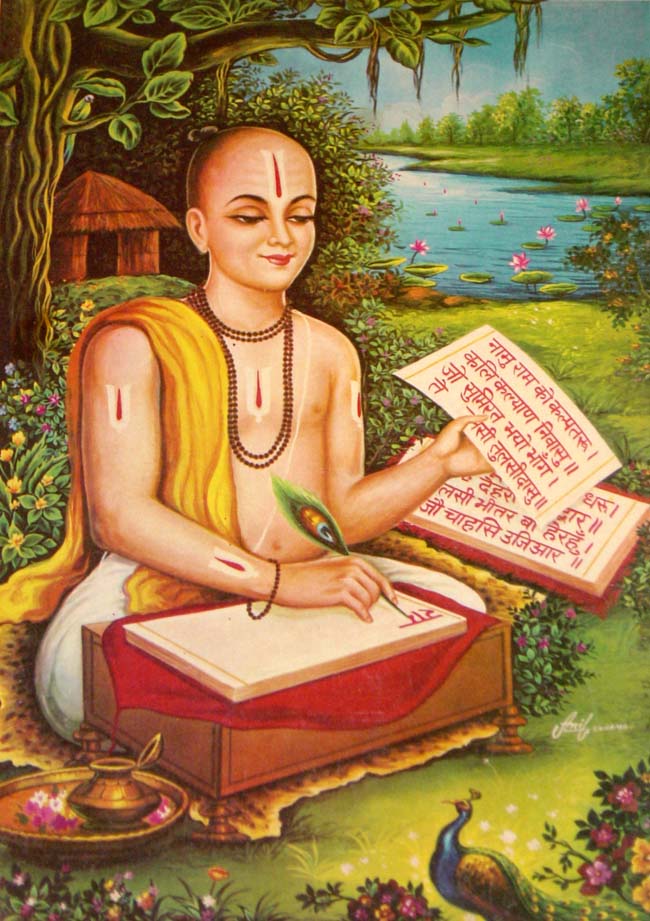
On a Sunday in the spring of 1574, in Ayodhya, an elderly man sat down to begin a poem in the language ordinary people actually spoke. Valmiki’s Sanskrit Ramayana had existed for something like two thousand years by then: magnificent, authoritative and almost entirely out of reach, the preserve of men trained from childhood to read it. What this man set out to do was hand the story of Rama back to the farmer, the weaver and the woman at the grinding stone. He wrote in Awadhi, the everyday dialect of the eastern Ganga plain. By his own account in the text, it took him two years, seven months and twenty-six days. The result, the Ramcharitmanas, is still sung aloud in millions of North Indian households every week, four and a half centuries later.
Goswami Tulsidas was a North Indian saint-poet, most widely dated to around 1511-1623, who composed the Ramcharitmanas: a retelling of the Ramayana in the Awadhi vernacular rather than in Sanskrit. A lifelong devotee of Rama, he lived mainly in Varanasi, is said to have founded the Sankat Mochan Hanuman temple there, and is traditionally credited with the Hanuman Chalisa.
It is difficult to overstate what that choice of language did. Across the Hindi-speaking belt, when someone says they are reading the Ramayana, they almost always mean the Ramcharitmanas. Phrases from it have slipped into everyday speech the way Shakespeare has into English. The Ramlila performances staged every autumn, the chaupai couplets that grandmothers recite from memory, the devotional idiom of Rama-bhakti in half of India: all of it runs through Tulsidas. He did not merely translate a story. He rebuilt it as something a village could hold.
A Life Known Mostly Through Legend
Before anything else, an honest caution: we know remarkably little about Tulsidas with certainty. Almost every colourful story about him comes from hagiographies written after his death, and scholars have argued over the basic facts of his life for more than a century. The earliest accounts are Nabhadas’s Bhaktamal (composed in the decades around 1600), Krishnadatta Misra’s Gautam Chandrika (1624), Veni Madhav Das’s Mula Gosain Charit (1630), Priyadas’s commentary on the Bhaktamal (around 1712) and a Gosain Charit of roughly 1770. Priyadas, the source of the most famous miracles, was writing about a century after Tulsidas died.
Some modern scholars dismiss the later accounts outright; others are unwilling to throw them away, on the grounds that oral memory in a devotional community is not worthless. What follows separates the two as carefully as possible. Where a detail rests on Tulsidas’s own writing, it is marked as such. Where it rests on tradition, that is said plainly. Readers who want the devotional life as the tradition tells it lose nothing by knowing which parts the historians cannot confirm.
When Was Tulsidas Born? The Dates Nobody Agrees On
There is no settled birth year for Tulsidas, and anyone who gives you one without a caveat is simplifying. Three figures circulate. Vikram Samvat 1568, equivalent to 1511 CE, is the date accepted by a long line of scholars including Sir George Grierson and R. G. Bhandarkar, and it is the one most often used in academic writing. The year 1497 CE appears in a great many popular Indian biographies and in school textbooks; its critics point out that it would give Tulsidas a lifespan of about 126 years, though defenders have replied, not unreasonably within the tradition, that longevity is no obstacle for a mahatma. The Encyclopaedia Britannica, meanwhile, offers a cautious “1543?”.
The tithi is less contested than the year. Tradition places his birth on Saptami, the seventh day of the waxing moon, in the month of Shravana, which falls in July or August. His death is generally placed in 1623 at Varanasi, by tradition at Assi Ghat on the Ganga, although the biographers do not agree on the exact day. If you want a single sentence to carry away: he was a sixteenth-century figure who lived into the early seventeenth, and the precise arithmetic is genuinely unresolved.
And Where Was He Born?
Two places claim him, and a third has been made official. Most scholars identify his birthplace as Soron, in present-day Kasganj district of Uttar Pradesh, partly because Tulsidas refers to hearing the Rama story at a place generally identified with Soron. A long and strong tradition instead names Rajapur, on the Yamuna, which most sources place in Chitrakoot district while at least one scholarly site places it in Banda. In 2012 the Uttar Pradesh government formally declared Chitrakoot his birthplace. Britannica hedges with “probably Rajapur”. The dispute is live, local pride is involved on both sides, and this article takes no position.
Rambola: The Child Who Was Sent Away
The tradition names his parents as Atmaram Dubey and Hulsi, and says the boy was called Rambola, “the one who said Rama”, because he is held to have uttered the name at birth instead of crying. Tulsidas himself confirms the name in the Vinaya Patrika. The surrounding details, that he stayed twelve months in the womb and was born with a full set of teeth, belong firmly to the genre of saint-legend and should be read as devotional rather than biographical.
One hard fact survives inside the legend, and it is a painful one. In both the Kavitavali and the Vinaya Patrika, Tulsidas states that his family abandoned him soon after his birth. The tradition supplies the reasons, inauspicious astrological configurations, and a maidservant who took the infant away; those names and places come from later accounts. But the abandonment itself is in his own voice. The poet who would spend his life writing about a prince exiled from his kingdom and about Hanuman, the servant who never leaves, began as a child nobody kept. Readers of the Ramcharitmanas have been drawing that connection for centuries, and it is hard to blame them.
The Guru Who Gave Him Rama
Tulsidas’s teacher is remembered as Narharidas, also called Narharyanandacharya, an ascetic of the Ramanandi tradition who is said to have taken the orphaned boy in. The tradition holds that Narharidas performed his upanayana, the sacred-thread initiation, at Ayodhya when he was about seven, and that it was from Narharidas that he first heard the Rama story told as something living rather than recited.
What followed was the long, unglamorous apprenticeship that Indian learning has always demanded. Accounts describe fifteen or sixteen years of study at Varanasi under a scholar named Shesha Sanatana, based at Pancaganga Ghat, covering Sanskrit grammar, the four Vedas, the six Vedangas, Jyotisha (traditional astronomy and astrology) and the six classical schools of philosophy. This matters for reading him. The Ramcharitmanas is written in a village dialect by a man who had read everything; its apparent simplicity is a decision, not a limitation. If you want the shape of the relationship that produced him, it is the guru-shishya parampara at full strength.
Ratnavali and the Turning Point
Here is the most repeated story about Tulsidas, and it needs careful handling. According to the Tulsi Prakash and several later works, he married a woman named Ratnavali, daughter of Dinbandhu Pathak, and loved her to the point of obsession. A son, Tarak, died in infancy. One night, finding her gone to her parents’ house, he swam a flooded river to reach her; she met him with a rebuke that has become proverbial, telling him that if he were even half as devoted to God as he was to her body of flesh and blood, he would already be redeemed. He is said to have walked away that night and never returned to householder life.
It is a magnificent story. It is also not attested anywhere in Tulsidas’s own writings. It appears only in later hagiography, and a serious body of opinion rejects it entirely: some authors treat the marriage as a later interpolation, and Jagadguru Rambhadracharya has argued from verses in the Vinaya Patrika and the Hanuman Bahuk that Tulsidas never married and was an ascetic from childhood. Both readings are held sincerely. What can be said without strain is that the tradition has found the story useful, because it dramatises something the Ramcharitmanas does teach: that attachment aimed at the wrong object is not love’s failure but its misdirection.
The Ramcharitmanas: Ayodhya, 1574
Tulsidas dates his own masterwork, which is why this is one of the few firm facts in his life. He began the Ramcharitmanas in Vikram Samvat 1631, that is 1574 CE, at Ayodhya, on a Sunday, on Ram Navami, the day celebrated as Rama’s birth. Tradition adds that he completed it in Vikram Samvat 1634 (1577 CE) on Vivaha Panchami, the day marking Rama and Sita’s wedding, after two years, seven months and twenty-six days. Britannica places the composition more loosely between 1574 and 1576 or 1577, so the end date carries slightly less weight than the beginning.
The title repays unpacking. Ramcharitmanas means something like “the lake of the deeds of Rama” — manas being a lake, with an unmistakable echo of Lake Manasarovar. The poem is not a book you read so much as a body of water you enter. It runs to seven kandas, or books, of very unequal length, following the same arc as the seven kandas of Valmiki’s Ramayana, though it is considerably shorter and differently weighted.
What Tulsidas Changed
The Ramcharitmanas is not a translation, and treating it as one misses the point. Valmiki’s Rama is a great man, bound and sometimes broken by dharma. Tulsidas’s Rama is God, consciously and from the first line, and the poem’s energy comes not from the plot but from the devotee’s posture before him. Britannica notes that while Valmiki’s Sanskrit epic is the ultimate source of the narrative, Tulsidas’s principal immediate source was the Adhyatma Ramayana, a devotional and Advaitic retelling, with the influence of the Bhagavata Purana also discernible. The theological temperature is simply different. If you want the specific divergences set side by side, we have a dedicated comparison of Valmiki’s and Tulsidas’s Ramayanas.
The other change was structural. By writing in Awadhi rather than Sanskrit, Tulsidas moved the text out of the hands of a literate elite and into the mouth of anyone who could memorise a couplet. That was not a neutral act in sixteenth-century North India, and the tradition preserves a memory of resistance to it: the legends about Varanasi pandits attempting to suppress or steal the manuscript, however embellished, are a fair record of how disruptive a vernacular scripture felt. Several surviving manuscripts are claimed to be in the poet’s own hand, and the oldest complete manuscript is dated 1647, a generation after his death.
The Works of Tulsidas
Twelve works are generally accepted as Tulsidas’s, with a handful of others popularly attributed to him. Britannica puts it carefully: besides the Ramcharitmanas, “eleven other works are attributed with some certainty”. Editors differ over which belong in the major group and which are minor, and over a few attributions altogether, so the table below marks the status rather than pretending to a settled canon.
| Work | What it is | Status |
|---|---|---|
| Ramcharitmanas | The life of Rama in seven kandas, in Awadhi; his masterwork | Securely his; self-dated |
| Vinaya Patrika | A “petition” of some 279 devotional verse passages, widely read as his most personal work and often treated as among his last | Securely his |
| Kavitavali | The Rama story again, in ornate kavitta metres rather than village song | Securely his |
| Dohavali | A collection of standalone couplets (dohas) on devotion and conduct | Securely his |
| Gitavali | Lyric songs on episodes from Rama’s life | Securely his |
| Krishna Gitavali | Sixty-one songs on Krishna, his one substantial turn away from Rama | Securely his |
| Barvai Ramayan | A compressed Rama narrative in the short barvai metre | Generally accepted, minor |
| Janaki Mangal | The wedding of Rama and Sita as an auspicious song cycle | Generally accepted, minor |
| Parvati Mangal | The wedding of Shiva and Parvati, in the same celebratory mode | Generally accepted, minor |
| Ramalala Nahachhu | A folk-style song for the child Rama’s pre-wedding nail-cutting rite | Generally accepted, minor |
| Ramagya Prashna | A work of divination using verses on Rama | Generally accepted, minor |
| Vairagya Sandipani | A short treatise on dispassion and the marks of a realised person | Generally accepted, minor |
| Hanuman Chalisa | Forty verses in praise of Hanuman; the most recited Hindu text after none | Popularly attributed; contested |
| Sankatmochan Hanumanashtak | Eight verses to Hanuman as remover of distress | Popularly attributed |
| Hanuman Bahuk | A plea to Hanuman composed, by tradition, around 1607 during severe bodily pain | Attribution varies by editor |
Did Tulsidas Write the Hanuman Chalisa?
The honest answer is that tradition says yes, and scholarship is divided. The Hanuman Chalisa carries Tulsidas’s signature within its verses, which is the standard way a poet of that era claimed a work, and the attribution is near-universal in practice: it is sung as his in temples and homes across India. Against that, some authors do not accept it as his, and the surviving manuscript evidence for it is thinner than for the Ramcharitmanas. One widely repeated account holds that he uttered it in a state of samadhi, deep absorption, at the Kumbh Mela at Haridwar; another attaches it to the Akbar legend described below.
For a devotee this changes nothing, and it would be graceless to pretend otherwise. But a reader who wants to know what is established should know that “traditionally attributed to Tulsidas” is the accurate phrase, and that the same caution applies more strongly to the Sankatmochan Hanumanashtak. We have full translations of both texts if you want to sit with the verses themselves: the Hanuman Chalisa with its meaning in English and the Sankatmochan Hanuman Ashtak.
Tulsidas and Varanasi
Varanasi holds Tulsidas the way few cities hold a poet. Tulsi Ghat, on the southern stretch of the riverfront, is named after him and is where he is traditionally said to have spent his last years; Assi Ghat, nearby, is where tradition places his death in 1623. He is credited with founding the Sankat Mochan Hanuman temple, still one of the busiest Hanuman shrines in India, at the spot in the woods where he is believed to have had a vision of the deity. Note the believed: the tradition itself uses that language, and so should we.
His most far-reaching contribution to the city, and arguably to Indian popular culture, was the Ramlila: the folk-theatre enactment of the Rama story, which he is credited with starting on the basis of his own text. Every autumn, in thousands of towns, amateur actors still stage the episodes he arranged, and audiences still follow the script in Awadhi. A poem became a liturgy, and then a season. For the wider spiritual weight of the city he chose, see our piece on Kashi and its significance for Hinduism.
The Akbar Stories, and Why to Treat Them Gently
You will find, in many retellings, an account of Tulsidas being summoned by the emperor Akbar, imprisoned at Fatehpur Sikri, freed when an army of monkeys descended on the city, and honoured thereafter. In some versions he composes the Hanuman Chalisa during those forty days of imprisonment. It is a wonderful story and there is no good reason to think it happened. It comes from Priyadas, writing around 1712, roughly a century after Tulsidas’s death, in a section of outright miracles; no contemporary record supports it.
Two other Mughal-era connections are repeated: that he sent a manuscript of the Ramcharitmanas to Akbar’s finance minister Todar Mal, and that the poet Abdur Rahim Khan-i-Khana was a personal friend who praised the work in verse. Both sit at the edge of what can be checked. The Rahim connection is at least plausible on literary grounds, since the two men were contemporaries working in overlapping idioms. The Akbar imprisonment is devotional literature, and reading it as history does Tulsidas no favours: he does not need a miracle to be remarkable.
Tulsi Jayanti
Tulsi Jayanti marks his birth and is observed on Shravana Shukla Saptami, the seventh day of the waxing moon in the month of Shravana, which falls in July or August. Because it is fixed to a lunar tithi rather than a Gregorian date, it moves each year, and the tithi can be reckoned differently in different regional calendars. Verify the date against a panchang calculated for your own city before planning anything around it, and bear in mind that for readers outside India, Indian Standard Time listings will not match local tithi timings. Observance tends to be quiet and textual: recitation of the Ramcharitmanas, often an akhand path of continuous reading, and gatherings at Tulsi Ghat and Rajapur.
Why Tulsidas Still Matters
The obvious answer is reach, and it is a real one: the Ramcharitmanas is probably the single most influential work of literature in the Hindi-speaking world, and the devotional vocabulary of hundreds of millions of people comes from it. But there is a sharper lesson in Tulsidas, and it is about access.
He had every credential required to keep the tradition closed. Fifteen years of Sanskrit training, a recognised guru, a place among the learned of Varanasi. He used all of it to write in the dialect of people who would never read Sanskrit. That is a particular kind of courage, and it is the opposite of the instinct that treats difficulty as proof of depth. Anyone who has sat through a spiritual explanation that seemed designed to make the listener feel small knows the alternative Tulsidas rejected.
There is something usable in his own situation too. A man who could say in his own verse that his family gave him away wrote the century’s warmest literature about belonging — about a God who is reachable, a servant who is never dismissed, a family that is restored. He did not resolve his life into a lesson. He turned it into something other people could live inside. For diaspora readers raising children a long way from any temple, that is perhaps the most practical thing he offers: the tradition travels in language, in a couplet someone remembers, more reliably than in any building.
Frequently Asked Questions
Who was Goswami Tulsidas?
Tulsidas was a North Indian saint-poet and devotee of Rama, most widely dated to around 1511-1623, who composed the Ramcharitmanas — the retelling of the Ramayana in the Awadhi vernacular that became the standard Ramayana of the Hindi-speaking world. He lived mainly at Varanasi, is credited with founding the Sankat Mochan Hanuman temple and with starting the Ramlila tradition, and is traditionally held to have written the Hanuman Chalisa.
When was Tulsidas born, and when did he die?
There is no agreed birth year. Vikram Samvat 1568 (1511 CE) is the date most scholars accept, 1497 CE appears throughout popular Indian biography, and Britannica suggests 1543 with a question mark. His death is generally placed in 1623 at Varanasi, by tradition at Assi Ghat, though the biographers differ on the exact date. The birth tithi is more consistently reported: Saptami of the waxing moon in Shravana.
Did Tulsidas write the Hanuman Chalisa?
Tradition says he did, and the text carries his signature in its verses, which is how poets of the period claimed authorship. But some scholars do not accept the attribution, and the evidence is weaker than for the Ramcharitmanas, which Tulsidas dates himself. The accurate formulation is that the Hanuman Chalisa is traditionally attributed to Tulsidas. In devotional practice it is sung as his without qualification, and nothing here is meant to unsettle that.
What is the difference between the Ramayana and the Ramcharitmanas?
Valmiki’s Ramayana is the Sanskrit epic, far older and longer, in which Rama is above all the ideal man tested by dharma. The Ramcharitmanas is Tulsidas’s sixteenth-century retelling in Awadhi, shorter, in which Rama is God from the opening and the governing emotion is devotion rather than epic grandeur. Tulsidas drew his narrative ultimately from Valmiki but worked most directly from the devotional Adhyatma Ramayana. Both follow a seven-book structure.
Why did Tulsidas write in Awadhi instead of Sanskrit?
Because he wanted the story to be heard by people who could not read Sanskrit — which in sixteenth-century North India meant almost everyone. He had the Sanskrit training to do otherwise; the choice of Awadhi was deliberate, and it is the reason the text spread as song and recitation rather than as scholarship. The tradition remembers opposition to it, which tells you how significant a break it was.
Was Tulsidas married?
This is genuinely disputed. Later hagiographies describe a marriage to Ratnavali whose rebuke prompted his renunciation, and the story is among the best known about him. It does not appear in his own writings. Some authors regard the marriage as a later interpolation, and Jagadguru Rambhadracharya has argued from verses in the Vinaya Patrika and Hanuman Bahuk that he was celibate from childhood. Both views have serious support.
How many works did Tulsidas write?
Twelve are generally accepted, with several more popularly attributed to him. Britannica says eleven works besides the Ramcharitmanas are attributed “with some certainty”. The major ones are the Ramcharitmanas, Vinaya Patrika, Kavitavali, Dohavali, Gitavali and Krishna Gitavali; the minor ones include Barvai Ramayan, Janaki Mangal, Parvati Mangal, Ramalala Nahachhu, Ramagya Prashna and Vairagya Sandipani. Editors disagree about the boundaries of the list.
Four hundred years on, the test of Tulsidas is not in any library. It is in a room in Lucknow or Leicester or New Jersey where someone who cannot read Awadhi grammar is nonetheless carrying a couplet in their mouth, learned from a grandmother who learned it from hers. He wanted the story to survive in ordinary speech, and it did. Of all the things a poet can be given, that is the rarest: not to be studied, but to be known by heart.
Continue Exploring
- Valmiki vs Tulsidas Ramayana: Key Differences Explained
- Introduction to the Ramayana: Story, Characters and Meaning
- Who Is Lord Hanuman? Story, Symbolism and Worship
- Who Is Lord Rama? The Story, Symbolism and Worship of Maryada Purushottam
- Guru-Shishya Parampara: How India Passed Its Deepest Knowledge