
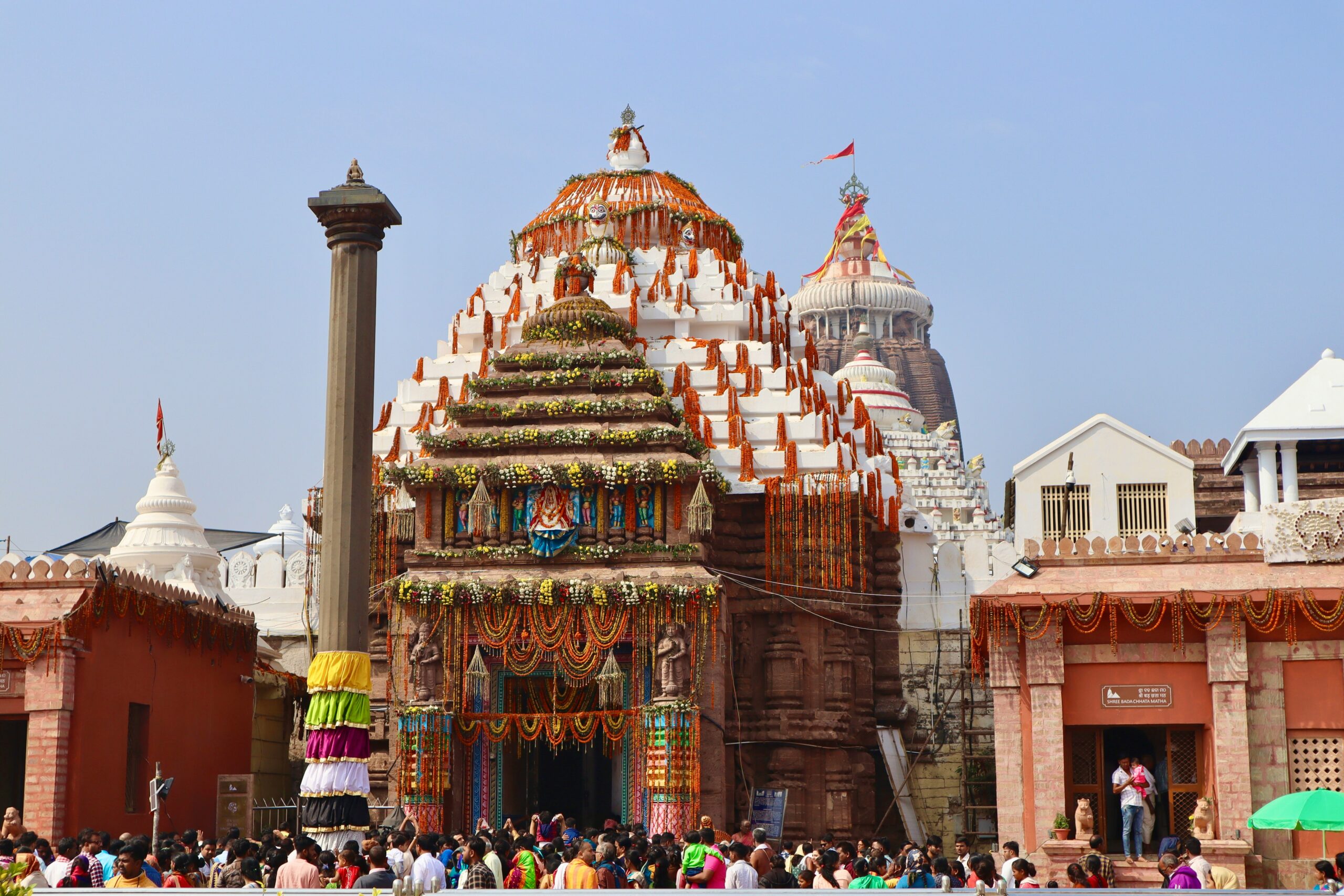
Stand on the Bada Danda, the broad sandy avenue that runs from the Lion Gate at Puri, on the second day of the waxing moon in Ashadha, and you will see something that has no real parallel anywhere in the world. Three wooden chariots, the tallest of them over forty feet high, are hauled down the road by hundreds of thousands of people pulling on coir ropes. Inside them are three deities with no hands to speak of, enormous round eyes that never close, and faces that look less like sculpture than like something half-emerged from a log. The English word juggernaut comes from this procession. Nothing about the Jagannath temple is quite what a visitor expects, and that begins with the deities themselves.
The Jagannath Temple at Puri, Odisha, is one of Hinduism’s four Char Dham pilgrimage sites, dedicated to Jagannath — a form of Vishnu or Krishna whose name means Lord of the Universe. Begun in the 12th century under the Eastern Ganga king Anantavarman Chodaganga Deva, it is famous for its unfinished wooden deities, its annual Rath Yatra chariot festival, and its vast temple kitchen.
Puri sits where the Odisha coast meets the Bay of Bengal, and the temple town has been known for centuries as Purushottama Kshetra, the field of the Supreme Person, and as Nilachala, the blue hill. It is the eastern point of the Char Dham circuit that also takes in Badrinath in the north, Rameswaram in the south and Dwarka in the west — a set of four whose origins are uncertain but which the Advaita tradition attributes to Adi Shankaracharya. One of the four Shankaracharya seats, the Govardhan Math, stands at Puri to this day.
Who Is Jagannath?
Jagannath is worshipped as a form of Vishnu, and more specifically in most traditions as Krishna, though the identification has never been tidy and that is part of the point. He appears not alone but in a group: his elder brother Balabhadra (Balarama), his sister Subhadra, and the Sudarshana chakra, Vishnu’s discus, which is installed as a presence in its own right. A family of siblings at the centre of a major shrine is unusual in Hinduism, and devotees make much of it — this is a God with a brother and a sister, who falls ill, who travels, who visits his aunt.
Scholars have long noted that the Jagannath cult looks like a confluence rather than a single stream. Vaishnava, Shaiva, Shakta, Buddhist and tribal elements are all visible in it. Traditions of the region speak of an earlier deity called Nilamadhava worshipped by the Sabara people, and the Daitapati servitors who handle the deities at Nabakalebara are themselves held to descend from that tribal lineage. The earliest known reference to Jagannath is said to occur in a Vajrayana Buddhist text, the Jnanasiddhi of Indrabhuti. Whatever the history, the result is a shrine that a very wide range of Indian religious life claims as its own.
Why the Deities Are Made of Wood, and Left Unfinished
The images at Puri are carved from daru, sacred neem wood, not from stone or metal — almost unheard of for deities of this standing. And they are visibly incomplete: broad, flat, column-like forms with stub arms and no proper hands or feet. Temple tradition explains this with a story, and it is worth telling in the tradition’s own register.
According to legends recorded in the Madala Panji, the temple’s own chronicle, a king named Indradyumna wished to install images of the Lord. A craftsman — in most versions Vishnu himself in disguise, in others Vishwakamra, the divine architect — agreed to carve them, on one condition: that he be left entirely undisturbed behind closed doors until the work was done. After a fortnight the queen, hearing nothing, could bear it no longer and opened the door. The carver vanished, leaving the images unfinished. A divine voice then told Indradyumna to install them exactly as they were.
Treat that as sacred narrative rather than history; the temple’s own sources frame Indradyumna as a king of a mythic age, and the sources differ even on which text the carving legend belongs to. But notice what the story does. Hinduism is full of exquisitely finished images, and here, at one of its four great dhams, the central deity is deliberately incomplete — the form abandoned mid-creation, retained as scripture. Devotees have read that for centuries as the plainest possible statement that the divine does not submit to our schedule, our curiosity, or our standards of finish.
Nabakalebara: When the Lord Changes His Body
Because the deities are wood, they age — and so, periodically, they are replaced. Nabakalebara, literally the new body, is the ritual in which fresh neem trees are identified by prescribed signs, felled, brought to Puri and carved into new images, and in which the old images are buried within the temple precinct. The ritual turns on a calendar rule: the year is one in which the lunar month of Ashadha occurs twice, the extra month being called adhika masa or mala masa. If you want the mechanics of why Hindu months behave this way, we have a full explanation of the Hindu calendar and why festival dates move.
The interval between Nabakalebaras is reported inconsistently even by careful sources — commonly as twelve or nineteen years, sometimes as eight, twelve or nineteen. It is not fixed, because it depends on the calendar. The most recent Nabakalebara was in 2015, nineteen years after the previous one in 1996. The practice is usually traced to 1575, when Ramachandra Deva I reinstalled the deities after their destruction. As for the next one: we could not verify a settled year from reliable sources, and figures circulating online are not well sourced. Watch for announcements from the temple administration rather than trusting a date you find on a calendar site.
At the heart of the ritual is the Brahma Padartha, a substance never seen or described, transferred from the old images to the new by blindfolded Daitapati servitors in total darkness. What it is has never been disclosed. It is one of the few genuinely guarded secrets left in Indian religious practice.
Who Built the Temple, and When
The temple as it stands was begun by Anantavarman Chodaganga Deva, the first great ruler of the Eastern Ganga dynasty, who reigned roughly 1078 to 1150 CE. He conquered the Utkala region in 1112, and historians reason that construction must have started some time after that; an inscription of 1134-35 records a donation to the temple, and the Kendupatna copper plates of Narasimhadeva II are among the sources used to reconstruct the sequence.
Here honesty is required: the completion date is not settled. A commonly cited figure is 1161 CE, but that falls after Chodaganga’s reign ended, and the standard reference works do not actually name who finished the building. One scholarly estimate places the main work around 1135-1150. His successor Anangabhima III (reigned roughly 1211-1238) is often brought into the story, and he did something arguably more striking than completing a building: he formally dedicated the entire kingdom of Utkala to Jagannath and styled himself the deity’s Rauta, or deputy. From then on the king of Puri ruled, in theory, as the Lord’s servant — a constitutional arrangement with no close parallel.
Something stood here before. An eleventh-century Sanskrit play, the Prabodha Chandrodaya Nataka of Krishna Mishra, mentions a shrine of Purusottama at the site, and the surrounding complex was rebuilt over earlier structures. Traditional accounts also describe a visit by Adi Shankaracharya in the eighth or ninth century.
Eighteen Invasions, and a Drum
The temple’s wealth and prominence made it a target, and the Madala Panji records that it was invaded and plundered eighteen times. The most severe episode came in 1568, when, following the defeat of the Gajapati ruler Mukunda Deva, the Afghan general Kalapahad reached Puri. The treasury was looted and the wooden images were desecrated and burned.
What happened next is one of the great stories of Odisha. Temple tradition holds that a devotee named Bisara Mohanty recovered the Brahma Padartha from the ruins and hid it inside a mridanga, a drum, keeping it safe until Ramachandra Deva I of Khurda installed new images in 1575. Through the Mughal period, as raids continued under a succession of officials, servitors repeatedly carried the deities away and concealed them around Chilika, Khurda, Banpur, Kodala and elsewhere. The images at Puri today are not the originals, and the tradition has never pretended otherwise. What was preserved was never the wood.
The Architecture of Srimandir
The temple is built in the Kalinga idiom of Odisha, its main tower in the soaring Rekha Deula form, and it reaches about 65 metres (around 214 feet) — one of the tallest temples in India. The structure is conventionally described as four linked sections, running from the sanctum outwards: the vimana or deula housing the garbhagriha, where the deities stand on the jewelled platform called the Ratnabedi; the mukhashala or frontal porch; the natamandapa, also called the jagamohan, the hall of dance; and the bhogamandapa, the hall of offerings.
Above the tower sits the Nilachakra, a disc of ashtadhatu — eight metals — about 3.5 metres tall and roughly 11 metres in circumference, with eight figures of the composite creature Navagunjara around its rim. It is regarded as sacrosanct in itself, and the flag flown from it daily is called the Patita Pavana, the saviour of the fallen. The outer wall, the Meghanada Pacheri, stands about 6.1 metres high and encloses a complex of more than thirty-seven thousand square metres containing at least 120 temples and shrines; an inner wall, the Kurma Bedha, rings the main temple.
Four gates face the cardinal directions and are named for animals: the Singhadwara or Lion Gate to the east, opening onto the Bada Danda and guarded by the figures of Jaya and Vijaya; the Hathidwara (Elephant) to the north, the Vyaghradwara (Tiger) to the south and the Ashwadwara (Horse) to the west. Inside the Lion Gate rise the twenty-two steps known as the Baisi Pahacha, which pilgrims climb with a reverence usually reserved for the sanctum itself. Facing the eastern gate stands the Aruna Stambha, a sixteen-sided monolithic pillar topped by a figure of Aruna, charioteer of the sun — which did not originally belong here at all. It was brought from the Konark Sun Temple by the Maratha ascetic Brahmachari Gosain.
Rath Yatra: The Chariot Festival
Once a year the deities leave. Rath Yatra begins on Ashadha Shukla Dwitiya, the second day of the waxing moon in Ashadha, usually falling in June or July, and the deities are brought out through the Lion Gate in the swaying, chanting procession called Pahandi and placed on three newly built chariots. The woods used are traditionally species such as phassi and dhausa, sourced from the former princely state of Dasapalla and floated down the Mahanadi as rafts; new chariots are constructed every year.
Jagannath rides the Nandighosha, sixteen wheels, about 832 wooden pieces, roughly 44 feet high. Balabhadra rides the Taladhwaja, fourteen wheels and about 763 pieces. Subhadra rides the Darpadalana, twelve wheels and about 593 pieces. Before the pulling begins, the Gajapati king of Puri sweeps the chariot platforms with a gold-handled broom in the rite called Chhera Pahara — the ruler of the land performing a sweeper’s work in public, every year, for centuries.
The destination is the Gundicha Temple, a short distance away, where the deities stay several days before the return journey, the Bahuda Yatra. On the way back the chariots halt at the Mausi Maa temple — the aunt’s house — for an offering of Podo Pitha, a baked rice cake. The festival closes with the Suna Besha, in which the deities are adorned on the chariots in gold ornaments; tradition holds the practice was begun by Kapilendra Deva in 1460, and the jewellery used is said to weigh nearly 208 kilograms. Related observances cluster through the preceding weeks: the forty-two-day Chandan Yatra, and Snana Yatra on the Jyeshtha full moon, when the deities are bathed with 108 pots of water and afterwards fall ritually ill, secluded for a fortnight in the period called Anasara.
Rath Yatra fell on 16 July in 2026, so it has passed for this year. The 2027 festival is widely listed for Monday 5 July 2027, but treat that as provisional: because the date is fixed to a lunar tithi, it should be confirmed against the temple administration’s own announcement and a panchang for your region before you book anything.
Mahaprasad and the Temple Kitchen
The kitchen at Puri is among the largest temple kitchens in the world — you will see it called the largest and the second largest in different places, so the superlative is best left alone. What is not in dispute is the scale and the method. Food is cooked in earthen pots stacked over wood fires, and offered to the deities as Mahaprasad, a sequence traditionally numbering fifty-six items, entirely vegetarian and cooked without onion or garlic. The practice of large-scale feeding here, the Chatra Bhog, is traditionally attributed to Adi Shankaracharya in the eighth century.
Once offered, Mahaprasad is sold in the open-air market inside the complex called Ananda Bazar, and the convention is strong that caste does not apply to it: people who would not otherwise eat together share Mahaprasad without hesitation, and have done for centuries. One tradition says the food is checked for the presence of a shadow dog, understood as a sign of divine rejection, and buried if anything is found wrong. We could not confirm Ananda Bazar’s current opening hours or prices from a reliable source, so ask on arrival rather than planning around a figure you read online.
The Ratna Bhandar: An Unfinished Reckoning
The temple’s treasury, the Ratna Bhandar, holds centuries of accumulated offerings, and for decades nobody knew exactly what was in it. It was reopened in 2024, after roughly four decades, for repair and inventory-related work. The actual itemisation of the valuables began on 25 March 2026 — the first such exercise since the inventory of 1978, a gap of forty-eight years — conducted by the Shree Jagannath Temple Administration with temple servitors, senior state officials, gemologists and representatives of the Reserve Bank of India, under procedures approved by the Odisha government.
By late May 2026, officials described the inventories of the Chalanti Bhandar (ornaments in daily use) and the Bahar Bhandar (festival ornaments) as finished, with counting underway in the inner chamber, the Bhitar Bhandar, where more than 120 ornaments had been documented and the work was put at around twenty per cent complete. It was then suspended from 24 May 2026 because of severe heat, heavy pilgrim numbers and preparations for Snana Purnima and Rath Yatra, with resumption expected in June. Beyond that we cannot responsibly say more: no reporting available to us confirms whether the count resumed, concluded, or produced a published list. If this matters to you, check the temple administration’s own statements for the current position.
Planning Your Visit
A word of caution before the table. Published timings for Puri disagree with one another, the ritual day shifts with the festival calendar, and the temple is not run on the schedule of a tourist attraction. The figures below are what current sources state, not a guarantee. Confirm on the day, locally, and be ready for the sequence to run late.
| Detail | What sources state |
|---|---|
| Location | Puri, Odisha, on the Bay of Bengal coast |
| Opening hours | Generally given as about 5:00 am to 10:30 pm; one official tourism source says closing at 10:00 pm. Some guides describe a midday closure, others do not. Verify locally. |
| General darshan | Sahana Mela, the free public darshan, is commonly listed for the morning hours. There is no regular admission ticket for general darshan. |
| Paid darshan | No reliable source confirms a standing VIP darshan product. Treat anyone demanding payment or promising guaranteed access with suspicion and verify with authorised temple staff. |
| Dress code | Modest traditional dress. Sources conflict on strictness: some state dhoti-kurta for men and saree or salwar for women as mandatory, others permit full-length trousers with a shirt. Dress conservatively and follow instructions on site. |
| Prohibited | Phones and cameras are not permitted; photography inside is prohibited. Footwear must be removed, and leather items are best left behind. Deposit facilities are reported near the entrance. |
| Who may enter | Non-Hindus and foreigners are not permitted inside; Jains, Sikhs and Buddhists are excepted. See below. |
| Nearest station | Puri railway station, roughly 2 to 3 km |
| Nearest airport | Biju Patnaik International Airport, Bhubaneswar, around 60 km, about 1.5 hours by road |
| Best time | October to March for weather. Rath Yatra and Snana Yatra draw enormous crowds; weekdays are generally easier. |
One recent change is worth knowing about. The approaches to the temple were substantially rebuilt as a wide corridor around the shrine, generally called the Shree Jagannath Heritage Corridor and also known as the Shree Mandir Parikrama, with the foundation laid in November 2021 and the project inaugurated on 17 January 2024. Visitors who last came before then will find the surroundings significantly altered.
Who Can Enter: The Restriction and the Argument About It
Non-Hindus and foreign visitors are not permitted to enter the Jagannath temple, with Jains, Sikhs and Buddhists excepted. The rule is believed to be as old as the temple, and no amount of payment, persuasion or local guiding changes it; visitors have been turned away, and the restriction has at times attracted international attention.
It has also been argued about within Hinduism for decades, and not quietly. A former Governor of Odisha suggested that foreigners who satisfy the Gajapati, the servitors and the Shankaracharya might reasonably be admitted; that view has not prevailed. Readers whose families are of mixed faith should plan on the basis that the rule will be enforced. Local practice commonly points non-Hindu visitors to a nearby rooftop from which the temple can be seen, often said to be at the Raghunandan Library, but we could not confirm this from an official source and would not want anyone to travel on the strength of it. Puri has a great deal else to offer, and the Bada Danda in festival season is in some ways a better view of this tradition than the sanctum would be.
Nearby
The Konark Sun Temple, a UNESCO World Heritage site and one of the supreme achievements of Kalinga architecture, lies around 35 km away and should not be missed. The Gundicha Temple, the destination of the Rath Yatra, is roughly 3 km from the main shrine and quiet for most of the year. The ancient Shiva shrine of Lokanath is about 2 km away, and Puri Beach is within walking distance of the temple. Further afield, Chilika Lake, Asia’s largest brackish-water lagoon, is a day trip, and Chandrabhaga beach sits near Konark.
Why Jagannath Matters Today
The usual answer is Rath Yatra, and it is not wrong: a festival in which the deity comes out to the people rather than waiting for the people to come in, in which a king sweeps the floor, in which the ropes are open to anyone whose hands can reach them. For a tradition sometimes accused of keeping the divine behind barriers of ritual and access, that annual reversal is a serious statement, and the fact that the same temple maintains an entry restriction that many Hindus find indefensible makes the contradiction worth sitting with rather than smoothing over.
But the thing most worth carrying away from Puri is the unfinished image. Every instinct we have says to complete what we start, to present the polished version, to keep the door closed until the work is done and then open it on something flawless. At Puri the door was opened early, the work stopped, and what was left half-made was installed as God and worshipped by millions for centuries. Nobody went back to fix it. There is a sanity in that which most of us could use — a tradition that was willing to say the incomplete thing is the holy thing, and mean it.
And in the Nabakalebara there is a second idea, stranger and gentler. The body is renewed, buried, carved again from a new tree. Only the undisclosed substance at the centre passes from one form to the next, in darkness, carried by men who are not permitted to see what they hold. Whatever else the Jagannath tradition is saying, it has a view about what persists and what does not, and it has been demonstrating it in public, with ropes and timber and a drum, for a very long time.
Frequently Asked Questions
Why are the Jagannath deities unfinished and made of wood?
They are carved from sacred neem wood, called daru, rather than stone or metal, and they are deliberately left incomplete, with stub arms and no proper hands or feet. Temple tradition explains this through the legend of King Indradyumna and a divine carpenter who was interrupted before finishing and vanished, after which a divine voice instructed that the images be installed as they were. The tradition treats the unfinished form as the correct form.
Can non-Hindus enter the Jagannath Temple at Puri?
No. Non-Hindus and foreign visitors are not permitted inside, though Jains, Sikhs and Buddhists are excepted. The restriction is believed to date from the temple’s founding and is enforced; it cannot be got round by paying a guide. It has been debated within Hinduism for decades without being changed. Plan on the rule applying, and consider visiting Konark and the surrounding shrines instead.
When is Rath Yatra, and what are the dates?
Rath Yatra falls on Ashadha Shukla Dwitiya, the second day of the waxing moon in the month of Ashadha, which places it in June or July. In 2026 it fell on 16 July. The 2027 festival is widely listed for 5 July 2027, but because the date follows a lunar tithi it should be confirmed against the temple administration’s announcement and a panchang for your own region before travelling.
What is Nabakalebara and when is the next one?
Nabakalebara is the ritual in which the wooden deities are replaced with newly carved ones, performed in years when the month of Ashadha occurs twice. The interval is not fixed and is reported variously as eight, twelve or nineteen years. The last Nabakalebara was in 2015, nineteen years after 1996. We were unable to verify a reliable date for the next one, and dates circulating online are poorly sourced — watch for official announcements.
What are the darshan timings at Jagannath Temple?
Sources disagree, which is why no single timetable should be trusted. The temple is generally described as open from about 5:00 am, with closing given as 10:30 pm by some sources and 10:00 pm by an official tourism page; some guides describe a midday closure and others do not. The ritual sequence also shifts with the festival calendar. Confirm with the Shree Jagannath Temple Administration or locally on the day.
Is Jagannath Puri one of the Char Dham?
Yes. Puri is the eastern shrine of the four Char Dham pilgrimage sites, alongside Badrinath in the north, Dwarka in the west and Rameswaram in the south. The origins of the circuit are uncertain, and the Advaita tradition attributes its establishment to Adi Shankaracharya; one of the four Shankaracharya seats, the Govardhan Math, is at Puri. Note that this circuit is different from the Chota Char Dham of Uttarakhand.
What is Mahaprasad at Puri?
Mahaprasad is the food cooked in the temple’s enormous kitchen in stacked earthen pots over wood fires, offered to the deities and then distributed. It traditionally comprises fifty-six items, is entirely vegetarian and uses no onion or garlic. It is sold at the Ananda Bazar inside the complex, and is shared across caste lines by long-standing convention. Current timings and prices are best confirmed on arrival.
There is a moment at the end of Rath Yatra when the chariots stand empty on the Bada Danda, enormous and already starting to be dismantled, and the deities are back inside. The wood will be broken up; some of it goes to the temple kitchen fires. Next year three more chariots will be built from new timber floated down the Mahanadi, and the crowd will come again. Nothing at Puri is permanent except the pattern — which is, when you think about it, a reasonable description of everything else as well.
Continue Exploring
- Rameswaram and the Ramanathaswamy Temple
- Adi Shankaracharya: Life, Teachings and the Four Mathas
- Who Is Lord Krishna? Story, Symbolism and Worship
- The Hindu Calendar Explained: Why Festival Dates Change Every Year
- How to Chant the Vishnu Sahasranama