
Most pilgrims arrive at Verul already tired. They have come for Ellora, and Ellora takes a full day: thirty-four halls cut backwards into a basalt cliff, and at the centre of them the Kailasa temple, carved downward out of a single rock by people who never once laid a stone. You come out of that into the afternoon light slightly stunned, and then somebody tells you that a kilometre and a half down the road there is a Jyotirlinga.
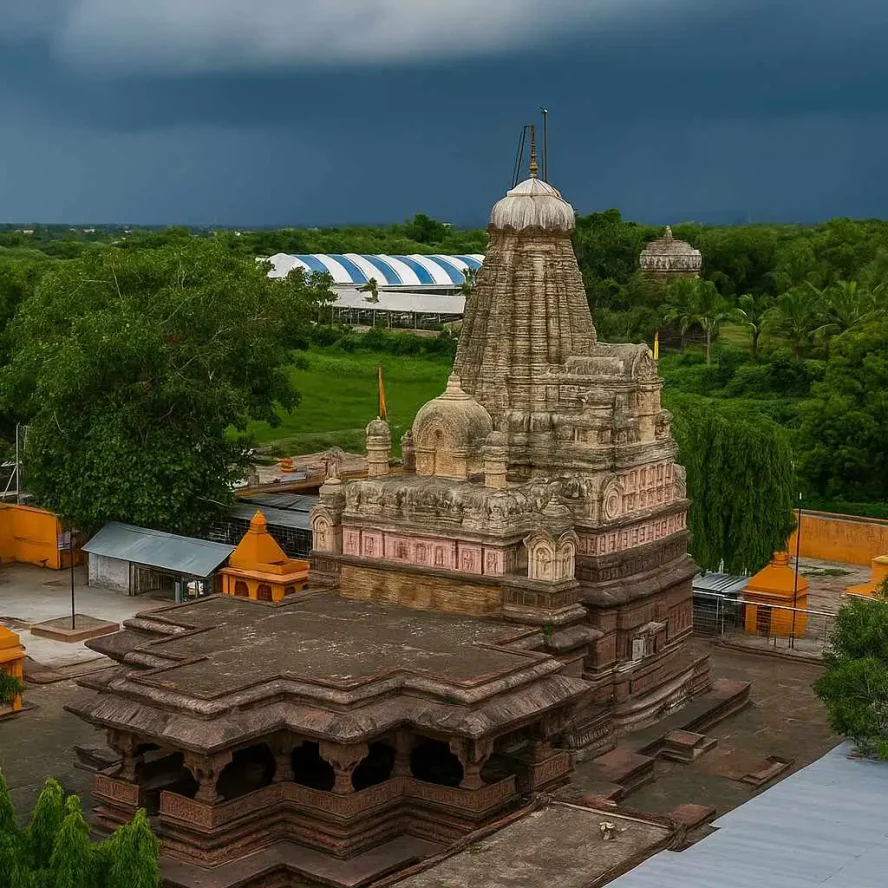
It does not look like the end of anything. Grishneshwar is a modest, dark, squat temple of volcanic rock, a five-tiered tower, a courtyard, a queue. Men stand at the sanctum door pulling their shirts over their heads, because that is the rule here and has been for as long as anyone can say. Inside, the linga faces east and the space is small enough that the chanting has nowhere to go.
And yet for a great many devotees this is the final stop. Grishneshwar is counted last in the traditional list of the twelve Jyotirlingas, the lingas of light, the twelve places where Shiva is held to have shown himself not as an image made by human hands but as a column of radiance. People who have spent years working their way around that circuit, from Somnath on the Gujarat coast to Kedarnath in the high Himalaya, finish here, in a Maharashtrian village next to a World Heritage site, at the smallest shrine of the set.
Where Grishneshwar Stands
The temple is in Verul (also written Ellora, after the caves), in the Khuldabad taluka of Chhatrapati Sambhajinagar district in Maharashtra. The city and district were officially renamed from Aurangabad in 2023; a great deal of signage, ticketing and travel writing still says Aurangabad, so expect to see both names and treat them as the same place.
It sits roughly 1.5 km from the Ellora Caves and about 30 km northwest of the city. The Deccan plateau here is black basalt, the same rock the caves are cut from and the same rock the temple is built of. That is not a coincidence anyone in Verul would find interesting. The stone was simply what was there.
The Shiva Purana names the place differently. It speaks of a mountain in the south called Deva, Devagiri, which commentators identify with modern Daulatabad, the great fort eleven or so kilometres away. The sacred geography of this shrine was mapped onto a fort hill long before the temple took its present shape.
The Story the Shiva Purana Tells
Grishneshwar has one of the most carefully told origin narratives of any Jyotirlinga, and it is worth attributing precisely: it occupies two full chapters, 32 and 33, of the Koti Rudra Samhita of the Shiva Purana. Most retellings compress it into four sentences and lose exactly the thing that makes it remarkable.
A brahmin named Sudharma, of the Bharadvaja lineage, lived near that southern mountain. He was learned, prosperous, generous, kept his fires and his three daily prayers, and was a devotee of Shiva. His wife Sudeha was devoted too, and capable, and childless.
The Purana is unusually frank about what childlessness did to her. She nags; he refuses to grieve. She quarrels with a neighbour, who calls her sonless and predicts the king will seize their property for want of an heir. She threatens her own life. Sudharma eventually offers two flowers to the sacrificial fire and tells her that one of them will yield a son, and she picks up the wrong one, the text says, through Shiva’s own delusion. He sighs and tells her to let the hope go.
It is Sudeha herself who proposes the second marriage. Sudharma warns her plainly about jealousy before he agrees. She insists. He marries her younger sister, Ghushma, and asks Sudeha to raise her like a daughter.
Ghushma’s practice is the heart of the story. Every day, with Sudeha’s blessing, she shapes 101 lingas out of clay, worships them, and carries them down to a nearby lake to immerse them, and does this until she has made a hundred thousand of them. A son is born to her. And Sudeha, who had been cool and calm, finds her heart beginning to blaze like fire. Chapter 32 ends there, promising the despicable thing that happened next.
What happens next is that Sudeha waits until the boy is asleep, cuts him apart with a knife, and throws the pieces into the lake where her sister immerses her lingas.
What Ghushma Does
This is the part that is almost always told wrongly. Ghushma does not rage, search or collapse. She hears her daughter-in-law wailing in the house and does not interrupt her morning worship. At midday she sees the bloodied bed and still shows no grief. The Purana gives us her reasoning: the one who gave the boy will also protect him, and Shiva, like a gardener, separates what he has joined.
Then she picks up the day’s clay lingas, walks to the lake, immerses them as she always does, and comes back to find her son standing on the bank. He tells her he died and was revived by the power of her virtue and the mercy of Shiva. The text notes, with a kind of dry precision, that she is not delighted, because she had never been distressed.
Shiva appears then as a mass of light, pleased, and offers a boon. He names Sudeha as the killer and says: I shall kill her with my trident.
And Ghushma spends her boon asking him to protect her sister.
When Shiva objects that the wrongdoer must die, she argues with him: that sin dissolves at the sight of Shiva, and that to help someone who has harmed you is itself the removal of sin. He gives way. He offers her a second boon, and she asks him to remain at that place, in her name, for the protection of the world. He agrees, takes the name Ghushmesha, and becomes the linga.
The lake is named Shivalaya, and the Purana says the mere sight of it fulfils desires. A tank at Verul still carries that name, Shivalay Tirth, and you will see it on local signboards and, lately, on traffic-barricade notices.
Sudeha, ashamed, performs an expiation and asks forgiveness. All three of them walk around the linga 101 times. The text promises Ghushma’s line excellent sons for 101 generations.
The Name Is Genuinely Unsettled
You will find the temple written as Grishneshwar, Ghrishneshwar, Ghrneshwara and Ghushmeshwar, and the explanations do not agree. The Purana derives it straightforwardly from Ghushma. Another reading takes the Sanskrit root ghrish-, to rub, and tells a story of Parvati rubbing saffron on her palm until a linga formed. A third gives Ghrneshwara as lord of compassion, which fits the narrative beautifully and may be precisely why it is popular. No etymology here is settled, and a post that states one flatly is overreaching.
A Temple Rebuilt, and Rebuilt Again
There is no surviving record of when a temple was first raised here. The structure is generally thought to predate the thirteenth century, and after that its history becomes a history of destruction and repair. It was pulled down during the Delhi Sultanate’s expansion into the Deccan in the thirteenth and fourteenth centuries, rebuilt, and damaged again in the long Mughal and Maratha conflict that ran through this region for a century.
Maloji Bhosale, grandfather of Chhatrapati Shivaji Maharaj, restored it in the sixteenth century. The temple you walk into today is an eighteenth-century Holkar reconstruction, and here the sources genuinely conflict, so it is worth saying so plainly. One account credits Gautama Bai Holkar of Indore with rebuilding it in 1729. Far more popular accounts credit Ahilyabai Holkar, who ruled Indore from 1765 to 1795 and who is justly famous for rebuilding Hindu temples across northern and central India, Kashi Vishwanath among them. The two cannot both be right about the same construction: Ahilyabai was born in 1725 and was a small child in 1729. It is quite possible that both women patronised work here at different times, which would explain how the two claims survive side by side. The honest position is that the present temple is an eighteenth-century Holkar rebuilding and the specific patron is disputed.
That pattern, destroyed and restored and destroyed and restored, is not unique to Verul. Somnath on the Gujarat coast went through it repeatedly and spectacularly. What is striking about Grishneshwar is how little the surviving temple advertises any of it. It is a working village shrine, not a monument to its own survival.
Reading the Architecture
The temple is built of the local dark red-to-black volcanic rock in a medieval Deccan idiom, and its plan is the classic three-part sequence: garbhagriha (the sanctum), antarala (a vestibule), and sabha mandapa (the assembly hall where devotees gather).
Above the sanctum rises a shikhara of five diminishing tiers, crowned by a gilded kalasha, the finial pot that marks the vertical axis of almost every Hindu temple, the point where the built structure stops and the sky takes over. Reported figures for the complex vary considerably between sources, and the ones you see quoted most often, a sanctum of roughly 289 square feet and a complex of around 44,000 square feet, are best treated as approximate rather than surveyed.
What is not in doubt is the carving. The pillars of the hall are worked in detail, and the walls carry scenes from Shiva’s legends along with a Dashavatara sequence, the ten descents of Vishnu. A Shaiva shrine carrying a full Vaishnava cycle on its walls is not a contradiction; it is ordinary. Temples of this period were built by people who did not experience those traditions as rival teams.
The linga in the sanctum faces east. A large Nandi, Shiva’s bull and his most constant companion, sits in the passage before the door, as he does at every Shiva temple, looking in at his lord, which is the posture devotees are being quietly taught.
What Devotees Come to Ask For
Ask around in the queue at Grishneshwar and the answers run in a direction you could predict from the story. People come about children. They come about families that have turned against each other: a brother who will not speak, a quarrel over property, the particular corrosiveness of resentment between people who live in the same house.
That is not folk invention. It is the narrative working as narrative is supposed to work. Grishneshwar is the Jyotirlinga whose founding story is about a woman who spent a boon from God on the person who had murdered her child. Of the twelve, it is the one about forgiveness. Mahakaleshwar at Ujjain is about time and death; Kedarnath is about ascent and endurance; Bhimashankar is about the forest and the demon in it. This one is about what you do with a grievance you are fully entitled to.
The ordinary offerings are simple and the same as at any Shiva shrine: water, milk, bilva (bel) leaves, white flowers, bhasma. Abhishekam, the ritual bathing of the linga, is the main paid service, and the temple also receives a steady traffic of people who simply touch the stone and leave, which at Grishneshwar is still permitted in a way it no longer is at several of the busier Jyotirlingas.
Visiting Grishneshwar: A Practical Guide
Check Before You Travel: This Is Genuinely in Flux
This is the most important thing on the page, and it needs stating carefully, because the situation as of early October 2026 is unresolved.
A development project of around 210 crore rupees is under way at Verul, intended to turn the caves, the garden and the temple into a single managed cluster: parking, a wider access road, an underground passage for devotees, queue management inside the temple, a relocated vendors’ complex and pilgrim accommodation. Work on the underpass in front of the temple began on 1 October 2026. Heavy vehicles have been barred from the State Highway 216 stretch past the temple for six months, reported as running from late September 2026 to late March 2027, and in the first days of the work police were turning back cars and autorickshaws as well, which caused real confusion and long walks in the sun.
Reports also circulated that the temple itself would close to the public for six months from 1 November 2026. Verul’s shopkeepers and residents and the Grishneshwar Devasthan Trust objected strongly, and a delegation submitted a memorandum to the District Collector, who assured them the temple would not be kept fully closed for six months and that the administration would keep the works as short as it could. As of early October 2026 the temple was open and daily darshan, including sparsh (touch) darshan, was continuing.
So: no full closure has been confirmed, and no closure has been formally withdrawn in writing either. If you are planning a journey to Grishneshwar in late 2026 or the first half of 2027, treat every timing below as provisional and confirm with the Devasthan Trust or recent local news before you book anything. Pilgrims flying in from abroad for a single Jyotirlinga should be especially careful here.
Getting There
The nearest airport is Chhatrapati Sambhajinagar (Aurangabad), roughly 30 km away, about 45 to 50 minutes by road in normal conditions. The most convenient railhead is Chhatrapati Sambhajinagar station, with Manmad Junction about 100 km off offering wider long-distance connections. By road the temple is 30 to 35 km from the city and around 11 km from Daulatabad fort. Local buses, shared autos and taxis all run the Ellora route; during the current works, expect to be dropped further from the temple than usual and to walk the last stretch.
Darshan Timings
Commonly published hours are roughly 5:30 am to 9:00 or 9:30 pm. Sources disagree on whether there is a midday break. Some describe continuous hours, others report a closure of around noon to 4:00 pm, and this is not reliably confirmed anywhere, so plan a morning visit rather than gambling on the afternoon. During Shravan and Maha Shivaratri the temple opens far earlier (as early as 3:00 am is reported) and closes later, and queues are very long.
General darshan is free. Paid priority darshan is offered, with quoted rates varying between sources, and abhishekam is bookable in person at the counter, reportedly around 551 rupees per person, with slots filling within hours during Shravan and Shivaratri. Treat all prices as indicative; they change, and the current works may change them further.
Dress Code, and the Bare-Chested Rule
Anyone may enter the premises. But local tradition at Grishneshwar requires men to remove their upper garments before entering the garbhagriha, and it is reported to be enforced. This surprises visitors more than almost anything else about the temple, and it is worth knowing in advance rather than discovering at the door. Women are expected in modest traditional dress; a saree or salwar kameez is the safe choice. Shoes come off well before the sanctum, as everywhere.
Best Time to Visit
October to March is the comfortable season on the Deccan; April and May are punishing, and the current arrangements involve more walking than usual. Arrive between 5:00 and 6:00 am if you want the temple quiet. Monday is Shiva’s weekday and draws more devotees; Shravan Mondays draw crowds of a different order altogether.
If you are planning around Maha Shivaratri, note that it falls on Phalguna Krishna Chaturdashi and the Gregorian date shifts each year. Panchang timings for the night’s four praharas are calculated for a specific city, almost always an Indian one. If you are observing from the United States, Britain, Canada or Australia, Indian Standard Time muhurats will not map onto your night at all. Use a local panchang or ask your temple, and do not simply copy an IST schedule off a website.
What Else Is Within Reach
Grishneshwar sits inside one of the densest concentrations of heritage anywhere in India, which is both its blessing and the reason it gets a half-hour of most itineraries.
- Ellora Caves, a UNESCO World Heritage Site since 1983: thirty-four Buddhist, Hindu and Jain excavations side by side across five centuries. Cave 16, the Kailasa temple, is carved top-down from living rock and is one of the most astonishing things human beings have made. Allow most of a day.
- Daulatabad Fort, about 11 km away, the Devagiri of the Purana, a hill fortress with a notoriously disorienting dark passage.
- Khuldabad, the walled town next door, with the dargah of Zainuddin Shirazi and the grave of Aurangzeb.
- Shivalay Tirth, the tank at Verul bearing the name the Shiva Purana gives the lake of the story.
- Bibi ka Maqbara in the city, and the Ajanta Caves about 100 km off, which deserve a separate day entirely.
Why This Shrine Matters Today
There is a practical teaching buried in the Ghushma story that survives translation into ordinary life better than most.
Notice what Ghushma actually does on the worst morning of her life. She hears the wailing, she sees the blood, and she goes and does her practice. Not because she has suppressed anything: the text is explicit that she feels no grief, because she had already settled the question of whom the child belonged to. Her steadiness is not stoicism. It is the result of a decision made long before the crisis and then repeated a hundred thousand times with clay in her hands.
That is a usable idea. The practice you keep on ordinary days is the thing that is available to you on the worst one. People who build nothing in advance have nothing to reach for.
And then there is the boon. Shiva arrives, offers her anything, and names her sister’s death as the obvious next step, and she argues him out of it. The Purana makes her the theologian in that exchange, not the supplicant. Her argument is that helping the person who harmed you is itself the dissolution of sin. Whatever you make of the metaphysics, the psychology is sound, it is extremely difficult, and the tradition thought it worth marking with one of twelve Jyotirlingas.
It is also worth sitting with the fact that Sudeha is not destroyed. She performs her expiation, she asks forgiveness, and she walks around the linga with the sister whose son she killed. A tradition that wanted a simple moral would have let the trident land. This one wanted something harder.
Frequently Asked Questions
Why is Grishneshwar called the last Jyotirlinga?
Because it comes twelfth in the traditional enumeration of the Jyotirlingas that most pilgrims follow, so a circuit done in order finishes here. The order is a devotional convention, not a ranking. No Jyotirlinga is lesser than another, and many pilgrims cover them in whatever sequence geography allows.
What is the story behind Grishneshwar temple?
The Koti Rudra Samhita of the Shiva Purana tells of Ghushma, who worshipped 101 clay lingas daily, bore a son by Shiva’s grace, and lost him to her jealous elder sister Sudeha. The boy was restored at the lake, and when Shiva offered to kill Sudeha, Ghushma asked instead that her sister be spared and that Shiva remain at that place. He did, as the Ghushmesha linga.
Do men really have to remove their shirts at Grishneshwar?
Yes. Local tradition requires men to enter the inner sanctum bare-chested, and it is reported to be enforced. You can keep your upper garment on in the rest of the premises. Women wear modest traditional dress.
Is Grishneshwar temple closed for six months in 2026?
Not confirmed. A six-month closure from 1 November 2026 was widely reported as a proposal during the development works, but after local objections the District Collector assured a Verul delegation that the temple would not be kept fully closed for six months. Darshan was continuing as of early October 2026. Because nothing has been settled in writing, verify with the temple trust or recent local news before travelling.
How far is Grishneshwar from the Ellora Caves?
About 1.5 km, easily combined in one trip, and most visitors do exactly that. Allow a full day for the caves and an hour or more for the temple, and note that road access near the temple is disrupted while the underpass and cluster works continue.
What is the best time to visit Grishneshwar Jyotirlinga?
October to March for the weather, and early morning, around 5:00 to 6:00 am, for a quiet darshan. Shravan and Maha Shivaratri are the most spiritually charged periods and by far the most crowded.
A Closing Thought
Verul is a strange place to end a pilgrimage. The great spectacle is up the road, carved out of a cliff, and visitors arrive at the temple with their capacity for awe already spent on it. But perhaps that is the right order. Ellora shows you what human devotion can do with a mountain and several lifetimes. Grishneshwar shows you what it can do with a handful of wet clay, repeated, and one impossible act of forgiveness.
The twelve Jyotirlingas are usually described as a map of Shiva’s light across the subcontinent. It may be truer to call them twelve different lessons. If so, the last one is the hardest: that the person you are most entitled to destroy is exactly where your practice gets tested.
Continue Exploring
- Who Is Lord Shiva? The Story, Symbolism and Worship of Mahadeva
- Bhimashankar Jyotirlinga: The Shiva Shrine Hidden in a Sahyadri Rainforest
- Mahakaleshwar Jyotirlinga, Ujjain: The Shrine of the Lord of Time
- Somnath Temple: The First Jyotirlinga and the Shrine That Kept Being Rebuilt
- Kashi Vishwanath Temple: The Jyotirlinga at the Heart of Shiva’s Own City
- Omkareshwar Jyotirlinga: The Island Temple Shaped Like Om