
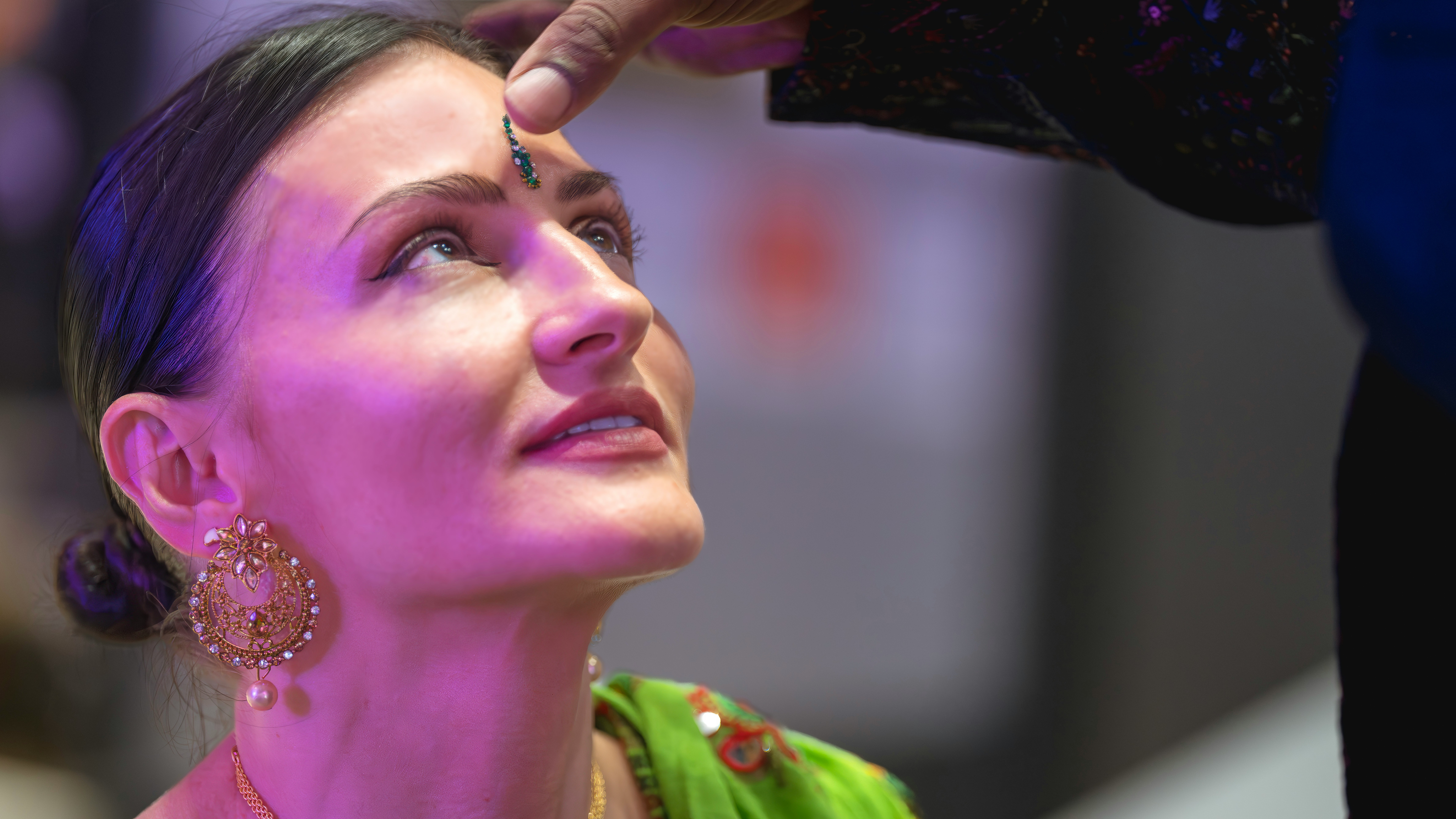
Stand in the queue at a large South Indian temple and watch what happens at the very end, after the lamp and the camphor and the crush of bodies. The priest reaches into a small brass bowl, takes a pinch of something red, and presses his thumb to the space between your eyebrows. And almost everyone — believers, tourists, bored teenagers, people who came because their mother insisted — does the same involuntary thing. They close their eyes.
Nobody teaches you that. The pressure lands on a spot the body seems to already know about.
Indians mark the forehead more variously, more frequently and for more reasons than almost any other culture on earth, and the marks are not interchangeable. The three horizontal ash lines on a Shaiva ascetic in Varanasi and the white clay U on a Srirangam priest are not two styles of the same thing. They are closer to two different sentences. This is a guide to reading them.
What Is a Tilak?
A tilaka — colloquially tilak or tika — is a mark applied to the body, most often on the forehead, though a devout person may mark the neck, chest, arms and stomach as well. It is not primarily decoration. It is, depending on the occasion, a declaration of which tradition you belong to, a sign that you have completed a ritual, a blessing placed on you by somebody else, or a mark of honour.
The crucial thing to understand at the outset is that the tilak is applied in three quite different situations, and conflating them causes most of the confusion:
- Sectarian — the daily mark that identifies you as Shaiva, Vaishnava, Shakta or Smarta. Worn by initiates, priests, ascetics and observant householders, usually after the morning bath and prayers.
- Ritual — the mark you receive at a temple, at the end of a puja, at a wedding, before an exam, when leaving on a journey, or when your car, shop or house is new.
- Honorific — the mark applied to welcome a guest, bless a soldier, or garland a returning daughter. Here the tilak means roughly what a handshake and a toast mean together.
A man wearing a sandalwood U down his forehead in Chennai at 6 a.m. is doing the first. A woman receiving kumkum from a priest at Tirupati is receiving the second. A village seeing off a young man to the army applies the third. Same gesture, three grammars.
Why the Space Between the Eyebrows?
The mark sits at bhrumadhya — the midpoint of the brows — which the yogic traditions identify with the ajna chakra, the sixth of the body’s subtle centres and the one called the seat of hidden wisdom. It is symbolised by a two-petalled lotus and associated with the syllable Om, and it is where meditative attention is traditionally gathered. This is why so much Indian sacred sculpture shows the eyes half-lowered and turned inward toward that point.
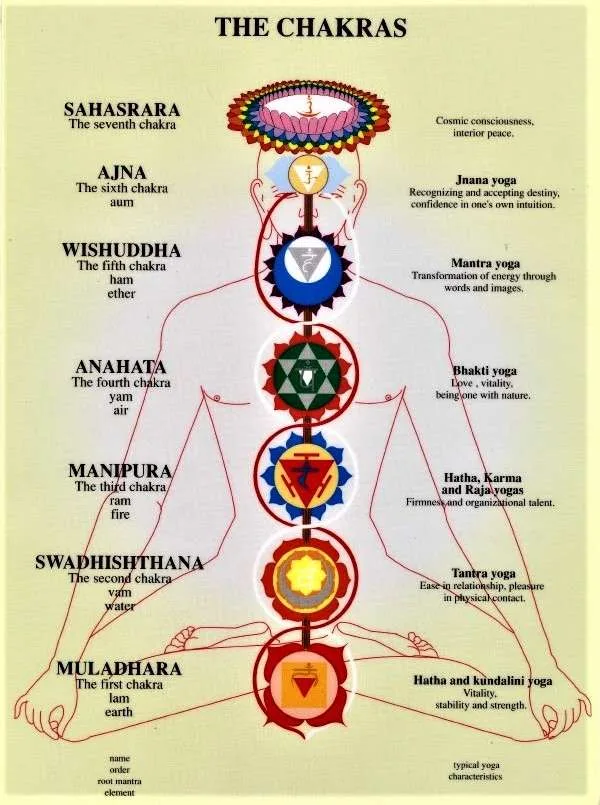
The ajna is also what English-speakers call the third eye: the faculty of seeing what the two physical eyes cannot. The mark, read this way, is not ornament but signage — a flag planted on the spot where attention is supposed to live. Traditional sources add that it helps retain energy that would otherwise dissipate and steadies concentration.
It is worth separating that traditional claim from the pseudo-physiological ones that circulate online. You will find confident assertions that the tilak stimulates the pineal gland, lowers blood pressure, prevents energy loss through an acupressure point, or cools the nerves. These are modern explanations grafted onto an ancient practice, and they are not established by evidence. The tradition’s own reason is sufficient and much older: this is where the mind is told to gather. Nothing in this article should be read as a medical claim.
The Three Great Families of Forehead Marks
Almost every sectarian mark in India is a variation on one of three designs. Learn these three and you can read most of a crowd.
Tripundra: the three horizontal lines of the Shaivas
Three roughly horizontal bands drawn across the forehead, traditionally in vibhuti or bhasma (sacred ash), often with a dot or short vertical stroke in the middle. This is the tripundra, the mark of devotees of Shiva, and it appears to be the older of the two main designs.
The second chapter of the Kalagni Rudra Upanishad — a short Shaiva text — reads the three lines through a cascade of triads: the three gunas (the qualities of nature), the three worlds, the three Vedas, the three sacred fires, the three syllables of Om, and Shiva’s own threefold power of will, knowledge and action. The ash itself carries the heavier meaning. It is what is left when everything burnable has burned, which makes it a daily reminder of what you are going to become, worn on the most visible part of the body.
You will see tripundra at its most uncompromising on sadhus (renunciants) at Varanasi’s ghats and at Shaiva temples across the country, including the great Jyotirlinga shrines — Mahakaleshwar at Ujjain among them, where ash from the cremation grounds has its own fierce significance.
Urdhva Pundra: the vertical lines of the Vaishnavas
Two or three vertical lines running from the hairline down toward the nose, usually joined at the bottom in a U or Y. This is the urdhva pundra — literally the upward mark — and it is understood to represent the feet of Vishnu placed on the devotee’s head. The Vasudeva Upanishad reads its lines through their own triads: Brahma, Vishnu and Shiva; the three Vedas; the three states of consciousness.
Here the variation becomes genuinely fine-grained, and the differences are not cosmetic — a knowledgeable observer can often name a person’s exact lineage from the shape:
- Sri Vaishnava. The white side lines are the thiruman, made from sacred white clay, representing Narayana’s feet; the coloured central line is the sricharanam, representing Lakshmi. Within this tradition the two sub-schools differ visibly: Tenkalai wears a Y-shape whose white lines meet low at the bridge of the nose, with a red central line of kumkuma, while Vadakalai wears a U-shape of curved white lines with a yellow central line of turmeric paste. The split is theological and centuries old; the forehead is where you can see it.
- Madhva. Two vertical lines of gopichandana (a pale clay traditionally sourced from Dwarka), a central black line called angara made from the previous day’s incense coal, and beneath it a red akshate dot of banana-flower ash mixed with turmeric. Those who do not perform the daily worship wear only the two lines — the mark reports not just your school but whether you kept your practice that morning.
- Gaudiya Vaishnava. Close to the Madhva form but without the fire-ritual line, applied with mud from Vrindavan, and finished with the shape of a tulsi leaf at the base. This is the mark most Westerners have seen, since it is worn in the Hare Krishna tradition.
- Others — Nimbarka, Vallabha, Swaminarayan, Ramanandi and the various Ayodhya lineages each have their own precise geometry, with named variants right down to whether the central mark is a line, a round dot or absent altogether.
The most committed Vaishnavas do not stop at the forehead. Following an order of application recorded in the tradition, marks are placed at twelve points on the body — forehead, belly, chest, throat, sides, arms, back, nape — each one accompanied by a different name of Vishnu: Keshava, Narayana, Madhava, Govinda, and onward. The body becomes a sequence of addresses.
The red bindu of the Shaktas
Devotees of the Goddess favour red: a red dot, sometimes set in the middle of three horizontal lines, sometimes alone, sometimes drawn as a semicircle. The colour is the colour of Shakti — power, blood, life, the fierce and nurturing forms of Durga — and the material is almost always kumkuma. During Navratri you will see it everywhere, on men and women alike.
Smarta practice, which honours five deities without exclusive allegiance to one, tends to use a simple mark and sits comfortably across these categories. Ganapatya devotees of Ganesha traditionally use red sandalwood paste.
What the Marks Are Actually Made Of
The material is part of the meaning, and substituting one for another is not a neutral choice.
- Chandan — sandalwood paste, ground on stone with a little water. Pale, fragrant and distinctly cooling on the skin, which is both the practical and the symbolic point: sandalwood is associated with the quieting of heat, both physical and mental.
- Kumkuma / kumkum — the familiar red powder, and worth knowing how it is made: turmeric, dried and powdered with a little slaked lime, which turns the yellow a deep red. Genuine kumkum is therefore a chemical reaction, not a dye. Much of what is sold commercially today is synthetically coloured, which is why many households still prepare their own or buy from temples.
- Vibhuti / bhasma — ash, ideally from a homa (fire ritual) or from burnt cow dung cakes prepared for the purpose. Grey, dry, weightless.
- Gopichandana — pale clay, traditionally from the Gopi Kunda lake near Dwarka in Gujarat.
- Vrindavan mud and thiruman clay — earth from a specific holy place, which makes the mark a way of carrying a pilgrimage site on your face.
- Roli, turmeric, charcoal, red lead, lac — regionally and historically also in use. Older sources list a wider range of materials than most people now realise.
Notice the pattern: the mark is made of ash, earth, wood, root or flower. It is always something that came out of the ground or the fire.
Bindi, Tilak and Sindoor: the Difference People Get Wrong
These three are constantly confused, including in Indian English. The distinctions are clean.
Tilak is the mark described above: applied by hand, usually in paste or powder, worn by men and women, carrying sectarian or ritual meaning.
Bindi is the dot between the brows worn by women across Indian religions — Hindu, Jain and Buddhist. The word is from Sanskrit bindu, meaning a point, a drop, a particle. In metaphysics the bindu is the point at which creation begins, and a word for the cosmos in its unmanifest state — which is a startling amount of weight for a small round sticker to carry. Traditional bindis were red or maroon, imitating kumkum and sindoor, and made of kumkum, sandal, lac, mica, kasturi or saffron. Today’s self-adhesive felt and metal bindis come in every colour and shape and are chosen to match an outfit.
Sindoor is different from both, and this is the distinction most often missed: it is vermilion applied to the parting of the hair, not to the forehead, and in most of India it is specifically a mark of marriage. It is applied by the groom to the bride’s parting during the wedding itself and worn daily thereafter. A bindi and a sindoor line are not alternatives; a married woman traditionally wears both.
The Bindi’s Many Names
India is not one country for this, as for anything else. The same dot is called:
Bindi in Hindi and Punjabi; tilaka or tikuli across the Hindi belt; pottu in Tamil and Malayalam; bottu, kunkuma or tilakam in Telugu; kunkuma, bottu or tilaka in Kannada; kunku or tikali in Marathi; chandlo in Gujarati; tikli in Konkani and Maithili; tip or teep in Bengali; phot in Assamese; tikili in Odia; tyok in Kashmiri; tilkodi in Sindhi; tika in Nepali; tilakaya in Sinhala.
If you have ever been gently corrected for using the wrong word in someone’s home, this is why.
Regional Styles
Shape is regional too, and distinctive enough to place someone:
- Maharashtra — the chandrakor, a crescent moon with a small dot, worn traditionally by men and women of all ages alike.
- Bengal — a large, bold round red bindi, iconic enough to be a visual shorthand for Bengali womanhood.
- South India — commonly a smaller red dot with a white tilak mark beneath or around it.
- Rajasthan — round bindis, but also long vertical tilak forms.
Who Wears What, and When
Men wear the tilak, and always have. Everything described in the sectarian section above — tripundra, urdhva pundra, the Madhva and Gaudiya marks — is worn by men as a matter of course, and the daily discipline falls especially on male initiates and priests. Men also receive kumkum at temples and during puja. What men do not traditionally wear is the decorative bindi, which belongs to women.
Children are marked constantly — a smudge of kajal or kumkum against the evil eye, a dot before a journey, a thumbprint before the first day of school.
Married women traditionally wear both bindi and sindoor; the bindi is part of the suhag, the lucky bridal trousseau, affixed on the wedding day. Red specifically carries associations of honour, love and prosperity.
Unmarried women and girls have long worn small ornamental bindis, and today wear whatever they like, in any colour.
Widows are the point at which honesty is required. Orthodox custom in many communities barred widows from the bindi, the sindoor and other markers of a married woman, along with coloured clothing. This was never universal, it varied enormously by region and community, and it has been widely criticised and substantially abandoned — by many families outright, and by reformers for well over a century. It is a real part of the history and is described here as history, not as a rule anyone should feel bound by.
And the practice crosses religious lines in ways that surprise people: Bengali Muslim women wear the teep as a regional rather than religious custom, stick-on bindis are worn by Hindus and Muslims alike in rural Sindh, and grooms in Java and elsewhere in Indonesia wear a forehead mark regardless of faith.
Beyond Worship: the Tilak as Civic Gesture
Some of the most common uses of the tilak are barely religious at all.
A guest arriving at a wedding is welcomed with a tilak and a few grains of rice pressed into it — the same essential gesture as touching an elder’s feet or offering Namaste, a way of saying that the person in front of you is more than an acquaintance. Soldiers and athletes are marked before they leave. Students are marked before exams. A new vehicle, a new shop, a new ledger at the start of the financial year, the first page of a child’s schoolbook — all receive a tilak. So does the murti (sacred image) at the start of a puja. In some traditions a tree is marked before it is cut, and a stone before it is quarried: an apology in advance.
It is also, in all of these cases, something somebody else does to you. You can apply your own sectarian mark, but the tilak of welcome and of blessing is given. That asymmetry is most of its emotional force.
How Old Is This?
Older than we can prove, which is a more useful answer than a confident one.
Clay female figurines from the Indus Valley sites carry red pigment on the forehead and in the hair parting. It is tempting to read that as a bindi and sindoor three or four thousand years back — and plenty of popular writing does — but we genuinely cannot say whether the pigment was religious, decorative or something else entirely, and responsible scholarship leaves the question open.
What is securely attested is textual. The word bindu appears in the Rig Veda, in the Nasadiya Sukta. The Shaiva and Vaishnava Upanishads discussed above give detailed interpretations of the three-line marks, which means the designs were established and theologically elaborated well before those texts were composed. By the time Hindu sectarian traditions crystallised under teachers like Adi Shankaracharya and the Vaishnava acharyas who followed, the forehead was already a settled place to publish your allegiance.
Why This Matters Today
Three practical things, for three sets of readers.
If you are Indian and you have stopped. Most urban Indians under forty wear a forehead mark only at temples and weddings, and that is a reasonable accommodation to office life rather than a moral failing. But it is worth knowing what you stopped doing. The tilak is the one religious practice in Hinduism that costs nothing, takes four seconds and is visible — which is exactly why it carried so much weight and exactly why it was the first thing to go. If you want a minimal version, kumkum or chandan after a morning bath, no mantra required, is where every tradition starts.
If you live outside India. The honest question is not whether the bindi is beautiful but whether you want to explain it at work. Many Hindus in the US, UK, Canada and Australia wear it at home and on weekends and not on Monday morning, and some wear it everywhere and field the questions. Both are legitimate. What helps is having a two-sentence answer ready for a colleague, because “it’s a religious thing” invites more questions than “it marks the point between the eyebrows where attention gathers in meditation” does. Children especially benefit from being given the real reason rather than a shrug — a kid who can explain their pottu will wear it; a kid who cannot, won’t.
If you are not Hindu and wondering whether you can wear one. There is a real and unresolved argument here, and it deserves to be reported rather than settled. When Western pop performers have worn jewelled bindis, Hindu representatives have objected that the bindi carries religious significance and is not a fashion accessory; other prominent Indian voices have welcomed the same gestures as an embrace of Indian culture. Both views are held sincerely by Hindus. The distinction most people find workable in practice: a bindi received from a priest or an aunty at an Indian wedding you were invited to is a gift and is worn with thanks, while a tripundra or urdhva pundra is a statement of initiated allegiance and is not a costume. When in doubt, ask the host — and note that in most Indian households the answer will be a delighted yes, followed by somebody doing it for you properly.
Frequently Asked Questions
What is the difference between a tilak and a bindi?
A tilak is a mark applied by hand in paste or powder, worn by men and women, carrying sectarian, ritual or honorific meaning — the three ash lines of a Shaiva or the white U of a Vaishnava are tilaks. A bindi is the dot worn between the eyebrows by women, traditionally red, now made in any colour and usually as a self-adhesive sticker. The bindi grew out of the tilak tradition but is largely decorative today.
Is the bindi the same as sindoor?
No. Sindoor is vermilion applied to the parting of the hair and in most of India signifies marriage; it is first applied by the groom during the wedding. The bindi sits on the forehead and is worn by married and unmarried women alike. A married woman traditionally wears both.
Why do Hindus put the mark between the eyebrows?
That point, bhrumadhya, is identified with the ajna chakra — the subtle centre associated with inner sight and concentrated attention, and the place where meditative focus is traditionally gathered. The mark flags the spot. Claims that it stimulates the pineal gland or confers specific health benefits are modern additions and are not established.
What do the three horizontal lines on the forehead mean?
Three horizontal lines, usually in sacred ash, form the tripundra — the mark of Shiva devotees. The Kalagni Rudra Upanishad interprets the three lines through many triads: the three gunas, the three worlds, the three Vedas, and Shiva’s threefold power of will, knowledge and action. The ash itself is a reminder of mortality.
What do the vertical U-shaped lines mean?
Vertical lines joined in a U or Y form the urdhva pundra, the mark of Vishnu devotees, understood as Vishnu’s feet. The precise shape identifies the lineage: Tenkalai Sri Vaishnavas wear a Y with a red central line, Vadakalai a U with a yellow one, Madhvas a pale clay mark with a black and a red centre, and Gaudiya Vaishnavas a Vrindavan-clay mark finished with a tulsi leaf.
Can men wear a tilak, and can men wear a bindi?
Men have always worn the tilak — the sectarian marks are primarily male practice among priests, initiates and observant householders, and men receive kumkum at temples like everyone else. In Maharashtra the crescent chandrakor is worn by men and women both. The decorative bindi, however, is traditionally a woman’s.
What is kumkum made from?
Traditional kumkum is turmeric powdered with a small quantity of slaked lime, which shifts the yellow to deep red. Much commercial kumkum today is synthetically coloured instead, which is why temple-prepared or home-made kumkum is still preferred by many households.
A Closing Thought
There is something quietly radical about a tradition that chose the forehead. Not a pendant that can be tucked into a shirt, not a thread under the clothes — the single most visible square inch of a human being, the part of you that enters a room first.
A tilak cannot be worn privately. It commits you in front of strangers, which is presumably the point, and it is also why its meaning keeps shifting as the rooms we walk into change. The grandmother in Madurai and the software engineer in New Jersey are making the same mark in the same place and taking on very different risks by doing so.
Either way, the next time a priest’s thumb lands between your brows and your eyes close by themselves, you will know what the gesture has been pointing at for three thousand years.
Continue Exploring
- The Meaning of Namaste — what you are actually saying
- Why We Touch Feet — the meaning of charan sparsh
- Why We Eat With the Right Hand — the logic behind an Indian table ritual
- Who Is Lord Shiva? — the deity whose devotees wear the tripundra
- The Nine Forms of Durga — the Goddess behind the red kumkum dot