
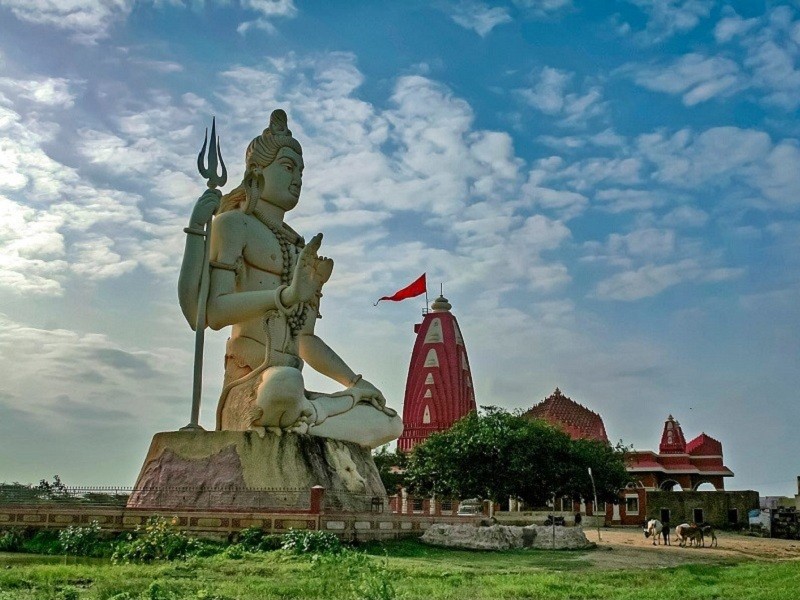
The road from Dwarka to Okha runs flat and bright along the Gujarat coast, past salt flats and wind turbines and the occasional camel standing in a field of thorn. About sixteen kilometres out, something rises above the low trees on your left: a seated figure in grey stone, twenty-five metres tall, knees crossed, palms open, eyes half shut. You see Shiva before you see the temple. That is deliberate. The statue is the landmark; the shrine itself is small, modern-looking, and almost hidden.
Then you take off your shoes, walk through a garden with a pond in it, and go down. The sanctum at Nageshwar is below ground level. You descend a short flight of steps into a cool, close, lamp-lit chamber, and there, at the bottom, is the lingam — dark, worn, plainly very old, sitting in a space that feels less like a temple hall than a cellar or a cave. Pilgrims are allowed to touch it and pour water over it themselves, which is rare among the twelve. People kneel on the wet stone and stay there longer than the queue behind them would like.
Of all twelve Jyotirlingas — the shrines where Shiva is said to have manifested as a pillar of light rather than been installed by human hands — Nageshwar is the one nobody can quite place. Two different Puranas tell two different stories about how Shiva came to be here. Three states claim the shrine. The forest it is supposed to stand in may have been underwater. And the government of India has never settled any of it.
Where Nageshwar Jyotirlinga Stands — and Why That Is Disputed
The temple most pilgrims mean when they say Nageshwar sits between Dwarka city and the island of Bet Dwarka, on the Saurashtra coast of Gujarat, in the district that now carries the name Devbhumi Dwarka. The district administration’s own page calls it a swayambhu — self-manifested — lingam in an underground sanctum, and places it in the ancient forest of Darukavana.
That is the problem. Nobody knows where Darukavana was.
The Shiva Mahapurana, which contains the standard list of the twelve, puts the forest on the shore of the western sea — the Arabian Sea — which fits Gujarat well enough. But the identification is an inference, not a statement. The Krishna literature associated with Dwarka names Somanatha and the Prabhasa tirtha and says nothing about a Nageshwara or a Darukavana, which is strange if the two sat a day’s walk apart. Some readers have suggested that Darukavana was at some point misread or re-read as Dwarakavana, which would tie the forest to Dwarka by a scribe’s hand rather than a god’s.
Two other sites press their own claims, and both are serious.
Aundha Nagnath, in Hingoli district, Maharashtra, is regarded across that state as the Jyotirlinga of Darukavana. Its case rests partly on the Dvadasha Jyotirlinga Stotra attributed to Adi Shankaracharya, which praises the shrine under the name Naganath, and partly on the suggestion that Sadanga was the old name of Aundh. The temple there is a substantial medieval monument: a thirteenth-century core in the Hemadpanti style built under the Yadavas of Devagiri, stones interlocked without mortar, outer walls carved with deities and elephants and geometric bands, badly damaged during the Delhi Sultanate invasions, and widely believed to have been repaired in the eighteenth century by Ahilyabai Holkar — the same queen who rebuilt the sanctum at Kashi. Its sanctum is a small basement chamber down a narrow stair, and its Nandi sits at the back of the temple rather than facing the deity, because of the story that the shrine turned around to face the poet-saint Namdev when he was refused entry at the front.
Jageshwar, in Almora district, Uttarakhand, has a quieter but linguistically neat argument: daruvana means a forest of deodar, and Jageshwar sits in one. The temple cluster there is commonly identified as the Nageshvara Jyotirlinga in local and some scholarly accounts.
No central or state authority has ever notified one of the three as the Jyotirlinga, and this site does not adjudicate between them. It is worth saying plainly why not. A Jyotirlinga is not a heritage listing; it is a claim about where light broke through. The traditions that maintain each of these three shrines have held them for centuries with entirely sincere conviction, and the texts are genuinely ambiguous. Readers planning a pilgrimage should know that the Dwarka temple is where the overwhelming majority of Jyotirlinga circuits go, and that devotees at Aundha and Jageshwar are not visiting a substitute.
If you have followed the series on this site through Vaidyanath and Bhimashankar, this will feel familiar. Three of the twelve are contested, and all three are contested for the same reason: the Shiva Purana names a place, and the place no longer exists under that name.
Two Legends, Two Puranas
Most writing about Nageshwar gives one story. There are two, from two different texts, and they do not reconcile. Both are worth knowing, because each explains something the other cannot.
The Shiva Purana: Supriya and the demon Daruka
This is the version you will hear from guides and read on the boards at the temple.
Darukavana was named for a demoness, Daruka, wife of the demon Daruka. She had worshipped Parvati with such devotion that the goddess granted her sovereignty over the forest, and the forest took her name. When the gods came hunting her husband’s people, Daruka used her boon the way a mother would: she picked up the whole forest and moved it into the sea, where it became a submarine city, walled in by water and guarded by sea serpents.
Into that city the demons dragged their prisoners. Among them was Supriya, a merchant and a devotee of Shiva. In captivity he did the only thing available to him. He set up a lingam of earth and taught the other prisoners to chant Om Namah Shivaya — and he kept them chanting. When the demons came to kill him for it, Shiva appeared and destroyed them with a divine weapon, and then did not leave. He remained in that place as a pillar of light. The lingam Supriya had raised was called Nagesha, lord of serpents, and Parvati beside him Nageshwari.
Some accounts number it the tenth of the twelve. The order in which the twelve are listed varies between the Shiva Purana‘s own enumeration and the Dvadasha Jyotirlinga Stotram, and little should be built on the number.
The Vamana Purana: the sages, the ascetic and the fallen linga
The second story is the one the Devbhumi Dwarka district administration actually cites on its official page, attributing it to the Vamana Purana, chapters six and forty-five. It is harder, stranger and much less told.
In Darukavana lived a community of Balakhilya sages, ascetics who worshipped Shiva. Shiva came to test them, and he came in the form that tests hardest: a naked wandering ascetic, his body wearing nothing but serpents. The sages’ wives were drawn to him and left their husbands to follow. The sages, enraged, cursed him — and the curse took effect: the linga fell from his body to the earth, and the earth shook with it. Brahma and Vishnu came and asked Shiva to take it back. He did, and he promised that he would remain at Darukavana as a Jyotirlinga for all time.
Read side by side, the two stories say different things. The Shiva Purana‘s Supriya is about devotion under duress: the chant held in a prison under the sea, Shiva arriving because somebody would not stop. The Vamana Purana‘s account is about the limits of ascetic pride — sages so certain of their own purity that they curse God for appearing in a form they did not approve of, and are then asked to live beside him permanently. That the official district page prefers the second is a small sign that the harsher story is the older local one. Neither should be presented as the single legend of the site.
Nagesha: Why Serpents
Shiva’s association with snakes runs through almost every image of him: Vasuki coiled at his throat, serpents at his wrists and in his hair, the great naga Shesha giving the Devi a garland of gem-studded snakes in the Devi Mahatmya. At Nageshwar the association is not decoration but the name of the deity.
The nagas of Hindu cosmology are not simply dangerous animals. They are a people — subterranean, aquatic, powerful, keepers of treasure and of water, capable of blessing and of poison in the same breath. To be the lord of serpents is to have authority over exactly the thing that can kill you. It is the same logic as the halahala, the poison Shiva drinks at the churning of the ocean and holds in his throat without swallowing or spitting it out.
That is why devotees come here with a specific kind of request. People afflicted by snakes in the literal sense — and in parts of rural India that is still a real affliction — come to Nageshwar. So do people who believe themselves afflicted by Nag Dosha, the astrological condition attributed to serpent-related karma, and by the slower venoms: addiction, a poisonous household, a mind that keeps biting itself. The readings that connect the serpent at Nageshwar to kundalini — the coiled energy of yogic physiology — are devotional and interpretive rather than scriptural, and are best held loosely; the texts themselves do not make that link at this shrine.
The Temple You Actually See
Visitors who come expecting the scale of Somnath, two hundred and thirty kilometres down the same coast, are sometimes disappointed, and it is worth setting expectations honestly.
Nageshwar is not an ancient monument. The present structure is modest and much renovated, built around and over the old underground sanctum rather than preserving a medieval temple above it. There is no soaring Nagara shikhara, no carved outer wall of the kind you will find at Aundha Nagnath or Trimbakeshwar. What there is: a clean white complex, a landscaped garden with a pond, a wide paved forecourt, and the twenty-five-metre seated Shiva that the district administration lists as the site’s principal attraction — among the largest Shiva statues in the country, and by far the most photographed thing here.
The architectural interest, such as it is, is underground and archaeological. The district page reports that excavations at the site have revealed five earlier cities, which would place human occupation here across a long sequence. That claim comes from the administration’s own description rather than from a published excavation report that this post could verify, and it should be treated as reported rather than established. Dwarka’s submerged-city archaeology is a contested field in its own right.
You will also hear from guides that the lingam here is unusual in facing south, or that it is of a distinctive three-faced shape. No official source confirms either, and this post does not print them as fact.
Visiting Nageshwar: A Practical Guide
Where it is and how to reach
The temple is on the Dwarka–Okha road, off NH 947. The district administration gives the distance as about 16 km from Dwarka railway station; travel sites give 17 or 18 km, which is the usual spread between a road measurement and a gate-to-gate one. Allow 25 to 35 minutes by car.
- By train: Dwarka station is the practical railhead, with a short road transfer. Okha is the terminus beyond Nageshwar — and here sources genuinely contradict each other, one table putting Nageshwar 8 km from Okha and the same site’s own FAQ putting it at 17 km. Check with your driver rather than a webpage.
- By air: Jamnagar is the nearest airport, roughly 130 km. Porbandar is the alternative. Rajkot and Ahmedabad are the larger options with more flights.
- By road: The Gujarat State Road Transport buses on the Dwarka–Okha route stop within walking distance. Autos from Dwarka run roughly ₹300–400 one way; a taxi doing the full Dwarka circuit is commonly quoted ₹1,500–2,500. Shared autos are cheapest but may drop you short of the gate.
Darshan timings — and an honest warning about them
This post could not find a current official temple website publishing a darshan schedule, and the two most detailed sources available disagree substantially:
- One widely used Dwarka travel site gives 5:00 AM – 12:30 PM and 4:00 PM – 9:00 PM, with a midday closure — and then prints a second table on the same page giving roughly 6:00 AM – 12:30 PM and 3:30 – 8:30 PM.
- Another gives 5:00 AM to 9:00 PM with no midday break, morning abhishek 5:00–6:00 AM, Rudrabhishek 6:00–8:00 AM, general darshan 8:00 AM – 7:00 PM, evening aarti at 7:00 PM and final darshan until 9:00 PM.
Those are not reconcilable, and we are not going to smooth them into one invented schedule. Plan to arrive before 8:00 AM, which is safe on every version and also the quietest hour, and confirm the current timings by phone with the temple or your hotel the day before. If you are travelling from the diaspora and building a tight itinerary, assume a midday closure and plan around it.
On Maha Shivaratri the temple keeps extended or overnight hours with continuous abhishekam and aarti. Through the month of Shravan (July–August) hours are extended and crowds are heavy, Mondays worst of all.
Dress code, etiquette and costs
No official dress code for Nageshwar was found. What is customary, and what the practical guides advise, is modest dress with shoulders covered — kurta-pyjama, saree or salwar kameez are never wrong at a Jyotirlinga, and shorts and sleeveless tops are best avoided. Footwear comes off at the counter. Leather belts and wallets are conventionally left with your shoes. Phones should be silenced and bags are screened; photography inside the sanctum should be assumed not to be allowed unless you are told otherwise.
Entry is free. Abhishek and Rudrabhishek are arranged in person with the priests on duty — one source reports a basic Rudrabhishek at around ₹500–800 with no online booking system, but that figure is third-party and unconfirmed, so treat the counter’s own quote as the real one. Prasad, garlands and bilva leaves are sold near the exit.
Best time to visit
October to March is the comfortable season on the Saurashtra coast; April to June is punishing, and the monsoon brings humidity rather than relief. For a quiet darshan, go on a weekday morning outside Shravan and avoid Monday, Shiva’s day. If you want the opposite — the shrine at full devotional pitch, with a long wait — Maha Shivaratri is the day.
Nearby: The Dwarka Circuit
Nageshwar is almost never visited alone. It is the first stop on the standard day trip out of Dwarka and sits naturally in a circuit with Krishna’s city.
- Dwarkadhish Temple (Jagat Mandir), Dwarka — the principal shrine of the region, dedicated to Krishna as king of Dwarka, and one of the Char Dham. Worth a reading of who Krishna is before you stand in front of it.
- Bet Dwarka — the island with the Shri Keshavraiji temple, where tradition places Krishna’s residence. Since 25 February 2024 it is reached by the Sudarshan Setu, a 2.32 km cable-stayed bridge from Okha with a 500 m main span, built at about ₹979 crore. The old ferry crossing is no longer the only way across, which has changed the character of a visit considerably.
- Rukmini Devi Temple — a short distance outside Dwarka, with a well-known story about why Rukmini’s shrine stands apart from her husband’s.
- Gomti Ghat and Sudama Setu in Dwarka town; Gopi Talav on the Okha road; Okha port itself.
- Somnath, roughly 230 km southeast — the other Gujarat Jyotirlinga, and the natural pairing for anyone working through the twelve.
Why This Matters Today
There is a practical lesson in Nageshwar that has nothing to do with travel logistics.
Three temples, in three states, each hold with complete sincerity that they are the Jyotirlinga of Darukavana. The texts do not settle it. No government has settled it. And the tradition has simply absorbed that, for centuries, without anyone being excommunicated and without the shrines being downgraded. Pilgrims at Aundha are not pretending. Pilgrims at Dwarka are not deceived. The Hindu tradition has an unusual tolerance for a sacred geography that overlaps and contradicts itself, and it is worth noticing how rare that is.
If you want something to carry away from the shrine itself, take the name. Nagesha is not the lord who removed the serpents. He is the lord of the serpents — the one who wears them, who holds the poison at his throat without swallowing it and without spitting it back out. That is a specific and demanding model. It does not promise that the venom in your life will be taken away. It suggests that what is poisonous can be held, consciously, without being either denied or let into the bloodstream.
Most of us do the opposite. We swallow — absorb the resentment, the humiliation, the bad habit, and let it circulate. Or we spit — pass it straight on to whoever is nearest, usually at home. The third option is harder and is what the image at the throat is actually for: to know exactly what you are carrying, to refuse to pass it on, and to keep standing.
Supriya, chanting in a prison at the bottom of the sea, is doing the same thing in narrative form. Nothing in his circumstances changed when he started. He simply refused to let the circumstances have the last word about what he would do with his mouth.
Frequently Asked Questions
Which is the real Nageshwar Jyotirlinga?
There is no authoritative answer. Three sites claim it: the Nageshwar temple between Dwarka and Bet Dwarka in Gujarat, Aundha Nagnath in Hingoli district, Maharashtra, and Jageshwar in Almora district, Uttarakhand. The Shiva Purana places Darukavana on the western sea, which favours Gujarat, but does not name a modern location; Shankaracharya’s Dvadasha Jyotirlinga Stotra praises the shrine as Naganath, which Maharashtra reads as Aundha. No government has notified any of them. The Gujarat temple receives the great majority of Jyotirlinga pilgrims.
How far is Nageshwar Jyotirlinga from Dwarka?
About 16 km from Dwarka railway station according to the Devbhumi Dwarka district administration; travel sites commonly say 17–18 km. It is on the Dwarka–Okha road, roughly 25–35 minutes by car, and is usually the first stop on a Bet Dwarka day trip.
What are the Nageshwar temple darshan timings?
Sources conflict. One set gives 5:00 AM – 12:30 PM and 4:00 PM – 9:00 PM with a midday closure; another gives 5:00 AM to 9:00 PM continuously with general darshan from 8:00 AM and evening aarti at 7:00 PM. No official temple website publishing a schedule could be found. Arrive before 8:00 AM, which works on every version, and confirm locally the day before. Hours are extended during Shravan and on Maha Shivaratri.
Why is Nageshwar called the lord of serpents?
The lingam is named Nagesha, from naga (serpent) and isha (lord), with Parvati at the site as Nageshwari. In the Shiva Purana account the submarine forest of Darukavana was guarded by sea serpents and ruled by demons, and Shiva manifested there to protect the devotee Supriya. In the Vamana Purana account Shiva arrives in the forest as a naked ascetic wearing nothing but snakes. Devotees associate the shrine with protection from snakes, from Nag Dosha, and from poison in the wider sense.
Is there a dress code at Nageshwar Jyotirlinga?
No official dress code was found. Customary practice is modest dress with shoulders covered — kurta-pyjama, saree or salwar kameez — with footwear and usually leather items left at the counter. Shorts and sleeveless tops are best avoided. Entry is free.
Can you touch the lingam at Nageshwar?
Devotees are generally permitted to perform their own abhishek at the lingam in the underground sanctum, which is less common among the twelve Jyotirlingas and part of what makes a visit here feel intimate. Arrangements can change with crowd levels and at festival times, so follow the priests’ instructions on the day.
A Closing Thought
The twelve Jyotirlingas are usually described as a map. Twelve points, one god, a route to be completed. Nageshwar quietly refuses to be a point on a map. Its forest is somewhere under the sea or under a deodar slope in Kumaon or under the Marathwada plain. Its story is two stories. Its temple is new and its lingam is old and its statue is the thing everyone photographs.
And yet the chamber you descend into is genuinely one of the most affecting spaces in the whole circuit — small, wet, crowded, dim, with people pressed close around a dark stone they are allowed to touch. Whatever the geography cannot settle, the room settles. You go down, which no other Jyotirlinga asks of you in quite the same way, and the going down turns out to be the point.
Continue Exploring
- Who Is Lord Shiva? The Story, Symbolism and Worship of Mahadeva
- Somnath Temple: The First Jyotirlinga and the Shrine That Kept Being Rebuilt
- Vaidyanath Jyotirlinga: Baba Baidyanath Dham, Deoghar
- Rameswaram and the Ramanathaswamy Temple: The Jyotirlinga Rama Built
- Who Is Lord Krishna? The Story, Symbolism and Worship of the Dark-Hued Lord