
In Kerala and Tamil Nadu there is a morning when small children are brought to a temple or a teacher and made to write for the first time. The child sits in an adult’s lap. A tray of raw rice is set down. Someone takes the child’s index finger, holds it steady, and guides it through the shapes of letters in the rice. The child cannot read. The child may not even be three. The point is not literacy. The point is that the first letter a person ever writes should be written in a goddess’s presence, with another hand steadying theirs.
That ceremony is called Vidyarambham, the beginning of learning, and the goddess it belongs to is Saraswati. Of all the major Hindu deities she is the one most people meet first — not in a temple but on a classroom wall, behind a garland, on the morning of an exam.
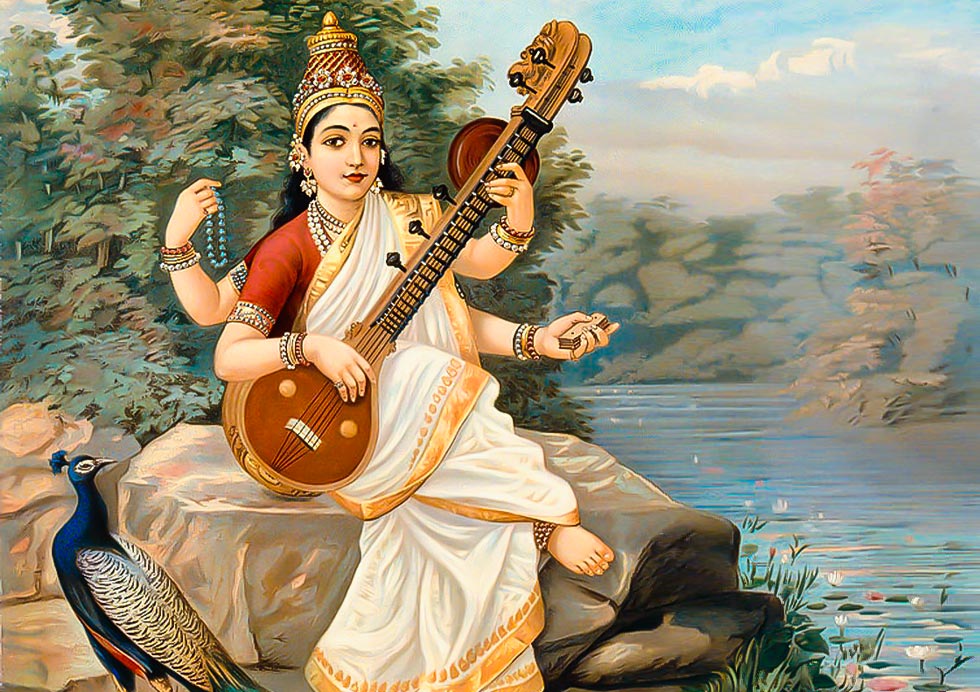
Saraswati is the Hindu goddess of knowledge, speech, music, learning and the arts. She first appears in the Rigveda as a mighty river deity and was later identified with Vac, the goddess of speech, becoming the patron of scholarship and the creative arts. She is depicted in white, holding a veena and a book, seated on a lotus with a swan beside her.
Her story is one of the most interesting transformations in the whole tradition: a river that became a voice, and a voice that became the patron of everyone who has ever tried to learn something difficult.
From River to Goddess: Saraswati in the Vedas
In the Rigveda, composed roughly between 1500 and 1000 BCE, Saraswati is primarily a river — a real, deified, roaring river associated with fertility, abundance and power. Hymn 6.61 is addressed to her alone, and hymns 7.95 and 7.96 she shares with a male river deity, Sarasvant. One famous line, Rigveda 2.41.16, calls her “best of mothers, the best of rivers, best of goddesses.”
As a water deity she is linked to purification, healing and wealth, and connected to the Apas (the waters) and the Maruts (storm gods). She forms a ritual triad with Ila and Bharati. She is credited with slaying Vritra, the demon of drought, and in the Yajur Veda with healing Indra after he drank too much Soma. Already in the Rigveda she presides over dhi — inspired thought, the flash of understanding — which is the seed of everything she later becomes.
Where was the river? That is genuinely unsettled. Many scholars identify the Vedic Saraswati with the dry or seasonal Ghaggar-Hakra channel in north-western India and Pakistan; others dispute that identification or argue the hymns describe more than one watercourse. This is an active archaeological and philological debate, and anyone who tells you it is closed is overstating the case.
Saraswati and Vac: how she became speech
The decisive shift happens in the later Vedic literature. In the Brahmanas, Saraswati is merged with Vac, the goddess of speech, and the Yajur Veda names her Saraswati-Vac. This matters because of what Vac was: the Shatapatha Brahmana presents her as the first deity Prajapati created and the instrument by which he created everything else. Speech is not a description of the world in this scheme. Speech is how the world got made.
The Brahmanas go further and call her the mother of the Vedas, identifying her with the knowledge that speech carries. By the time of the Mahabharata, Vac has faded as a separate figure and Saraswati has absorbed her completely, appearing as a humanised goddess of great beauty who simply is speech. In the classical and medieval period she is the goddess of learning, poetry and music, and tradition credits her with producing Sanskrit itself.
The river never entirely disappears. It becomes a metaphor that the tradition uses constantly: knowledge as a current, learning as something you step into, a teacher as a crossing-place. A goddess who began as water and ended as language did not change subject so much as change medium.
What Saraswati Looks Like, and What Each Detail Means
Saraswati is unusually easy to recognise, because almost everything about her image is deliberately plain. She wears white and has a white complexion, signifying sattva — purity, clarity, the quality of lucid goodness. She wears little jewellery. She is not armed, not crowned with wealth, not attended by elephants. Where Lakshmi is gold and Durga is a storm, Saraswati is a still white page.
She usually has four arms, and the tradition reads each object carefully.
| Attribute | What it is | What it means |
|---|---|---|
| Pustaka | A book or palm-leaf manuscript | The Vedas and all learning; knowledge that is studied, not merely felt |
| Veena | A stringed instrument | The creative arts, and knowledge brought into harmony |
| Mala | A rosary of beads | Meditation, repetition, spiritual discipline |
| Water pot | A vessel of water | Discrimination between right and wrong; sometimes read as Soma |
| Hamsa | A swan or goose, her mount | The power to separate truth from falsehood, as a swan is said to separate milk from water |
| Peacock | An alternative mount | Pride and display, which the learned must keep under control |
| White lotus | Her seat | Light, knowledge and truth; growing clean out of muddy water |
| White garments | Her dress and complexion | Sattva — clarity and purity, free of passion and inertia |
Some texts read her four hands as mirroring Brahma’s four heads, standing for mind, intellect, imagination and ego — the four faculties a person actually learns with. Two-armed forms are also common. In the Devi Mahatmya tradition she appears as the eight-armed Maha Saraswati, holding weapons in her lotus hands, which is a very different goddess from the one on the classroom wall. The tantric form Matangi is depicted green or dark blue.
The veena detail repays attention. A goddess of knowledge might reasonably hold only a book. That she holds an instrument as well is the tradition’s way of saying that scholarship and art are not separate departments. The same goddess governs grammar and raga, mathematics and dance.
Brahma’s Daughter or Brahma’s Wife? An Honest Look at a Real Disagreement
Saraswati is usually described as connected to Brahma, the creator. Exactly how is one of the clearest cases in Hindu literature of the Puranas flatly contradicting one another, and it is better to lay that out than to pick a side and present it as settled.
- Daughter. The Brahma, Padma and Brahmanda Puranas, and parts of the Skanda Purana, call her Brahma’s mind-born daughter, often a virgin goddess.
- Consort. The Brahma Vaivarta Purana, the Devi Bhagavata and the Lalitopakhyana make her Brahma’s wife, in some accounts created from the Shakti of Krishna or of Tripura Sundari.
- Both. The Matsya and Bhagavata Puranas hold both at once. The Matsya account has Brahma’s desire for her leading to the birth of Svayambhuva Manu. The Bhagavata sidesteps the problem by having a new Brahma marry the Saraswati created by the previous one.
- Neither. The Shiva Purana has her reject Brahma’s advances outright and curse him.
There is a further tangle around Savitri and Gayatri. The Padma Purana tells of Brahma marrying Gayatri at Pushkar in Savitri’s absence, and Savitri cursing him for it. Some texts treat Saraswati, Savitri and Gayatri as three names of one goddess; others keep them firmly separate.
None of this is a flaw in the tradition, and it is worth saying clearly to anyone coming to Hinduism from a single-canon religion. The Puranas are a library assembled over many centuries by many communities, each with its own theological priorities. A goddess who is a daughter in one text and a wife in another is not evidence of confusion; she is evidence of a conversation that went on for a thousand years. Treat any single account as one voice in it.
Saraswati among the Tridevi
Saraswati, Lakshmi and Parvati together form the Tridevi, the three principal goddesses, commonly mapped onto knowledge, wealth and power. In Shakta theology the Devi Mahatmya works with a related triad — Mahakali, Mahalakshmi and Mahasaraswati — assigned to the three gunas, with Mahasaraswati as rajasic and creative, Mahalakshmi as sattvic and sustaining, and Mahakali as tamasic and dissolving. Puranic pairings beyond that vary considerably from text to text.
One striking local variation: in medieval Bengal sculpture Saraswati appears as a second wife of Vishnu, making her Lakshmi’s co-wife. The Devi Bhagavata tells of Saraswati, Lakshmi and Ganga quarrelling over Vishnu, with curses that turn Lakshmi into the tulsi plant and send Ganga and Saraswati to flow as rivers — the river identity surfacing again, this time as a punishment.
When Saraswati Is Worshipped
Saraswati’s main festival is Vasant Panchami, the fifth day of the bright half of the lunar month of Magha, which falls in late January or February. It is also called Saraswati Puja or Saraswati Jayanti. In 2027 it falls on Thursday, 11 February. As with every Hindu festival, the tithi begins and ends at times calculated for a specific city, so readers outside India should check a panchang set to their own location rather than assuming Indian Standard Time applies — in North America, Britain or Australia the observance can land on a different calendar day.
Regional practice varies a great deal:
- West Bengal, Assam, Odisha and Tripura: Vasant Panchami is a major public occasion, observed in homes, temples and above all schools and colleges, where students worship their books and instruments instead of using them.
- Bihar and Jharkhand: known simply as Saraswati Puja. Images are made of earth, boondi is distributed as prasad, and the images are immersed after a havan.
- Kerala and Tamil Nadu: the main Saraswati worship falls instead in the last three days of Navaratri — Ashtami, Navami and Dashami. Books and instruments are placed before the goddess on Ashtami and taken back on Vijaya Dashami.
- Goa: observances run from Maha Saptami through to Vijayadashami.
- Bali: Saraswati Day closes the 210-day Pawukon year and is followed by Banyu Pinaruh, a day of ritual cleansing.
Vidyarambham, the first-writing ceremony described at the start of this article, takes place on Vijaya Dashami in Kerala and Tamil Nadu. It is the single clearest expression of what Saraswati means to ordinary households: the day you begin is more important than the day you finish, and you should begin it in good company.
Temples Where Saraswati Is Worshipped
Saraswati has fewer dedicated temples than most major deities, which devotees sometimes explain by saying she is worshipped wherever learning happens. The significant shrines include:
- Sharada Peeth, Kashmir — among the earliest known Saraswati shrines, with remains dated between roughly the 6th and 12th centuries CE, and counted among the Shakta pithas. It is a ruin, lies in the Neelum Valley in Pakistan-administered Kashmir, and is of deep significance to Kashmiri Pandits. Access is governed by the political situation rather than by temple timings, and anyone considering a visit should check the current position carefully.
- Gnana Saraswati Temple, Basara, Telangana — on the bank of the Godavari, and the best-known place in India for Akshara Abhyasam, the first-letters ceremony.
- Sharadamba Temple, Sringeri, Karnataka — the Saraswati shrine at the matha associated with Adi Shankaracharya, and a living centre of Sanskrit scholarship.
- Koothanur Maha Saraswathi Temple, Tamil Nadu — a rare temple in the state dedicated to her alone, linked to the poet Ottakoothar.
- Wargal Saraswati Temple, Telangana, Maa Sharda Mandir, Maihar, Madhya Pradesh, and Sarala Temple, Jagatsinghpur, Odisha — all significant regional centres.
Temple timings, dress codes and access arrangements change, sometimes at short notice and especially around festivals, so confirm details with the temple or a recent official source before travelling.
Mantras Addressed to Saraswati
The simplest and most widely used invocation is the seed mantra Om aim mahasaraswatyai namah — aim being the syllable traditionally associated with her and with speech. Beyond it, the best-known prayer is the Saraswati Vandana, a Sanskrit verse recited at the opening of countless school assemblies and music lessons, which describes her as white as jasmine, the moon and snow, seated on a white lotus, holding the veena, and asks her to remove the sluggishness of the mind. In the Shakta tradition the dhyana verse at the opening of the fifth chapter of the Devi Mahatmya describes Maha Saraswati in her eight-armed form.
There is no requirement to chant in Sanskrit, and many teachers are explicit about this. The devotional logic of Saraswati worship is that attention offered to learning is itself the offering, which is why placing a book before her image counts as puja.
Saraswati Beyond Hinduism
Saraswati travelled further than almost any other Hindu deity. In Jainism she is revered as the goddess who carries and spreads the teachings of the Tirthankaras, and appears under names including Vidyarupa.
In Buddhism her earliest appearance is in the Golden Light Sutra, whose Chinese translation dates to 417 CE and which gives her a chapter of her own, associating her with eloquence, memory, a healing bath and protection; in one hymn within it she appears as an eight-armed war goddess. Later Buddhist tradition pairs her with Manjushri, the bodhisattva of wisdom, and develops forms such as Vajravina, shown playing a lute. The Karandavyuha Sutra gives her an extraordinary origin: born from the eyetooth of Avalokiteshvara. In Japan she became Benzaiten, still worshipped today, often near water — the river deity resurfacing eight thousand kilometres from the Rigveda.
Why Saraswati Matters Today
There is a particular idea embedded in Saraswati worship that is worth pulling out, because it cuts against the way most of us now treat knowledge. She is not the goddess of information. She is the goddess of vidya — knowledge that has been received properly, from someone, in a relationship, with respect — and of vac, which is knowledge spoken aloud, in a voice, to someone who is listening. A goddess of pure data would not need a veena.
This is why her rituals look the way they do. You do not worship Saraswati by acquiring more. On Vasant Panchami in Bengal, students stop working. The books go on the altar and stay shut. For one day the relationship to learning is gratitude rather than consumption, which is a genuinely useful corrective for anyone who has ever confused having read something with having understood it.
The hamsa carries the same message in a sharper form. The swan that separates milk from water is a symbol of discrimination — the ability to tell what is nourishing from what merely fills the space. That image was devised long before anyone had a feed to scroll, and it has not aged a day. Saraswati’s gift, in her own tradition’s telling, is not the quantity of what you know. It is the judgement to know what is worth knowing, and the voice to say it clearly.
Frequently Asked Questions
Who is Goddess Saraswati?
Saraswati is the Hindu goddess of knowledge, speech, music, learning and the arts. She appears in the Rigveda as a deified river and was later identified with Vac, the goddess of speech, which is how she became the patron of scholarship and the creative arts. She is one of the Tridevi, alongside Lakshmi and Parvati, and is worshipped especially by students, teachers, writers and musicians.
Why does Saraswati hold a veena and a book?
The book, or pustaka, stands for the Vedas and all formal learning. The veena stands for the creative arts and for knowledge brought into harmony rather than merely accumulated. Holding both is the tradition’s way of refusing to separate scholarship from art: the same goddess presides over grammar and over music. Her other two hands typically hold a rosary, for meditation, and a water pot, for discrimination between right and wrong.
Is Saraswati Brahma’s wife or his daughter?
The Puranas genuinely disagree, and there is no single correct answer. The Brahma, Padma and Brahmanda Puranas call her Brahma’s mind-born daughter. The Brahma Vaivarta Purana and Devi Bhagavata make her his wife. The Matsya and Bhagavata Puranas hold both, with the Bhagavata avoiding the difficulty by having a later Brahma marry the Saraswati made by an earlier one. The Shiva Purana has her refuse him and curse him. These are different theological traditions, not a puzzle with a hidden solution.
When is Saraswati Puja in 2027?
Vasant Panchami, the main Saraswati Puja, falls on Thursday, 11 February 2027. In Kerala and Tamil Nadu, Saraswati Puja is instead observed on the last three days of Navaratri, in the autumn. Festival tithis begin and end at times calculated for a particular city, so if you are outside India, check a panchang set to your own location — the observance may fall on a different calendar day where you live.
Was the Saraswati river real?
The Rigveda clearly describes a substantial, physically present river. Which river remains debated. Many scholars identify it with the now dry or seasonal Ghaggar-Hakra channel in north-western India and Pakistan; others question that identification or suggest the hymns refer to more than one watercourse over time. The archaeological and textual argument is ongoing, so the honest answer is that she was a real river whose course is not settled.
Why is Saraswati shown with a swan, and sometimes a peacock?
The hamsa — a swan or goose — is her usual mount, and symbolises discrimination, from the traditional image of a swan separating milk from water. It stands for the trained ability to tell truth from falsehood. The peacock appears as an alternative mount and is generally read differently: as pride and display, which the learned person is expected to keep under control rather than indulge.
How do you worship Saraswati at home?
The common household practice is simple: place her image facing east if possible, offer white or yellow flowers, light a lamp, and set your books, pens or musical instruments before her rather than using them that day. Many families offer boondi, kheer or seasonal fruit. Reciting the Saraswati Vandana or the mantra Om aim mahasaraswatyai namah is usual but not required. Practice varies widely by region and family, so a tradition you have been taught at home is not wrong because it differs from a guide online.
Three thousand years ago someone looked at a river and saw a goddess in it. The river went quiet, or moved, or dried; the goddess did not. She moved into speech, and then into books, and then into instruments, and then into Jain and Buddhist scripture and onto an island in Indonesia and a shrine by a lake in Japan. Every February, somewhere, a child is still having their finger guided through letters in a tray of rice. For a deity whose whole business is transmission, that may be the most fitting thing about her.
Continue Exploring
- Who Is Goddess Lakshmi? The Story, Symbolism and Worship of the Goddess of Fortune
- Who Is Goddess Durga? The Story, Symbolism and Worship of the Warrior Goddess
- Significance of Navratri: The Spiritual Meaning of the Nine Nights
- Adi Shankaracharya: Life, Teachings and the Four Mathas
- Female Saints of India: Seven Women Who Changed Indian Devotion